
Safe Haven Meaning in Trading
A safe haven is an asset investors buy when fear rises, expecting it to hold or gain value while riskier assets fall. In forex the usual safe havens are the Japanese yen, Swiss franc and US dollar, with gold alongside them.
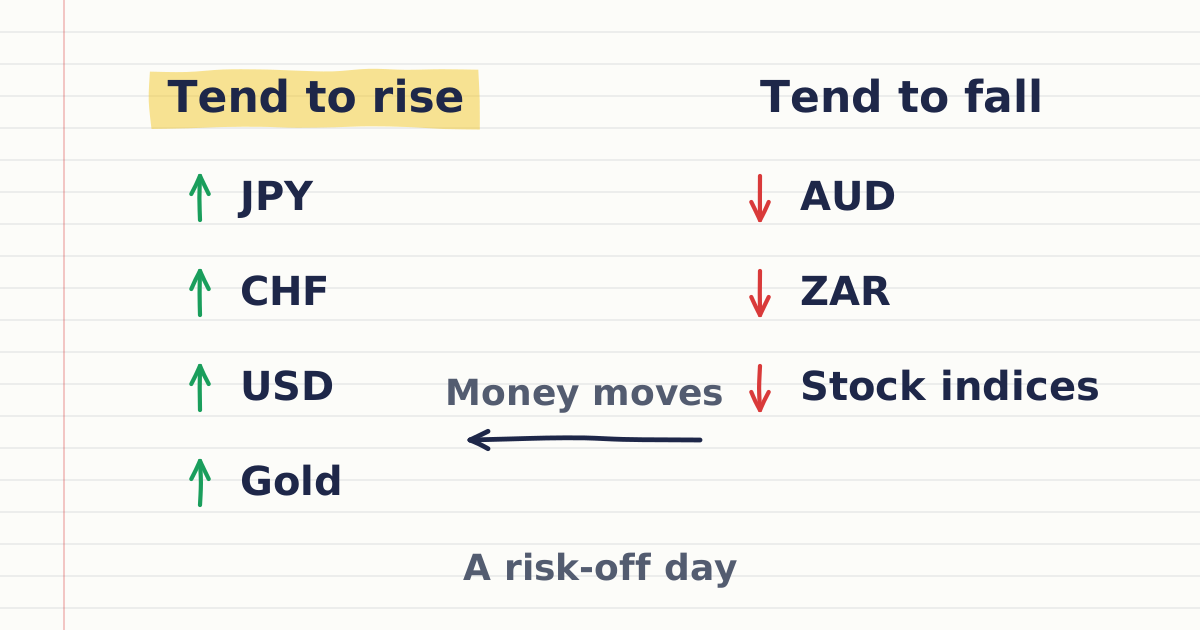
A safe haven is an asset investors buy when fear rises, because they expect it to hold or gain value while riskier assets fall. In forex the classic safe havens are the Japanese yen (JPY), the Swiss franc (CHF) and the US dollar (USD); gold plays the same role among commodities.
When markets turn risk off, money moves into them, and pairs such as AUDJPY, USDZAR and XAUUSD move fast. The risk on, risk off lesson shows how to read that shift across markets.
Which assets are safe havens?
The International Monetary Fund found that in risk-off episodes the yen, Swiss franc and US dollar tend to strengthen against other major and emerging-market currencies, while gold tends to rise when investors turn pessimistic. The table sums up how each one behaves.
| Safe haven | What tends to happen in risk off | Common pairs and symbols |
|---|---|---|
| Japanese yen | Appreciates against G-10 and emerging-market currencies | USDJPY, AUDJPY, EURJPY |
| Swiss franc | Appreciates, as the yen does | USDCHF, EURCHF |
| US dollar | Appreciates against most currencies, emerging-market ones included | USDZAR, EURUSD |
| Gold | Rises with economic pessimism | XAUUSD |
Higher-yielding and commodity currencies, such as the Australian dollar and emerging-market currencies, tend to weaken in the same moves. The how to trade gold guide covers what else drives the gold price, such as real interest rates.
Why do safe havens rise when markets fall?
Investors cut risk by selling shares and higher-yielding currencies and parking the money where they expect it to keep its value, so demand for the havens jumps just as everything else is sold. Low-interest currencies such as the yen also gain when traders close carry trades they funded in them.
The BIS described the yen appreciating sharply as carry trades unwound in August 2024. The carry trade and swap lesson explains that mechanism.
Worked example: safe haven on XAUUSD
A geopolitical shock hits markets and gold rises from $4,000.00 to $4,060.00 an ounce during the session. You bought 0.10 lot of XAUUSD, which is 10 ounces at a 100-ounce contract (check the Specification window for your symbol), at $4,000.00.
| Step | Calculation | Result |
|---|---|---|
| Move | $4,060.00 − $4,000.00 | $60.00 an ounce |
| Move in percent | $60.00 ÷ $4,000.00 | 1.5% |
| Result on 0.10 lot | $60.00 × 10 ounces | $600.00 |
The same day, a short USDJPY position of 0.10 lot (10,000 dollars) taken at 150.00 and closed at 147.00 gains 3.00 × 10,000 = ¥30,000, about $204.08 at 147.00.
How do you track safe havens in MetaTrader 5?
In MetaTrader 5 you track safe havens by watching XAUUSD, USDJPY and USDCHF next to a stock index CFD, so a flight to safety shows at a glance. Add them to Market Watch from the Symbols window and keep them on one chart profile.
When the index drops while gold and the yen rise together, money is moving to safety. Set price alerts at key levels so you see the move as it starts.
What do traders often get wrong about safe havens?
The common mistake is assuming safe havens always rise when markets fall, when in a scramble for cash even havens can be sold. In March 2020 the Financial Stability Board reported that government bonds and gold were sold to raise cash while the US dollar rose sharply.
Traders watch which haven is actually being bought on the day, and the dollar is the one that held up in that phase.
Sources
- International Monetary Fund (IMF), The Behavior of Currencies during Risk-off Episodes, Working Paper by Reinout De Bock and Irineu de Carvalho Filho, 11 January 2013, accessed 26 October 2026: in risk-off episodes the Japanese yen, Swiss franc and US dollar appreciate against other G-10 and emerging-market currencies. https://www.imf.org/en/Publications/WP/Issues/2016/12/31/The-Behavior-of-Currencies-during-Risk-off-Episodes-40233
- Federal Reserve Bank of Chicago, What Drives Gold Prices?, Chicago Fed Letter No. 464, November 2021, accessed 26 October 2026: gold prices rose with economic pessimism; real rates and pessimism were the dominant factors from 2001; findings are correlations. https://www.chicagofed.org/publications/chicago-fed-letter/2021/464
- Bank for International Settlements (BIS), Carry off, carry on, BIS Quarterly Review, 16 September 2024, accessed 26 October 2026: low yen rates made it a funding currency; carry trades unwound in August 2024 and the yen appreciated sharply. https://www.bis.org/publ/qtrpdf/r_qt2409a.htm
- Financial Stability Board (FSB), Holistic Review of the March Market Turmoil, 17 November 2020, accessed 26 October 2026: flight-to-safety and dash-for-cash phases; government bonds and gold were sold to raise cash; the US dollar appreciated considerably. https://www.fsb.org/uploads/P171120-2.pdf
Practise what you learned
Open an account to use MetaTrader 5. Start on a demo account before risking real money.
Open Account