
Carry Trade: How Swap Works and Why Carry Unwinds
A carry trade holds a higher-interest currency against a lower-interest one to collect the rate difference, which on a CFD arrives as a nightly swap. Swap accrues in small nightly steps while the exchange rate can move many times that in a day, so traders size carry positions for the price move.
Module 13 · Lesson 4 of 5
What you'll learn
- What a carry trade is and how it shows up as swap on a CFD position.
- How swap is set, why it can be negative on both sides, and how to calculate it.
- Why a carry unwind happens fast.
- Why the price risk on a carry position is far larger than the swap.
What is a carry trade?
A carry trade is a position that holds a currency with a higher interest rate against one with a lower interest rate, to collect the difference between the two rates. In the classic version, an investor borrows the low-yield currency, sells it, and holds the high-yield one. The "carry" is that interest gap, earned while the position stays open.
The gap is called the interest rate differential: the higher rate minus the lower one. The exchange rate between the two currencies can move far more in a day than the interest gap pays in a month, which is why the price move drives the size of the position.
What are positive and negative carry?
- Positive carry means the swap credits your account at each rollover. On a currency pair, one direction can be positive while the other is negative.
- Negative carry means the swap debits your account at each rollover.
Which currencies are used in carry trades?
A carry trade borrows, or sells, a low-interest funding currency and holds a higher-yielding investment currency. The Bank for International Settlements (BIS) calls the Japanese yen the predominant funding currency and the Swiss franc another popular one. In August 2024, the high-yielding currencies it found hit hardest were the Mexican peso, Brazilian real and South African rand.
| Role | Interest rate | Examples named by the BIS (2024) |
|---|---|---|
| Funding currency | Low; borrowed or sold | Japanese yen, Swiss franc |
| Investment currency | Higher; held | Mexican peso, Brazilian real, South African rand |
These roles shift as central banks move rates, so traders check current policy rates before choosing a pair.
How does a carry trade work in forex?
In forex CFD trading, a carry trade works through swap: the overnight credit or charge applied to a position still open at the platform's daily rollover. A CFD involves no real loan or deposit of currency. Instead, the broker adjusts your account each night by an amount based on the interest gap between the two currencies, less its own charge.
Swap basics, including the daily rollover, are in the Beginner lesson on spread, commission and swap and our guide to swap in forex. What moves the interest gap itself is covered in monetary policy and currencies. Swap-free accounts, and why some traders look for them, are covered in is forex trading halal.
How is swap set?
Swap is set by the broker from the interest-rate difference between the two currencies plus the broker's own markup, and it is shown per symbol as swap long and swap short. Because the markup is taken on both sides, the two figures are not mirror images. When the rate gap is small, the markup can make both sides negative.
MetaTrader 5's help page on Market Watch lists the specification fields: swap type (for example in points or as a percentage of price), swap long for buys, swap short for sells, and a swap multiplier for each weekday.
What is the triple swap day?
The triple swap day is the weekday whose rollover carries three nights of swap, to cover the weekend. MetaTrader 5's help uses Wednesday as its example: the swap is tripled when a position rolls from Wednesday to Thursday. The day is set per symbol, so read it from your own specification rather than assuming it.
Brokers revise swap figures over time, so read the current figures from your account's contract specification.
How do you calculate the swap on a carry position?
Swap earned or paid = swap per lot per night × lots × nights of swap, where a triple swap day counts as three nights. A position held from one Monday to the next pays seven nights' worth from five rollovers, because the triple day covers the weekend.
Worked example, using a hypothetical high-yield pair where 1.00 lot is worth $10 per pip and the swap long is +$8 per lot per night:
- You hold 1.00 lot long for 22 rollovers, 4 of them triple swap days.
- Normal nights: 18 × $8 = $144.
- Triple days: 4 × 3 × $8 = $96.
- Total swap: $144 + $96 = +$240, which is 30 nights' worth.
Now the price moves 150 pips against you: 150 × $10 = −$1,500. Net: $240 − $1,500 = −$1,260. That loss cancels about 188 nights of swap ($1,500 ÷ $8); a fall of just 24 pips ($240 ÷ $10) wipes out the 30 nights.
The short side, at a swap short of −$11 per lot per night, for the same 22 rollovers:
- 18 × −$11 = −$198, plus 4 × 3 × −$11 = −$132.
- Total swap: −$330. The price must move 33 pips in the short's favour ($330 ÷ $10) just to cover it.
| Position (1.00 lot, 30 nights' worth) | Swap | 150-pip move against | 150-pip move in favour |
|---|---|---|---|
| Long, swap +$8 a night | +$240 | −$1,260 net | +$1,740 net |
| Short, swap −$11 a night | −$330 | −$1,830 net | +$1,170 net |
Pip values differ by pair and account currency, so work out your own with the pip value calculator.
Why is the price risk bigger than the swap?
The price risk is bigger because swap accrues in small, known steps each night, while the exchange rate can move many times that amount in a single session. In the example above, one 150-pip move outweighs more than six months of nightly swap.
| Swap (the carry) | Price move | |
|---|---|---|
| Size | Small, known in advance per night | Unknown, can be large |
| Direction | Set by the rate gap and broker markup | Either way, any time |
| When it arrives | Once per rollover, triple on one weekday | Continuously, and in gaps |
| What sets it | Interest rates plus the broker's markup | Buying and selling in the market |
Both are calculated on the full position, not the margin, as the leverage and margin lesson shows. A $1,500 loss is half of a $3,000 account, whatever the swap paid, so the size is set from the price risk.
What is a carry unwind?
A carry unwind is a fast fall in the high-yield currency when many holders of the same carry position close it at the same time. Closing a carry trade means selling the high-yield currency and buying back the low-yield one, so crowded exits push the price sharply against anyone still holding.
The BIS documented one in its Bulletin No 90 of 27 August 2024: volatility returned in early August as the unwinding of leveraged trades amplified the reaction to a weak US data release, and FX carry trades were hit hard. It put their size at a rough ¥40 trillion ($250 billion), likely too low because of data gaps.
A longer episode shows the scale. In 2007 Australia had high interest rates: the Reserve Bank of Australia's cash rate target was 6.25% and rose to 7.25% by March 2008. Yet AUD/JPY fell 47.8% between July 2007 and February 2009, based on ECB euro reference rates.
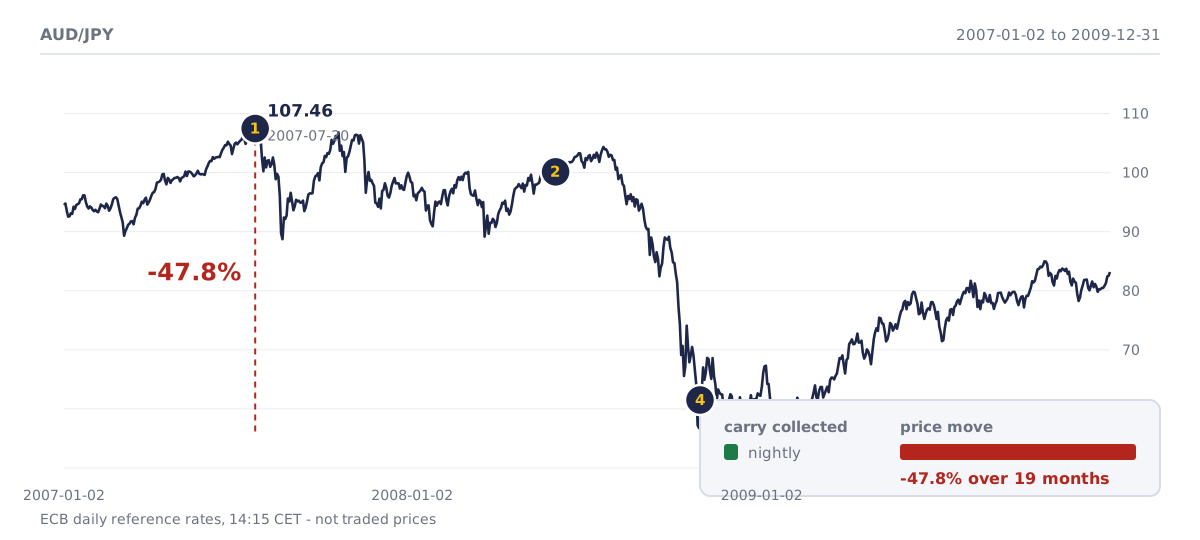
- The peak: 107.46 on 20 July 2007, while the Australian dollar still paid a high rate.
- The fall begins in the second half of 2007, while Australia's cash rate target was still rising.
- The low point on the chart: 56.13 on 2 February 2009, 47.8% below the peak.
- The legend contrasts nightly carry with the price move. It is a schematic contrast, not a measured amount of swap.
How do traders manage risk on a carry trade?
Traders manage carry-trade risk by sizing the position for the price move rather than the swap, because a move against the position can be far larger than the swap it collects, especially when many traders exit at once. Leverage magnifies that move, and the swap itself shifts when rates or the broker's charges change.
- Sharp reversals. A sudden shift to caution, with rising volatility, can hit high-yield currencies hard, so carry traders track risk sentiment, as explained in risk-on and risk-off.
- Gaps. Prices can jump over a stop-loss at the weekend open or after news, so the size allows for a fill past the stop.
- Rate changes. A rate cut in the high-yield currency, or a rise in the low-yield one, narrows the gap and the swap, so traders follow both central banks' decisions.
This lesson is part of the Advanced Trading Strategies module.
Try it on demo
On a MetaTrader 5 demo account, right-click two currency pairs in Market Watch and open Specification. Note swap long, swap short and the weekday with a multiplier of 3. Calculate 30 nights' worth of swap on 0.10 lot for each side, then compare it with what a 100-pip move costs at that size.
Quick check
- In a carry trade, the position holds
- On a CFD, the carry shows up as
- A long 1.00 lot earns +$8 of swap a night. How much swap is 30 nights' worth?
- The same position moves 150 pips against you at $10 a pip. The price loss is
- The swap long and swap short on the same pair are
Frequently asked questions
Is a carry trade risky?
Its main risk is the exchange rate, not the swap. The swap is small and steady, while the exchange rate can move many times that amount in a day and leverage magnifies the move, so traders size the position for the price risk.
How is carry trade return calculated?
The result is the swap collected plus or minus the price move on the position. In the worked example, +$240 of swap and a 150-pip move against 1.00 lot at $10 a pip give $240 − $1,500 = −$1,260; the same move in favour gives +$1,740.
Why is my swap negative on both buy and sell?
Because the broker's markup is applied to both sides. When the interest gap is small, the markup can exceed it, making both swap long and swap short negative. Check your symbol's specification.
What is the yen carry trade?
The yen carry trade borrows or sells Japanese yen, a low-yielding currency, to hold higher-yielding currencies or assets. The BIS calls the yen the predominant carry funding currency. When these positions were unwound in early August 2024, the yen appreciated more than any other currency on 5 August, and FX carry trades were hit hard.
Sources
- Bank for International Settlements (BIS), The market turbulence and carry trade unwind of August 2024, BIS Bulletin No 90, 27 August 2024: volatility resurfaced in early August as the unwinding of leveraged trades amplified the reaction to a negative US macro release; FX carry trades were hit hard; their size was roughly ¥40 trillion ($250 billion), likely biased down by data gaps; markets stabilised quickly. https://www.bis.org/publ/bisbull90.htm
- Bank for International Settlements (BIS), The market turbulence and carry trade unwind of August 2024, BIS Bulletin No 90 (full PDF), 27 August 2024: carry trades borrow in low-yielding currencies such as yen to invest in higher-yielding assets; the yen is the predominant carry trade funding currency and the Swiss franc another popular one; on 5 August the yen appreciated the most; among high-yielding investment currencies, the Mexican peso was hit hardest, followed by the Brazilian real and South African rand (changes against the US dollar, 1-5 August 2024). https://www.bis.org/publications/bulletin-90-market-turbulence-and-carry-trade-unwind-august-2024.pdf
- MetaQuotes, MetaTrader 5 Help: Market Watch, accessed 19 October 2026: the symbol specification shows swap type, swap long for buy positions, swap short for sell positions and a swap multiplier per weekday (the example triples swap from Wednesday to Thursday). https://www.metatrader5.com/en/terminal/help/trading/market_watch
- Reserve Bank of Australia, Cash Rate Target, accessed 19 October 2026: the cash rate target rose from 6.25% to 6.50% on 8 August 2007 and to 7.25% on 5 March 2008. https://www.rba.gov.au/statistics/cash-rate/
- European Central Bank, Euro foreign exchange reference rates, accessed 19 October 2026: daily reference rates for JPY and AUD, published for information purposes only; AUD/JPY derived from them was 107.46 on 20 July 2007 and 56.13 on 2 February 2009. https://www.ecb.europa.eu/stats/policy_and_exchange_rates/euro_reference_exchange_rates/html/index.en.html
Practise what you learned
Open an account to use MetaTrader 5. Start on a demo account before risking real money.
Open Account