
Forex Trading Strategies: How Common Approaches Work
Module 13
Lessons in this module
- 1Multi-timeframe analysis8 min
Top down analysis is reading one market on several timeframes, largest first, using a higher timeframe for context, a middle one for structure and a lower one for detail. It gives every chart one job, so you set the context first and place entries and stops on the smaller charts.
- 2Breakout vs mean reversion7 min
A mean reversion strategy is a set of trading rules built on the assumption that a price stretched far from its recent average tends to drift back toward it. A breakout approach assumes the opposite, that the stretch continues, so each depends on whether the market is ranging or trending.
- 3Trading the news8 min
News trading is opening, holding or deliberately avoiding positions around scheduled economic releases such as NFP, when prices, spreads and fills can change within seconds. Each stance has its own logic, costs and risk controls, and traders choose theirs before the number lands.
- 4Carry trades and swap8 min
A carry trade holds a higher-interest currency against a lower-interest one to collect the rate difference, which on a CFD arrives as a nightly swap. Swap accrues in small nightly steps while the exchange rate can move many times that in a day, so traders size carry positions for the price move.
- 5Volatility regimes8 min
Volatility in forex is how far and how fast a currency pair’s price moves over a period, whatever the direction. It runs in regimes, calm or volatile stretches that persist and then shift, and each regime changes the stop distance and position size that carry the same risk.
About this module
A forex trading strategy is a written set of conditions for when to enter, how much to risk and when to exit, built on an assumption about how a market behaves. Each strategy fits the conditions its assumption describes, so skilled traders match the approach to the market and size every position for the times it does not fit.
This module shows how common approaches are built, when each one fits and how risk is controlled.
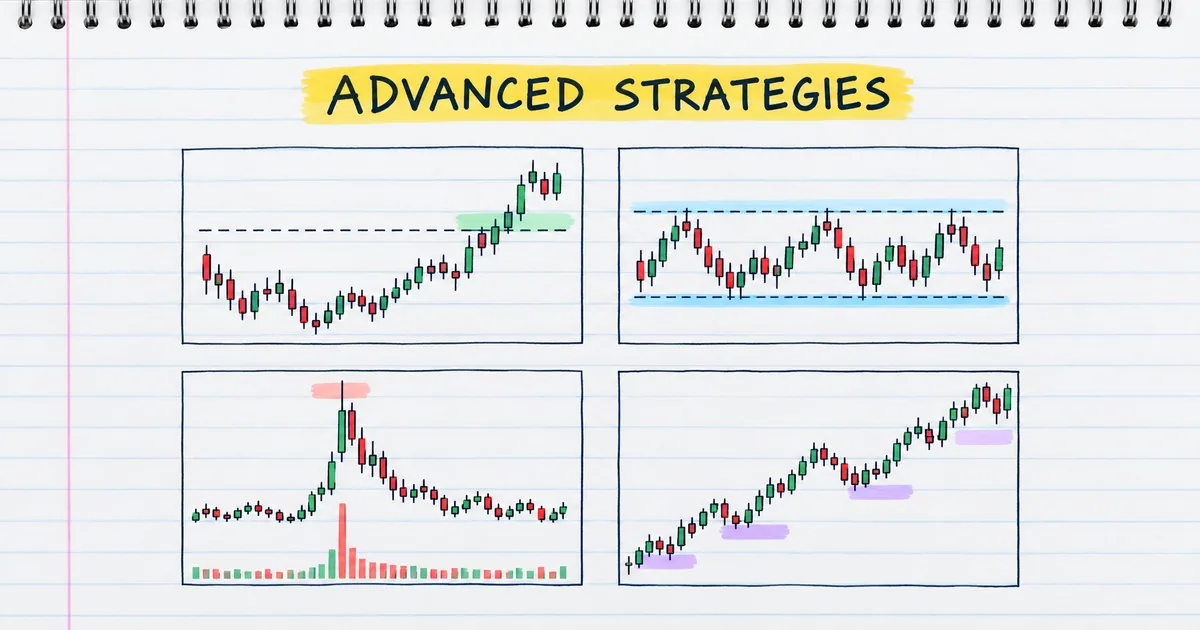
In this module you learn top-down analysis across several timeframes, how breakout and mean-reversion approaches differ and which market conditions each assumes, the different stances traders take around scheduled news, how carry trades and swap work and why they can unwind sharply, and how calm and volatile regimes change stop distances and position sizes.
You should be comfortable with the Intermediate material first, especially Module 6, Technical Analysis and Module 10, Trade Management. Test each approach on a demo account before trading it live.
What are the main types of forex trading strategies?
The main forex trading strategies fall into four groups by what they assume: trend following, breakout, mean reversion and fundamental strategies such as news and carry trading. Holding periods cut across them, from scalping in minutes to swing trading over days and position trading over weeks.
- Trend following trades in the direction of the higher-timeframe trend, often entering on pullbacks. Top-down analysis sets that direction.
- Breakout enters when price leaves a range, assuming the move continues. Mean reversion fades moves to the edge of a range, assuming price returns to its average. The breakout vs mean reversion lesson compares them.
- Fundamental strategies act on data: trading the news around scheduled releases, and carry trades that earn the interest-rate difference through swap.
- By holding period: scalping and swing trading can use any of the above, and price action trading reads bare candles within any of them.
How do you choose a forex trading strategy?
Choose a forex trading strategy by matching three things: the market condition it assumes, the time you can spend watching charts, and the stop distance your account can size correctly. A trend method struggles in a range, and a scalping method struggles if you can check the chart only twice a day.
The same risk buys very different sizes. On a $2,000 account at 1% risk ($20), a swing trade on EURUSD with an 80-pip stop allows $0.25 a pip, so 0.02 lot after rounding down (a $16 risk). A scalp with an 8-pip stop allows $2.50 a pip, or 0.25 lot. The volatility regimes lesson shows how stop distances change when markets calm down or speed up.
How do you test a forex trading strategy?
Test a forex trading strategy by writing its rules precisely enough that two people would take the same trades, then running them over 100 or more past or demo trades and measuring expectancy and drawdown. A method that works on a handful of trades has not been tested yet.
Backtest an automated version in the MT5 Strategy Tester, or log each manual trade in a trading journal. Then read the record with the trading performance metrics and the expectancy calculator.
What do traders ask about forex trading strategies?
Traders ask four things first: which strategy is best, which suits beginners, whether a strategy can win every time and how much money a strategy needs. The answers below each stand alone, with links to the lessons and guides that cover them.
What is the best forex trading strategy?
No single strategy is best, because each one fits the conditions it assumes. The best one for you has rules you can follow every time, a positive expectancy over many tested trades, and a stop distance your account can size at your risk per trade.
Which forex strategy is best for beginners?
Many beginners start with trend following on the daily or 4-hour chart, because signals come slowly and leave time to plan each trade. Swing trading fits around a job, since a few checks a day are enough.
Does any trading strategy win every time?
No. Every strategy has losing trades and losing runs. What matters is the average result across many trades and position sizes that keep each loss small, which the risk reward ratio lesson ties to your win rate.
How much money do you need for a forex strategy?
It depends on the stop distance and the smallest position size. At 0.01 lot of EURUSD a pip is worth about $0.10, so an 80-pip stop risks $8; at 1% risk per trade that needs an $800 account. A 20-pip stop at the same size risks $2 and needs $200.
Practise what you learned
Open an account to use MetaTrader 5. Start on a demo account before risking real money.
Open Account