
Trade Management: Managing Open Trades and Risk
Module 10
Lessons in this module
- 1Scaling in and out8 min
Scaling in and out of a trade means opening or closing a position in parts instead of all at once. Every add or partial close changes your average entry price and your total risk, so both must be worked out again after each step.
- 2Break-even stops8 min
Break even in forex is the price at which closing a trade gives a result of zero after the spread, commission and swap are counted. A break-even stop is a stop loss moved to that price, or to the entry, once the trade has moved in your favour.
- 3Correlation risk10 min
Forex pair correlation is a number from −1 to +1 that describes how closely two currency pairs have moved together in the past. Two positions in highly correlated pairs can act like one larger position, so their risks add up.
- 4News gaps and slippage8 min
Slippage in trading is the difference between the price you expected for an order and the price it actually fills at, and it can be worse or better. It tends to grow around news and weekend gaps, when a stop loss closes at the first available price past your level.
- 5Writing trading rules8 min
Trading rules are written if-then statements you set before trading, saying exactly what you will do in each situation, such as how much to risk or when to stop. Each rule is specific enough that afterwards you can say whether you followed it or broke it.
About this module
Trade management is everything you decide about a position after you open it: whether to add to it or reduce it, when to move the stop loss, and how much combined risk your open trades carry. Every adjustment changes the position's risk and cost, so skilled traders decide each one before the trade opens.
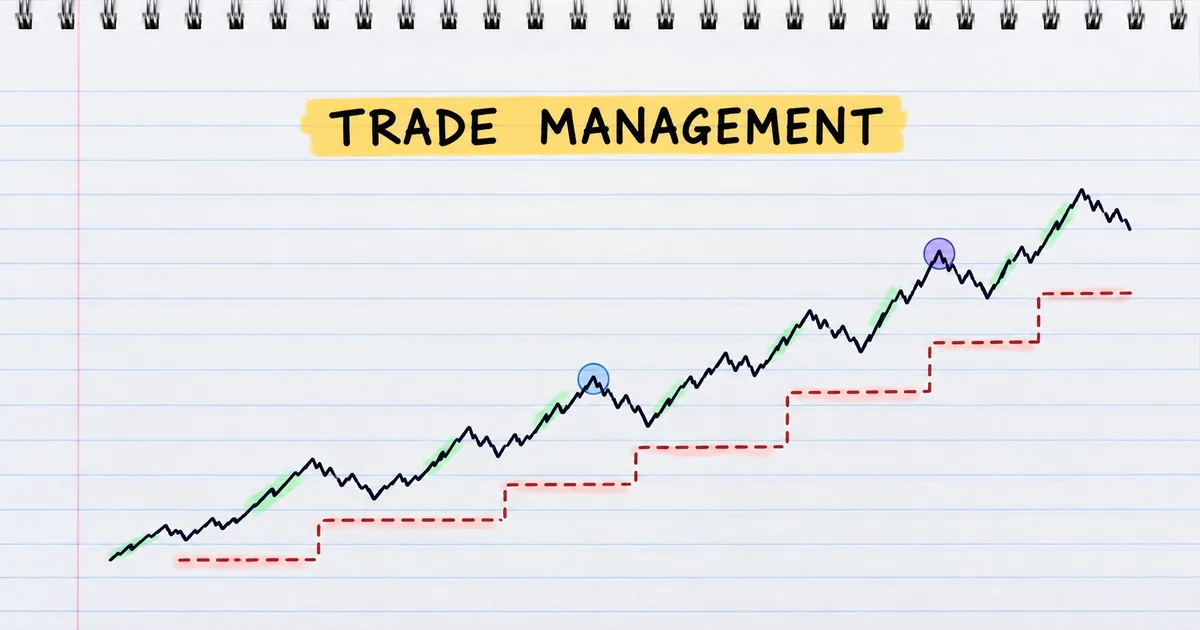
In this module you learn how scaling in and out of a position changes your average price and risk, what moving a stop to break even protects and how to calculate the break-even price, why trades in correlated currency pairs can act like one larger position, how skilled traders plan for slippage and gaps around news, and how to write your own trading rules so each decision is made before the trade, not during it.
It builds on Module 5, Risk Management, especially position sizing, and on the MetaTrader 5 tools from Module 9.
How do you manage a trade after entry?
Manage a trade after entry with rules set in advance: leave the stop where the plan put it, move it to break even only at a set profit, take partial profit at a set level, and close if the reason for the trade is gone. Each rule is written before the trade opens.
A worked example, before costs: buy 0.20 lot of EURUSD at 1.0800 with a stop at 1.0760 (40 pips, $80 at risk) and a target at 1.0880 (80 pips). At 1.0840 you close 0.10 lot for $40 and move the stop on the rest to 1.0800. The worst case is now $40 of profit; if the target is hit, the remaining 0.10 lot adds $80, for $120 in all. Holding the full 0.20 lot would have made $160 or lost $80. The scaling in and out lesson compares the two.
Why is trade management important?
Trade management is important because the decisions after entry change the result as much as the entry does: where the stop moves, how much you close early and how many related positions you hold all change the risk. Planned in advance, they keep risk where you set it.
Related positions are the easiest to miss. A long EURUSD and a long GBPUSD at 1% risk each are both bets against the US dollar, so together they can act like close to 2% on one idea. The correlation risk lesson shows how to count them.
How is trade management different from risk management?
Risk management sets the size and stop before you enter; trade management covers every decision after entry, such as scaling, moving the stop and closing early, within the risk you already set. A trade management rule should never add risk beyond the first stop.
Module 5, Risk Management covers the first part: position sizing and the stop. This module covers the second, and ends with writing your trading rules so both parts are on paper.
What do traders ask about trade management?
Traders ask four things first about trade management in forex: whether to move the stop as price moves, whether to take partial profits, when to close a trade early and how to handle weekend gaps. The answers below each stand alone, with links to the lessons that cover them.
Should you move your stop loss as price moves?
Only in your favour and only by a rule, such as to break even after price has moved by your first risk distance, or with a trailing stop. Never move a stop further away to give a losing trade more room.
Should you take partial profits?
It depends on your method. Closing part of a position locks in some gain and lowers the risk on the rest, but it also shrinks your largest winners. Test both on your own record and keep the version with the better expectancy.
When should you close a trade early?
When the reason for the trade is gone, for example the level you traded from breaks, or a high-impact release is due that your plan says not to hold through. Closing because you feel nervous is not a reason; write the conditions down in advance.
How do you handle weekend gaps?
Price can open on Monday away from Friday's close, and a stop loss then fills at the first available price. Reduce size or close positions before the weekend if your plan says so, as the news, gaps and slippage lesson explains.
Practise what you learned
Open an account to use MetaTrader 5. Start on a demo account before risking real money.
Open Account