
FOMO in Trading: Fear, Greed and How to Manage Them
FOMO in trading is the fear of missing out on a price move, which pushes you to enter late, chase the price and abandon your plan. Fear and greed pull you off your plan in other ways, and rules written before you trade keep you on it.
Module 11 · Lesson 1 of 4
What you'll learn
- What FOMO in trading is, and how it changes your risk.
- How fear and greed affect stops, targets and size.
- How to work out what a chased entry costs.
- Habits that keep you on plan, from pause rules to a journal.
What is FOMO in trading?
FOMO in trading, short for fear of missing out, is the urge to enter a trade because the price is already moving and you are not in it. It usually means entering late, chasing a fast move past the level you planned to use, or dropping your rules because waiting feels like losing out.
Common triggers are a fast move you missed, posts showing other people's wins, breaking news, and the urge to win back a recent loss. Skilled traders answer every one of them the same way: the trade happens at the planned level, or not at all.
Definitions
- Chasing: entering after a fast move, at a worse price than you planned.
- Trading plan: your written rules for entry, stop, target and position size.
- Structural stop: a stop loss placed at a chart level, such as below support, not at a fixed distance from entry.
What are fear and greed in trading?
Fear and greed in trading are two emotions that commonly push traders away from their plan: fear makes you avoid or cut trades, and greed makes you take more risk than you planned. Both are normal. Everyone who trades feels them. What matters is whether your rules were written before the feeling arrived.
- Fear: hesitating on a valid trade, closing a winner early, or moving the stop further away to avoid taking a loss.
- Greed: opening a larger position than planned, removing the take profit because the trade "could go further", or adding size for no written reason.
FOMO sits between the two: fear of missing the move leads to a greedy action, a trade your plan never asked for.
Do not confuse these emotions with a fear and greed index. CNN's Fear and Greed Index combines seven market indicators to gauge the mood of the US stock market. It measures the crowd's mood, not your own decisions.
How do fear, greed and FOMO show up in your trades?
Each emotion leaves a typical pattern in your trade history, and each has a rule or check that limits it. The table pairs each behaviour with the habit that works against it. Each habit is decided before entry, so the emotion has nothing left to change once the trade is open.
| Emotion | Typical behaviour | The rule or check that limits it |
|---|---|---|
| FOMO | Entering late after a fast move, or because others online seem to be winning | Enter only at your planned level; if it is missed, skip the trade |
| Fear | Closing winners before the target | Set the target before entry and leave it |
| Fear | Moving the stop further away to avoid a loss | Set the stop on entry and never widen it |
| Greed | Opening a position larger than planned | Size every trade from your account and stop distance |
| Greed | Removing the take profit or adding size after a win | Decide the target and maximum size before entry |
Sizing is explained in the position sizing lesson, and the checks to run before entry are in the pre-trade risk checklist.
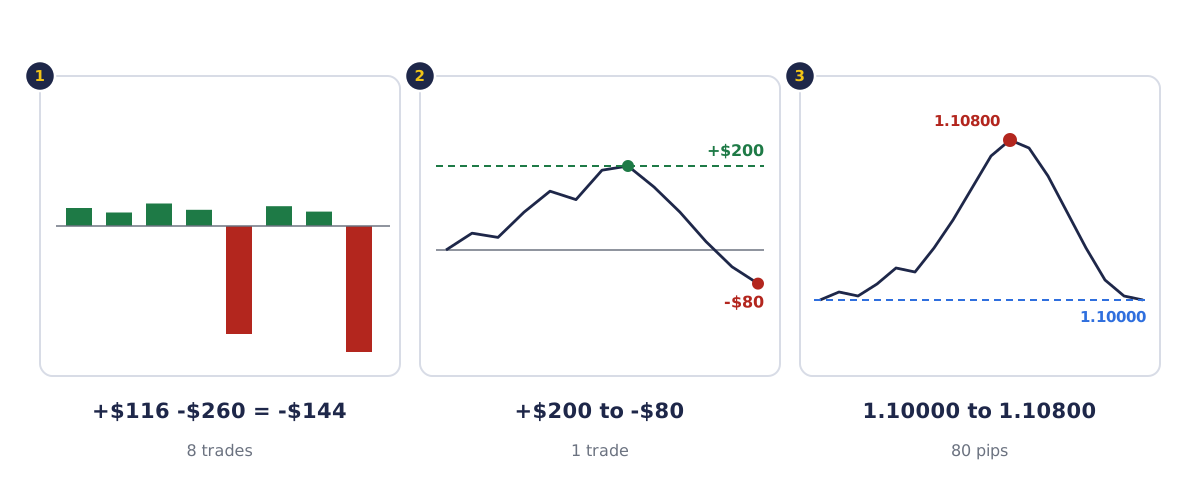
- Fear: eight trades. Six small wins add up to +$116, and two large losses add up to −$260, for a net result of −$144.
- Greed: one trade reached its +$200 target, was held for more, and closed at −$80.
- FOMO: the entry was at 1.10800, 80 pips above the 1.10000 level the move started from, and the price then fell back.
How do you calculate the cost of a FOMO entry?
To calculate the cost of a FOMO entry, measure the new distance from your entry to the stop loss in pips and multiply it by the pip value of your position. If you chase a move but keep the same chart-based stop, the same position size risks more money and the room left to your target shrinks.
Risk in money = stop distance in pips × pip value per pip of your position.
Worked example with synthetic figures: you plan to buy the EURUSD currency pair at 1.08500, with a structural stop at 1.08250 below support and a target at 1.09000. At 0.20 lot each pip is worth $2 (about $10 per pip for one standard lot). The price jumps before you act, and you buy at 1.08700, keeping the same stop and target.
| Planned entry | FOMO entry | |
|---|---|---|
| Entry | 1.08500 | 1.08700 |
| Stop loss | 1.08250 | 1.08250 |
| Stop distance | 25 pips | 45 pips |
| Risk at 0.20 lot ($2 per pip) | $50 | $90 |
| Distance to target at 1.09000 | 50 pips ($100) | 30 pips ($60) |
| Risk-reward ratio | 1:2 | 1:0.67 |
The chased entry risks $40, or 80%, more ($40 ÷ $50), and the target is 20 pips closer. Resizing to keep $50 of risk gives $50 ÷ (45 pips × $10) = 0.111, rounded down to 0.11 lot: $49.50 at risk for $33 to the target.
The position size calculator does the resizing for you from the new stop distance.
Why does social media make FOMO worse?
Social media makes FOMO worse because it tends to show other people's wins, which makes it feel as if everyone is making money except you. That feeling is the pressure FOMO feeds on. Posts rarely show the losses or costs behind a screenshot.
The effect is measurable. In a survey published 20 October 2021, the UK Financial Conduct Authority (FCA) polled 1,000 people aged 18 to 40 who invest in high-risk investment products. 58% agreed that constantly hearing about a certain investment on the news, on social media and from other people encouraged them to purchase specific investments.
Skilled traders treat a screenshot as someone else's trade: it says nothing about their own level, stop or size. Keep the feed off the screen while you trade, and test any idea you see against your written plan before it goes anywhere near the order window.
How do you manage fear, greed and FOMO?
You manage fear, greed and FOMO by deciding as much as possible before the trade, while you are calm, and by setting fixed points to pause. Skilled traders still feel every one of these emotions. The difference is that, once the trade is live, the emotion has nothing left to decide.
- Wait for your own conditions. Write the level and signal your plan needs. If the price has moved past it, the trade is missed.
- Size before entry. Calculate the position size from your risk per trade and stop distance before placing the order.
- Set the stop and target on entry. Do not widen the stop or remove the target while the trade is open.
- Use pause rules. For example, stop for the day after two losses in a row, or wait for the next candle to close after a move you missed.
- Keep a journal. After each trade, write why you entered: plan, fear, greed or FOMO. The trading journal lesson shows how.
Revenge trading, trading at once to win back a loss, is the next lesson. The wider picture is in why beginners lose money.
How do you follow your rules when the market moves fast?
You follow your rules in a fast market by keeping them short, visible and decided before the session, so there is nothing to work out while the price is moving. A rule written in calm can feel wrong when a candle races away from you. That feeling is the signal to follow the rule, not to rewrite it.
- Keep rules short and visible. A rule you can read in two seconds is one you can follow in a fast market.
- Know how a stop fills. In a fast or gapping market a stop loss closes at the next available price, which can be beyond its level, so the loss can be bigger than planned. Factor that into your size around big news.
- Treat missed trades as normal. Skipping a missed entry means some moves happen without you. Your next planned setup is the one you trade.
Try it on demo
On a MetaTrader 5 demo account, open the History tab of the Toolbox and list your last 20 trades. Beside each, write one word: plan, fear, greed or FOMO. Find the word beside your largest loss, and write one rule that would have limited it.
This lesson is part of the Trading Psychology module.
Quick check
- FOMO most often produces an entry that is
- You planned a 25-pip stop at 0.20 lot ($2 per pip). You chase and enter 20 pips higher, keeping the same stop. Your risk is now
- Many small wins and a few large losses is a pattern that often points to
- Which habit limits greed most directly?
- What turns noticing an emotion into a better trading decision?
Frequently asked questions
How do you stop FOMO in trading?
You limit FOMO by deciding your entry level, stop, target and size before the price moves, and by skipping any trade whose entry you missed. Waiting for the next candle to close after a fast move also gives you time to check the plan.
How do you tell FOMO from a real trading opportunity?
A real opportunity meets the conditions your plan wrote down before the move, at the level and size you planned. FOMO is entering because the price is moving, others seem to be winning, or you fear missing out. If you cannot name the plan rule, it is FOMO.
Is it ever too late to enter a trade?
Yes, if the price has moved past the entry level your plan sets. A later entry with the same stop means more money at risk and less room to the target. If your plan allows a new entry, recalculate the size first.
How do you control greed in trading?
You control greed by fixing your position size and take profit before entry and not changing them while the trade is open. Sizing every trade from your account and stop distance keeps a winning run from turning into one oversized position.
Sources
- Financial Conduct Authority (FCA), Young investors driven by competition and hype, 20 October 2021: 1,000 people aged 18 to 40 who invest in high-risk investment products surveyed; 58% agreed that constantly hearing about a certain investment on the news, on social media and from other people encouraged them to purchase specific investments. https://www.fca.org.uk/news/press-releases/young-investors-driven-competition-hype
- CNN, Fear and Greed Index, first published 23 November 2021: the index uses seven market indicators to gauge stock market movements and the emotion driving the market. https://www.cnn.com/markets/fear-and-greed
Practise what you learned
Open an account to use MetaTrader 5. Start on a demo account before risking real money.
Open Account