
Trading Discipline: How to Be Disciplined in Trading
Trading discipline is following your own written trading rules on every trade, especially when breaking them feels easier. It is measured by how often you follow your rules, not by whether your trades win.
Module 11 · Lesson 4 of 4
What you'll learn
- What trading discipline means and why it is measured by behaviour, not results.
- The five places discipline usually breaks, and the rule that covers each.
- Practical supports that close decisions before you sit down to trade.
- How to measure discipline with a rule-followed rate.
This lesson completes the Trading Psychology module.
What is trading discipline?
Trading discipline is following your own written trading rules consistently, on every trade, including when it is uncomfortable. It is not about willpower or never feeling fear. It is about doing what you decided in advance, such as keeping your stop loss where you placed it, even when changing it would feel better in the moment.
Definitions
- Written rule: an if-then statement set before you trade.
- Rule break: any trade that did something your rules did not allow, whatever the result.
- Rule-followed rate: the share of your trades that followed every rule, as a percentage.
- Pre-commitment: making a decision in advance and removing the option to change it later, for example by placing the stop loss with the order.
Why does trading discipline matter?
Trading discipline matters because a rule only limits losses if you follow it, and you can only judge your rules if you follow them. If you break your risk rule on some trades, your results mix two different methods. You can no longer tell whether a loss came from the rules or from the break.
Discipline keeps each loss to the size you planned, so a losing afternoon stays inside the limits you set in advance. It also keeps your journal a clean test of your rules, which is how good rules get better.
Where does trading discipline usually break?
Trading discipline usually breaks at a predictable moment: when a rule is about to stop you from doing something you badly want to do, and no one is watching. Rules rarely fail on a quiet day. They fail when they would cost you something.
| Breaking point | What it looks like | Rule that addresses it |
|---|---|---|
| Moving a stop loss | Dragging the stop further away to avoid the loss | If my stop is set, then I never move it further from the entry price |
| Skipping the checklist | Rushing in because the move "looks obvious" | If I have not answered every checklist question, then I do not open the trade |
| Oversizing after wins or losses | Doubling size after a winning run, or after a loss to win it back | If I open a trade, then it risks no more than 1% of my starting balance |
| Overtrading | Taking extra trades that do not match your setup, just to stay active | If I have opened my maximum number of trades today, then I open no more |
| Trading outside your sessions | Trading late at night out of boredom | If it is outside the hours I chose, then I open no new trades |
Each rule in the right-hand column shows the if-then format; set the numbers to match your own plan. The position size calculator works out the size that keeps a trade within a fixed risk.
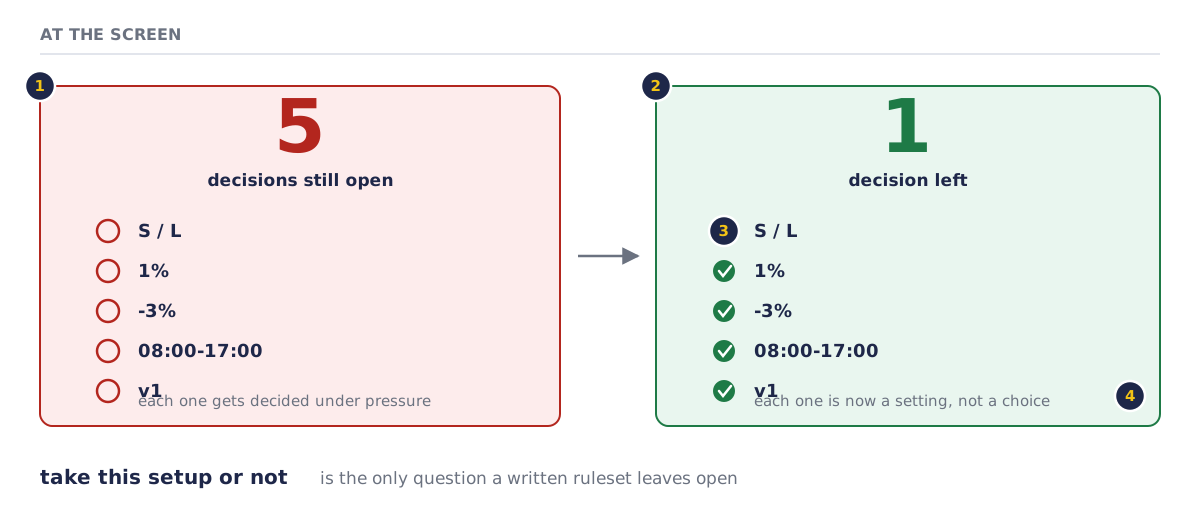
- Five decisions still open when you sit down: stop loss, risk per trade, daily loss limit, trading hours and which version of your rules applies. Each one gets made under pressure.
- The same five, closed in advance. Each becomes a setting rather than a choice.
- The stop loss typed with the order is usually the easiest one to close first.
- What is left is one calm question: take this setup or not.
How can you be disciplined in trading?
You become more disciplined in trading by leaving fewer decisions open at the screen, not by trying harder. Each support below closes a decision before the pressure arrives, so there is less left to argue with yourself about mid-trade. Start with the one that addresses your most common break.
- Write your rules down. Dated and numbered, they are the standard you measure against.
- Run a checklist before every order. The pre-trade risk checklist turns your rules into yes or no questions.
- Place orders and stops in advance. In MetaTrader 5 the stop loss is set to limit the position loss and can be entered with the order. A pending order is carried out even if your platform is closed: see pending orders in MT5.
- Use alerts instead of watching the screen. MetaTrader 5 alerts notify you of a market event so you can leave the monitor: see MT5 price alerts.
- Keep a journal. Record which rule each trade followed or broke, as the trading journal lesson shows.
- Set a daily loss limit. When today's losses reach your number, close the platform until tomorrow.
- Take breaks. After a loss or a set number of trades, step away.
How do you measure trading discipline?
You measure trading discipline with a rule-followed rate: the number of trades that followed every rule, divided by the total number of trades, as a percentage. You record it in your journal as a yes or no for each trade. A trade counts as followed only if no rule was broken.
Rule-followed rate = trades that followed every rule ÷ total trades × 100
Track it next to your results, plus two more numbers:
- Cost of breaks: the actual loss on each broken trade minus the loss your rules allowed.
- Most-broken rule: the rule that appears most often among your breaks.
How does a moved stop change the numbers?
Moving a stop turns a planned $20 loss into a larger one, and a few moved stops can cost more than the rule-followed trades suggest. Here is a synthetic set of 20 demo trades on a $2,000 account, with one rule: risk 1% of the balance ($20 per trade), with the stop loss placed when the trade opens.
Seventeen trades followed the rule and risked $20 each, whatever their result. On three, the stop was moved further away as price approached it, and each lost more than planned:
| Trade | Planned loss | Actual loss | Extra loss beyond plan |
|---|---|---|---|
| Break 1 | $20 | $35 | $15 |
| Break 2 | $20 | $50 | $30 |
| Break 3 | $20 | $45 | $25 |
| Total | $60 | $130 | $70 |
Recompute it step by step:
- Rule-followed rate: 17 ÷ 20 × 100 = 85%.
- Extra loss: ($35 − $20) + ($50 − $20) + ($45 − $20) = $15 + $30 + $25 = $70.
- In units of planned risk: $70 ÷ $20 = 3.5. Three breaks cost three and a half extra planned losses.
An 85% rate sounds high, but the breaks added $70 of loss the rule was written to prevent. The journal points to the fix: a rule never to move the stop further away.
What mistakes do disciplined traders avoid?
Disciplined traders avoid four common mistakes: judging discipline by results, changing rules in the middle of a trade, forgetting how a stop fills in a volatile market, and following weak rules without reviewing them. Discipline controls your behaviour; the planned review is where the rules themselves improve. Each mistake has a simple fix:
- Confusing results with discipline. A broken rule that happened to win is still a break, and a rule-following trade that hit its stop is still a correct trade.
- Changing rules in the moment. Editing a rule during a trade is a break. Change rules only at a planned review.
- Gaps and slippage. A stop loss fills at the next available price, which in a fast market can be worse than its level. Size and set your daily limit with that in mind.
- Never reviewing the rules. Following a weak rule perfectly repeats its weakness. Use the journal at each planned review to keep the rules that work and fix the ones that do not.
Advanced psychology is covered later, in Module 16.
Try it on demo
On a MetaTrader 5 demo account, place your next 20 trades with the stop loss entered in the order window before you click. After each trade, write "followed" or "broke" and name the rule in your journal. At the end, work out your rule-followed rate and the extra loss from any breaks.
Quick check
- Trading discipline is best described as
- Where is a rule most likely to break?
- You followed your rules on 34 of 40 demo trades. Your rule-followed rate is
- Your rule risks $20 per trade. You move the stop and lose $45. How much did the break cost beyond plan?
- Which support removes a decision before you reach the screen?
Frequently asked questions
How do I become a disciplined trader?
You become a disciplined trader by deciding as much as possible before you trade. Write your rules down, place every stop loss with the order, run a checklist and record in a journal whether each trade followed your rules. Then add a support where your journal shows the most breaks.
Why is discipline important in trading?
Discipline is important because rules only limit losses when you follow them. It also keeps your journal honest, so it shows whether the rules themselves work.
How do you stick to your trading plan?
Keep the plan short, written and in front of you, and close as many decisions as possible before the session: the stop loss entered with the order, the size worked out first, a checklist and a daily loss limit. Then journal every trade as followed or broken, and fix the rule your journal shows you break most.
How do you stop moving your stop loss?
Decide the stop before you open the trade and enter it in the order window, then add a written rule that you never move it further away from the entry. Journal every moved stop with the extra loss it caused.
How can I avoid overtrading?
You avoid overtrading by writing a maximum number of trades per day and taking only setups that match your rules. Count each trade in your journal, and when you reach the limit, close the platform until tomorrow. Any trade past the limit counts as a rule break.
Sources
- MetaQuotes, MetaTrader 5 Help: Executing Trades, accessed 19 October 2026: the stop loss level is set to limit the position loss; a pending order is performed by the broker even if the trading platform is closed; alerts notify you of market events so you can leave the monitor. https://www.metatrader5.com/en/terminal/help/trading/performing_deals
Practise what you learned
Open an account to use MetaTrader 5. Start on a demo account before risking real money.
Open Account