
How Do Earnings Reports Affect Stock Prices? EPS, Guidance and Gaps
Earnings reports affect stock prices by changing what the market expects a company to earn, so prices react to results and guidance versus forecasts, not to profit alone. Because many reports land outside regular trading hours, a stock CFD can open at a very different price from its last close.
Module 8 · Lesson 4 of 5
What you'll learn
- What an earnings report is and which figures traders read first.
- How to calculate EPS and what beats and misses mean.
- Why guidance can move a share more than the quarter itself.
- Why a stock CFD can gap past your stop loss, and how dividends adjust a position.
What is an earnings report?
An earnings report is a company's regular announcement of its financial results for the latest quarter or year: how much it sold, how much profit it made and, often, what it expects next. Listed companies publish them on dates set in advance, and the share price, and any CFD on that share, can react sharply when they land.
In the United States, they are formal filings with the Securities and Exchange Commission (SEC), whose investor site explains that domestic companies file annual reports on Form 10-K, quarterly reports on Form 10-Q, and current reports on Form 8-K.
| Filing | What it is | When |
|---|---|---|
| Form 10-Q | Quarterly report with unaudited financial statements | For each of the first three quarters of the company's financial year |
| Form 10-K | Annual report | Once a year |
| Form 8-K | Current report on major events, including results press releases | When a reportable event happens |
Many companies first announce results in a press release, filed with an 8-K, and hold an earnings call soon after. The SEC's guide to reading an 8-K notes that the full financial statements follow later in the 10-Q or 10-K.
Earnings call: a conference call where managers discuss the results and answer analysts' questions.
How do earnings reports affect stock prices?
Earnings reports affect stock prices by changing what investors expect a company to earn in future. Before a report, the share price already reflects a forecast. When results and the company's outlook come in better or worse than that forecast, buyers and sellers reprice the share, sometimes by a large amount in one move.
This is why a profitable company's share can still fall on results day: the market asks whether results beat expectations, not whether the company made money. The same idea, that prices react to surprises, is explained in what makes prices move in trading.
What are an earnings beat and an earnings miss?
- Consensus estimate: the average forecast of the analysts who follow the company.
- Beat: an actual figure above the consensus estimate.
- Miss: an actual figure below it.
Traders often read the result and the guidance together:
| EPS versus estimate | Guidance | How traders often read it |
|---|---|---|
| Beat | Raised | Positive, unless already priced in |
| Beat | Cut | Mixed: the weaker outlook can outweigh the beat |
| Miss | Raised | Mixed: the better outlook can soften the miss |
| Miss | Cut | Negative |
The reaction also depends on what was already priced in, so traders weigh each result against the expectations built into the price.
What is EPS (earnings per share)?
Earnings per share (EPS) is a company's net profit for a period divided by the number of its shares. The SEC's beginners' guide to financial statements describes it as what shareholders would receive for each share if all the period's net income were paid out.
EPS = net income ÷ number of shares outstanding
Example with synthetic figures: Company A earns net income of $134 million in a quarter and has 100 million shares, so EPS is $134 million ÷ 100 million = $1.34.
Which figures matter most in an earnings report?
The figures traders read first are revenue, earnings per share and guidance, each compared with what analysts expected. Revenue shows whether sales are growing, EPS shows profit per share, and guidance shows what management expects next. Together they show whether the business is meeting the expectations built into its share price.
| Figure | What it measures | What it is compared with |
|---|---|---|
| Revenue | Total sales in the period | Analysts' revenue estimate and the same quarter last year |
| EPS | Net profit per share | Consensus EPS estimate |
| Guidance | The company's own forecast for coming quarters or the full year | The previous guidance and analysts' forecasts |
Why can guidance matter more than the quarter?
Guidance can matter more than the quarter because the quarter is already over, while guidance changes expectations for every quarter still to come. A share price reflects what investors think a company will earn in future, so a lowered forecast can outweigh a better-than-expected past quarter.
Guidance: a company's own forecast of future results, such as expected full-year EPS or revenue. A company can raise or lower it as the year goes on.
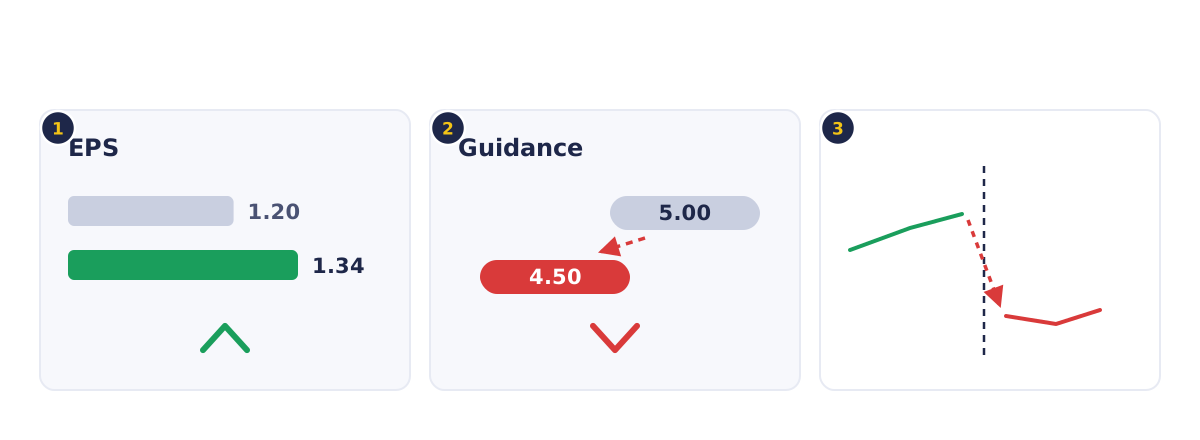
- EPS beat the estimate: $1.34 against $1.20.
- Full-year EPS guidance was cut, from $5.00 to $4.50.
- The share price opened sharply lower after the release, despite the beat.
Why do stock CFDs gap after earnings?
Stock CFDs often gap after earnings because many companies release results outside regular trading hours, when the main market is closed. When trading resumes, the price jumps straight to a new level that reflects the news, with no trading at the prices in between. A CFD on that share follows the jump.
Earnings from the largest US companies also feed into index CFDs, as the US30 Dow Jones guide explains.
Regular US stock trading hours are 9:30 a.m. to 4:00 p.m. Eastern Time. The SEC's bulletin on extended-hours trading notes that companies may announce important news outside these hours, which may lead to significant price changes.
Gap: a jump between one price and the next with no trading in between. A share CFD tracks the underlying share's price, as explained in what is a CFD, so it inherits the gap.
How does an earnings gap affect a stop loss?
An earnings gap can make a stop loss close a trade well past its level, because the price jumps over the stop and the order fills at the first available price. As ASIC's CFD guide explains, a standard stop loss may not be executed at the price you set; only a guaranteed stop fixes the exit price.
Worked example with Company A (synthetic):
- Before the report, Company A's share closes at $100. You hold a CFD long of 50 shares, opened at $100, worth $5,000.
- Your stop loss is at $96, so the loss you planned for is 50 × $4 = $200.
- After the close, Company A beats its EPS estimate ($1.34 against $1.20) but cuts its guidance.
- The share opens at $92, an 8% gap. No price traded between $100 and $92.
- Your stop triggers at the open and fills near $92. The loss is 50 × $8 = $400.
| Planned | Actual | |
|---|---|---|
| Exit price | $96 | about $92 |
| Loss per share | $4 | about $8 |
| Loss on 50 shares | $200 | about $400 |
The stop did not fail; it limited the loss to the first price available. The stop loss and take profit lesson explains how standard and guaranteed stops fill, and the position size calculator helps you work out a size that keeps a realistic gap within your plan. Sizing for gap risk is part of position sizing.
How do dividends and corporate actions affect a stock CFD?
When the underlying share pays a dividend, a stock CFD position is usually adjusted in cash: a long position is credited and a short position is debited. ASIC's guide explains that buying a CFD credits an amount mirroring the dividend, while selling one debits a similar amount.
Other corporate actions, such as a share split, can also lead your provider to adjust a position's size or price. Your broker's terms set how and when, so check them before holding a share CFD through a company event.
How do you manage stock CFD trades around earnings?
To manage a stock CFD through earnings, size the position for a realistic gap, not just for your stop distance, because the price can open beyond your planned exit. Leverage applies the gap to the whole position, not just your margin, and thinner liquidity outside regular hours can mean wider spreads.
- Know the date: note when the company reports and whether results land before the open or after the close.
- Size for the gap: a standard stop fills at the first available price, so work out the loss at a gap level as well as at your stop.
- Read both sides: the gap can go either way, so judge results and guidance against expectations together.
Try it on demo
In MetaTrader 5, right-click a share CFD in Market Watch and open its Specification. Read the trading sessions for each day to see when the instrument is closed, which is when an earnings gap forms.
This lesson is part of the Fundamental Analysis module.
Quick check
- A company's earnings per share is judged mainly against
- Net income is $134 million and there are 100 million shares. EPS is
- A company beats the EPS estimate but lowers its guidance. The share price
- Why do stock CFDs often gap after earnings?
- You are long 50 share CFDs at $100 with a stop at $96. The share opens at $92. Your loss is about
Frequently asked questions
Why do stocks fall after good earnings?
Stocks can fall after good earnings when the results were already expected or when guidance for future quarters is weaker. The price reflects expectations, so a beat that was priced in, or a cut to the outlook, can still push the share lower.
When is earnings season?
Earnings season is the few weeks after each quarter ends, when many listed companies release results on dates they announce in advance. The SEC's Form 10-Q instructions (revised February 2025) give larger US companies 40 days after the quarter ends to file, and others 45 days. Many results land before the market opens or after it closes.
What is a good EPS?
A good EPS is one that beats the consensus estimate and grows on the same quarter a year earlier. The raw figure depends on the company's size and number of shares, so traders judge it against those two benchmarks rather than in isolation.
Do you get dividends on a stock CFD?
You do not receive a dividend as a shareholder, because a CFD does not give you the share. Instead, providers usually make a cash adjustment: long positions are credited and short positions are debited. Check your broker's terms for the timing and amount.
Sources
- U.S. Securities and Exchange Commission, Investor.gov, Form 10-Q (accessed 27 October 2026): domestic issuers file annual reports on Form 10-K, quarterly reports on Form 10-Q and current reports on Form 8-K; the 10-Q includes unaudited financial statements and is filed for each of the first three fiscal quarters. https://www.investor.gov/introduction-investing/investing-basics/glossary/form-10-q
- U.S. Securities and Exchange Commission, Investor.gov, How to Read an 8-K, 26 January 2021: many companies announce quarterly and annual results in a press release and an 8-K, often with a conference call, and the full financial statements appear later in the 10-Q or 10-K. https://www.investor.gov/introduction-investing/general-resources/news-alerts/alerts-bulletins/investor-bulletins/how-read-8
- U.S. Securities and Exchange Commission, Form 10-Q General Instructions, SEC 1296 (02-25) (accessed 27 October 2026): a 10-Q is due 40 days after the end of the fiscal quarter for large accelerated and accelerated filers, and 45 days for all other registrants. https://www.sec.gov/files/form10-q.pdf
- U.S. Securities and Exchange Commission, Beginners' Guide to Financial Statements (accessed 27 October 2026): EPS is total net income divided by the number of outstanding shares. https://www.sec.gov/about/reports-publications/beginners-guide-financial-statements
- U.S. Securities and Exchange Commission, Investor.gov, Extended-Hours Trading: Investor Bulletin, 6 June 2022: regular trading hours are 9:30 a.m. to 4:00 p.m. Eastern Time; companies may announce important news outside regular hours, which may lead to significant price changes; spreads are generally wider outside regular hours. https://www.investor.gov/introduction-investing/general-resources/news-alerts/alerts-bulletins/investor-bulletins-42
- Australian Securities and Investments Commission (ASIC), Moneysmart, Thinking of trading contracts for difference (CFDs)? (accessed 27 October 2026): a stop loss may not be executed at the price you set unless it is guaranteed; buying a CFD credits an amount mirroring a dividend and selling one debits a similar amount. https://static.moneysmart.gov.au/files/publications/thinking-of-trading-in-contracts-for-difference-cfds.pdf
Practise what you learned
Open an account to use MetaTrader 5. Start on a demo account before risking real money.
Open Account