
What Moves the Forex Market? The Main Drivers Explained
The forex market moves when demand for one currency changes against another, driven mainly by interest rates, economic data, trade flows, risk sentiment and news. Behind every move is a shift in the balance of buyers and sellers, and the biggest moves usually follow what the market did not expect.
Module 1 · Lesson 5 of 5
What you'll learn
- What moves the forex market, in one sentence.
- How buyers and sellers set the price, including the bid and ask.
- The main drivers, from interest rates, inflation and trade to news and liquidity.
- Why surprises matter most, and how fast markets behave.
What moves the forex market?
The forex market moves when demand for one currency changes compared with another. Interest rates and central bank decisions, economic data such as inflation and jobs figures, trade flows, risk sentiment and major events shift that demand. Prices then move toward whichever side has more buyers or sellers, and surprises move them most.
The same mechanism moves every market, from currencies to shares and commodities: prices move because the balance between people wanting to buy and people wanting to sell keeps changing. When more buyers than sellers want to trade at the current price, the price rises until enough sellers appear. When sellers outnumber buyers, it falls.
A price is simply the latest level at which a buyer and a seller agreed to trade. For currencies, the Reserve Bank of Australia says exchange rates are determined by the demand for, and supply of, a currency in the foreign exchange market.
- Demand: how much people want to buy at a given price.
- Supply: how much people want to sell at a given price.
- Order: an instruction to buy or sell a set amount.
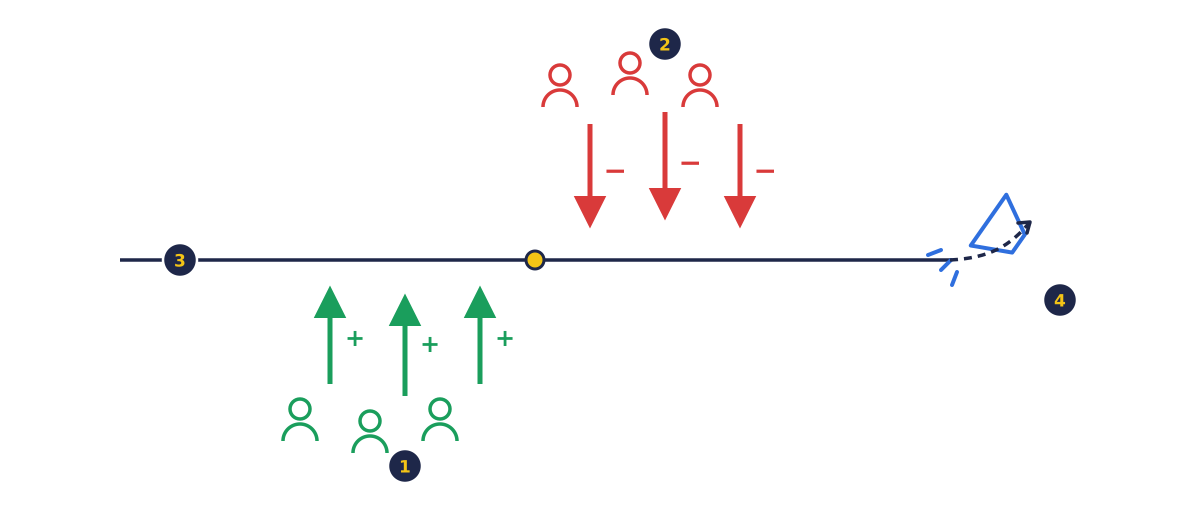
- Buyers (demand) push the price up.
- Sellers (supply) push it down.
- The price line is where the two sides currently meet.
- News tips the balance toward one side. A different headline could tip it the other way.
How do buyers and sellers set the price?
Buyers and sellers set the price through their orders: buyers say the most they will pay, sellers the least they will accept, and a trade happens where they meet. When buy orders use up everything sellers offer at one price, the next trade happens at a higher price. Heavy selling does the opposite, pushing the price lower.
- Bid: the price at which you can sell.
- Ask: the price at which you can buy, slightly above the bid.
- Spread: the gap between bid and ask, a cost on every trade, explained in spread, commission and swap.
- Order book: the list of waiting buy and sell orders at each price.
MetaTrader 5 shows this list in its Depth of Market window. For over-the-counter instruments, such as many CFDs, its levels may be built from your broker's bid and ask prices rather than real orders.
Worked example: more buyers than sellers
Synthetic figures: a share is quoted at $20.00 bid and $20.02 ask, with sellers waiting here:
| Ask price | Units offered |
|---|---|
| $20.02 | 500 |
| $20.03 | 600 |
| $20.04 | 800 |
A buy order for 1,500 units arrives:
- It buys all 500 units at $20.02.
- It buys all 600 units at $20.03.
- It buys 400 units at $20.04, leaving 400 there.
The best ask is now $20.04. Nobody decided the share was worth more; one large buyer used up the cheaper sellers. A large sell order walks down the bids the same way.
What are the main drivers of price?
The main drivers of price are supply and demand, news and economic data, interest rates, risk sentiment, major events, liquidity and volatility. Each works by changing how many people want to buy or sell, or how much volume waits at each price. Their effects differ between asset classes.
| Driver | What it is | Example | Typical effect |
|---|---|---|---|
| Supply and demand | How much people want to buy or sell at each price | Many buy orders, few sellers | Price moves toward the side with more pressure |
| News and data | New information about value | Company results, inflation, jobs or growth figures | Little change if expected; a sharp move either way if it surprises |
| Interest rates | The return on a currency's deposits and bonds | An unexpected rate rise | All else equal, tends to support that currency; an unexpected cut, the reverse |
| Risk sentiment | How much risk investors will take | Global shares fall sharply | Money shifts between riskier and safer assets |
| Major events | Political and world events | Elections, conflicts, natural disasters | More uncertainty; sudden moves either way |
| Liquidity | How many buyers and sellers are active | A public holiday | Wider spreads, bigger jumps on smaller orders |
| Volatility | How far and how fast price swings | A busy news day | Bigger moves in both directions; size, not direction |
Why does news move prices?
News moves prices when it changes what people expect, so the surprise matters more than the news itself. Prices already reflect what most people expect. If a result arrives exactly as forecast, few people change their orders. If it is better or worse than expected, buyers or sellers rush in and the price can jump.
The Reserve Bank of Australia lists speculation, news and events among the influences on exchange rates.
| News as expected | News that surprises | |
|---|---|---|
| What changes | Little; it was already in the price | Expectations about value, rates or growth |
| Typical reaction | Small or brief | Fast, sometimes large, either direction |
Even wording can surprise. A Federal Reserve Board study describes 28 January 2004, when markets fully expected US rates to stay unchanged, yet bond yields jumped because new wording in the statement suggested rates would rise sooner than expected.
The economic calendar and big releases are covered in Module 8, Fundamental Analysis.
Worked example: a surprise on a chart
This chart uses synthetic prices: 5-minute candles on a currency pair quoted to four decimal places.

- Calm range: until 09:00 the price drifts between about 1.0846 and 1.0858.
- News candle: a surprise at 09:00 lifts the price from near 1.0852 to 1.0890, a 38-pip rise.
- Snap-back: the next candle closes at 1.0872, giving back 18 pips.
A pip here is 0.0001, as explained in lots, pips and pip value. On a 0.10 lot position, where one pip is worth $1, the news candle is a $38 change, gained or lost depending on the position's direction. Five minutes later, $18 had reversed. Check pip values with the pip value calculator.
How do interest rates affect prices?
Interest rates, set mainly by central banks, affect prices by changing the return people earn for holding a currency's deposits and bonds. All else equal, when one country's rates rise compared with others, its interest-paying assets look more attractive to foreign investors. They need that currency to buy them, so demand for it rises. Lower rates work the other way.
The Reserve Bank of Australia says that, all else being equal, an increase in interest rates contributes to the exchange rate being higher than otherwise, and that its monetary policy decisions play a key role in influencing the exchange rate. As with news, markets react most to rate changes they did not expect.
How do inflation, trade and economic data affect currencies?
Inflation, trade and economic data affect a currency by changing how much of it people need or want to buy. Trade creates real demand: buyers abroad need a country's currency to pay for its exports. Inflation and growth figures change what markets expect from interest rates, which is why data releases can move currencies within seconds.
- Trade: the Reserve Bank of Australia explains that more demand for a country's exports also increases demand for its currency, while more demand for imports adds to the currency's supply.
- Commodity prices: for big commodity exporters, export prices matter. The RBA notes that commodity prices have a large influence on the terms of trade, and a rise in the terms of trade is associated with a stronger Australian dollar.
- Inflation: the RBA says the exchange rate is affected by relative rates of inflation between countries.
| Data release | What it measures | Why currency traders watch it |
|---|---|---|
| Interest rate decision | The central bank's policy rate | Changes the return on holding the currency |
| Inflation (CPI) | How fast consumer prices are rising | Shapes expectations for future interest rates |
| Employment | Jobs created and the unemployment rate | A signal of economic strength and future rates |
| GDP | Total output of the economy | Shows whether the economy is growing or shrinking |
| Trade balance | Exports minus imports | Shows trade-driven demand for the currency |
A pair compares two currencies, so data from both economies matters. Each release moves prices mostly through the gap between the figure and what was expected.
What is risk sentiment?
Risk sentiment is how much risk investors are willing to take on at a given time. When confidence is high, money tends to flow toward riskier assets such as shares. When fear rises, it tends to move toward assets seen as safer. These shifts can move many related prices at once, across different markets.
The Reserve Bank of Australia notes that its currency tracks changes in risk sentiment, typically rising when global share prices rise.
How do liquidity and volatility affect price moves?
Liquidity is how easily something can be bought or sold without moving its price much; volatility is how far and how fast its price swings. In a liquid market there is plenty of volume at each price, so one order moves the price only a little. In a thin market, the same order can push it much further.
Liquidity is often lower on holidays and in quiet hours, and it changes as financial centres open and close, covered in forex market sessions. Where your broker's prices come from is explained in brokers and liquidity providers.
What happens when prices move fast?
When prices move fast, they can jump past nearby levels, reverse sharply and cost more to trade, all within seconds. On a leveraged position, a fast move changes the result quickly in either direction, so skilled traders set their stop loss and position size before a big release, not during it.
- Reversals: part of a sharp move can reverse within minutes.
- Gaps: the price jumps a level with no trades between, for example after a weekend.
- Wider spreads: the bid-ask gap can widen around big news.
- Slippage: your order is filled at a worse price than the one you saw.
Stop losses, including how they fill in fast markets, are covered in Module 5, Risk Management.
Try it on demo
In MetaTrader 5 on a demo account, open Market Watch, right-click a currency pair and choose Depth of Market. Watch the bid, ask and spread for a few minutes, noting how the spread behaves in calm and busy moments. Do not trade; just observe.
This lesson is part of Market Basics. Next, see how the side you take turns a price move into a gain or a loss in going long and short.
Quick check
- What sets a market price at any moment?
- The best ask is $20.02 with 500 units offered. A buy order for 1,500 units arrives. What happens to the ask?
- Good news is expected and then arrives exactly as expected. The price most likely
- Risk sentiment means
- Buyers abroad want more of a country's exports. All else equal, what happens to demand for its currency?
- Liquidity is low, for example on a holiday. What is more likely?
Frequently asked questions
Why do prices go up when there are more buyers?
Because buyers use up what sellers offer at the current price. The next buyer must then pay the next price at which someone will sell, which is higher.
Does good news always make a price go up?
No. If good news was already expected, the price may barely move, or even fall if the result disappoints. What matters is how news compares with expectations.
Does the same thing move every currency pair?
No. A pair compares two currencies, so it moves on news from both economies and on how their interest rates, inflation and growth compare. Currencies of big commodity exporters, such as the Australian dollar, can also follow the prices of what those countries export.
Can you predict which way a price will move?
Traders work with probabilities, not certainties. Knowing what moves prices, which releases are scheduled and when liquidity is thin tells you when big moves are likelier. Position size and a stop loss then set what each trade can cost, whichever way the price goes.
Sources
- Reserve Bank of Australia, Drivers of the Australian Dollar Exchange Rate (education explainer) (accessed 27 October 2026): exchange rates are determined by the demand for and supply of a currency; all else being equal, higher interest rates contribute to a higher exchange rate; the RBA's monetary policy decisions play a key role in influencing the exchange rate; the currency tracks changes in risk sentiment, typically rising with global share prices; more demand for exports increases demand for the currency, more demand for imports increases its supply; commodity prices have a large influence on the terms of trade, and a rise in the terms of trade is associated with an appreciation. https://www.rba.gov.au/education/resources/explainers/drivers-of-the-aud-exchange-rate.html
- Reserve Bank of Australia, Understanding Exchange Rates and Why They Are Important, Bulletin, 13 December 2018: exchange rate movements are influenced by speculation, news and events; the exchange rate is affected by relative rates of inflation between countries. https://www.rba.gov.au/publications/bulletin/2018/dec/understanding-exchange-rates-and-why-they-are-important.html
- Board of Governors of the Federal Reserve System, Do Actions Speak Louder than Words? The Response of Asset Prices to Monetary Policy Actions and Statements, Finance and Economics Discussion Series 2004-66, 1 November 2004: the 28 January 2004 rate decision was fully anticipated, yet a change in statement wording moved Treasury yields sharply. https://www.federalreserve.gov/pubs/feds/2004/200466/200466pap.pdf
- MetaQuotes, Depth of Market, MetaTrader 5 Help (accessed 27 October 2026): the window shows bids and asks; real prices and order volumes for exchange-traded instruments; levels calculated from Bid and Ask prices for over-the-counter instruments. https://www.metatrader5.com/en/terminal/help/trading/depth_of_market
Practise what you learned
Open an account to use MetaTrader 5. Start on a demo account before risking real money.
Open Account