
Long vs Short in Trading: What Going Long and Short Mean
Going long means you buy and profit if the price rises, while going short means you sell first and profit if the price falls. Both directions lose by the same amount when the market moves the other way.
Module 2 · Lesson 2 of 5
What you'll learn
- What going long and going short mean, in plain terms.
- How you open and close each kind of position.
- How to work out the profit or loss on either direction.
- How the worst case differs between a long and a short, and how traders cap it.
- What it means to hold a long and a short at the same time.
What does going long and short mean in trading?
A long position is a trade opened by buying, so it gains if the price rises. A short position is a trade opened by selling, so it gains if the price falls. Either one loses when the market moves the other way, by the same amount the other direction would have gained.
A few terms you will see throughout this lesson:
- A position is an open trade. You open it, and later you close it.
- Long is buying first. You want the price to end higher than where you opened.
- Short is selling first. You want the price to end lower than where you opened.
- Bullish and bearish describe the view behind a trade. A trader who expects a rise is bullish and may go long; one who expects a fall is bearish and may go short.
- Closing reverses what you did. A long is closed by selling; a short is closed by buying.
- Your profit or loss is the difference between the opening and closing prices, multiplied by the size of the position.
Think of a concert ticket you expect to get more expensive. Buying early means a price rise works in your favour, which is long. Short is the mirror image: you benefit when the price drops, and you are hurt when it rises.
How can you sell something you do not own?
With shares, you sell something you do not own by borrowing it, selling it, and buying it back later to return it. With a CFD there is nothing to borrow, because you never own the underlying asset in either direction, so you open a short simply by pressing Sell.
The US Securities and Exchange Commission (SEC) describes a short sale as the sale of a stock you do not own, and explains that short sellers profit if the price drops and they buy back lower (SEC, Key Points About Regulation SHO).
A contract for difference (CFD) is an agreement to settle the difference between the opening and closing price. That makes opening a short on a CFD as simple as opening a long: you press Sell instead of Buy. The lesson what is a CFD and the CFDs Explained module cover this in more detail.
What is the difference between long and short?
The difference between long and short is the direction you need the price to move. A long opens with a buy and gains when the price rises. A short opens with a sell and gains when the price falls. Each loses when the price moves the other way, and the worst case is not the same for both.
| Long | Short | |
|---|---|---|
| You open with | A buy | A sell |
| You close with | A sell | A buy |
| You profit when the price | Rises | Falls |
| You lose when the price | Falls | Rises |
| Opening price on most platforms | The ask (the higher price) | The bid (the lower price) |
| How far the price can move in your favour | No upper limit | Down to zero |
| How far the price can move against you | Down to zero | No upper limit |
| Button in MetaTrader 5 | Buy | Sell |
Every combination of direction and market move comes down to four outcomes:
| Price rises | Price falls | |
|---|---|---|
| Long | Profit | Loss |
| Short | Loss | Profit |
Notice that the table is symmetrical. Being long or short is not a strategy in itself; it is only a statement of which way you need the price to move.
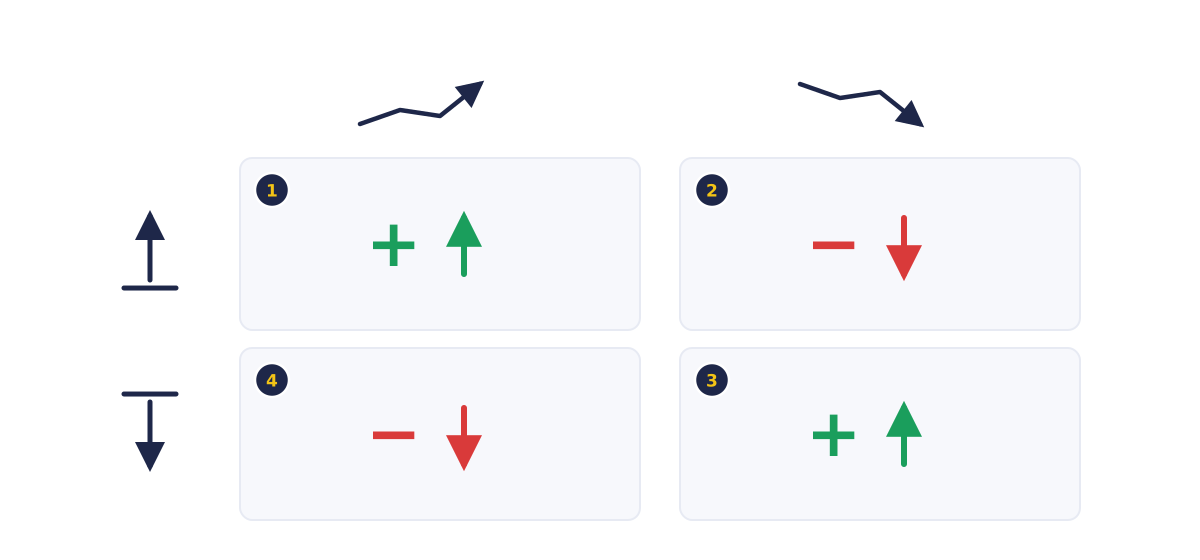
- Long in a rising market: profit.
- Long in a falling market: loss.
- Short in a falling market: profit.
- Short in a rising market: loss.
Move the price in the widget below. Both directions stay on screen together, so you can see that whatever one side gains, the other loses by exactly the same amount.
How do you calculate profit and loss on a long or short?
Profit or loss = price change in your favour × position size. For a long, the change in your favour is the closing price minus the opening price. For a short, it is the opening price minus the closing price. If the result is negative, it is a loss.
Worked example. You open EURUSD at 1.1000 with a position of 0.10 lot. One standard lot is 100,000 euros, so 0.10 lot is 10,000 euros, and each pip (0.0001) is worth $1. Pips and pip value are explained in full in the lesson on lots, pips and pip value, and the pip value calculator works out the pip value for other pairs and sizes.
| Trade | Price moves to | Pips in your favour | Profit or loss |
|---|---|---|---|
| Long at 1.1000 | 1.1050 | +50 | +$50 |
| Long at 1.1000 | 1.0950 | −50 | −$50 |
| Short at 1.1000 | 1.0950 | +50 | +$50 |
| Short at 1.1000 | 1.1050 | −50 | −$50 |
Same move, opposite results.
This example leaves out trading costs. In practice the spread means a new position starts slightly negative in either direction, and holding a position overnight can add a financing charge that may differ for long and short positions. Costs are covered in the lesson on spread, commission and swap.
Why do long and short trades open at different prices?
Long and short trades open at different prices because every symbol has two prices. The bid is the price at which you can sell, and the ask is the higher price at which you can buy. The gap between them is the spread. MetaTrader 5 shows both prices on the Sell and Buy buttons.
- A long opens at the ask and closes at the bid.
- A short opens at the bid and closes at the ask.
This is why a position shows a small loss the moment you open it, whichever direction you choose. The price has to move in your favour by at least the spread before the trade breaks even.
How does risk differ between long and short trades?
Risk differs between long and short trades in the worst case. A long can lose at most its full value, because a price cannot fall below zero. A short has no fixed upper limit on loss, because a price can keep rising. In both directions, traders set the loss they accept with position size and a stop loss.
A short's gain is capped the other way, since a price can fall no further than zero. The SEC describes the same asymmetry for short sales of shares, where the potential loss is unlimited (SEC, Key Points About Regulation SHO).
With CFDs, both directions are usually traded with leverage, which magnifies gains and losses equally (see the lesson on leverage and margin). Prices can also gap past a level, for example after news or over a weekend.
A stop-loss order closes a position automatically at a price you set, which caps the planned loss in either direction. In a fast or gapping market it fills at the next available price, which can be beyond the level you set. The position size calculator shows how position size and stop distance together set the amount at risk.
When do traders go long or short?
Traders go long when their analysis suggests a price will rise and go short when it suggests a price will fall. Some also open a short to offset, or hedge, a long exposure they already hold, so that a fall in price is partly balanced by the short. The direction follows the analysis.
What matters at this stage is that every position needs the price to move one particular way. The skill is in reading the market, choosing the direction that fits your view and planning the exit before you enter.
Can you go long and short at the same time?
Yes, on many platforms you can hold a long and a short on the same symbol at once, which is called hedging. While both are open, a gain on one is offset by a loss on the other. Costs such as the spread and overnight swap apply to each position, so a hedge carries the cost of both.
In MetaTrader 5 this depends on how your account records positions. A hedging account can hold several positions on one symbol, including opposite ones. A netting account holds only one position per symbol, so an opposite order reduces, closes or reverses it (MetaTrader 5 Help, General Principles).
Try it on demo
Open MetaTrader 5 on a demo account and pick any EURUSD H1 chart. Find one clear rise and one clear fall that have already happened. For each, say out loud which direction would have profited and which would have lost. Then open the order window and note the two prices shown on the Sell and Buy buttons: those are the bid and the ask. You do not need to place a trade.
Quick check
- Going short means you profit when the price
- You close a long position by
- You go long EURUSD at 1.1000 and the price falls to 1.0950. You have
- You short 0.10 lot of EURUSD at 1.1000, where 1 pip is worth $1. The price falls to 1.0980. Your profit or loss is
- Which statement about losses is true?
Frequently asked questions
What does long vs short mean in trading?
Long means you open a trade by buying and profit if the price rises; short means you open by selling and profit if the price falls. Both lose when the price moves the other way.
Is going short riskier than going long?
A short carries one extra risk: its loss has no fixed upper limit, because a price can keep rising, while a long can lose at most the value of the position. In everyday trading, position size and leverage decide how much a move is worth far more than direction does.
How do you close a short position?
You close a short by buying the same size back. On MetaTrader 5 you can close it from the Trade tab, which places the opposite order for you.
Is it better to go long or short?
It depends on your analysis. A long suits a view that the price will rise and a short a view that it will fall, and both work the same way mechanically. A short has no fixed upper limit on loss, so it needs a planned exit just as a long does.
Do long and short positions cost the same?
Not always: both pay the spread, but overnight financing (swap) can be different for long and short positions on the same symbol. Check the swap values in the symbol's specification before holding a position overnight.
Sources
- U.S. Securities and Exchange Commission (SEC), Key Points About Regulation SHO (last modified 31 May 2022): definition of a short sale, how short sellers profit when the price drops, and the possibility of unlimited losses. https://www.sec.gov/investor/pubs/regsho.htm
- MetaQuotes, MetaTrader 5 Help: General Principles (trading) (accessed 27 October 2026): netting and hedging position accounting, and how an opposite order affects a netting position. https://www.metatrader5.com/en/terminal/help/trading/general_concept
Practise what you learned
Open an account to use MetaTrader 5. Start on a demo account before risking real money.
Open Account