Asset Classes Explained: The Main Types and Which You Can Trade
Asset classes are groups of investments that behave alike, such as stocks, bonds, cash, property, commodities, currencies and crypto. On a trading platform you mostly meet five: forex, stocks, indices, commodities and crypto, each quoted differently, moved by different news and usually traded as CFDs on the price.
Module 1 · Lesson 2 of 5
What you'll learn
- What an asset class is, and the main asset classes in investing and trading.
- The five main asset classes you can trade, with an example symbol for each.
- How each one is quoted, and how to read a forex quote.
- How to work out what a price move is worth in US dollars.
- How volatility, trading hours and leverage limits differ between asset classes.
What are asset classes?
An asset class is a group of investments that share similar features, behave in similar ways in the market and carry similar kinds of risk. The traditional asset classes are stocks (equities), bonds (fixed income) and cash, with property and commodities often added. Traders also treat currencies (forex), stock indices and crypto as asset classes.
Asset classes matter because they do not all move together. The US Securities and Exchange Commission's investor education site, Investor.gov, describes asset allocation as dividing your investments among different assets, such as stocks, bonds and cash, and notes that conditions that make one asset class perform poorly may improve returns for another.
What asset classes can you trade as a beginner?
As a beginner you can usually trade five main asset classes: forex, stocks, stock indices, commodities and crypto. At most retail brokers you trade them as CFDs, which means you take a position on the price going up or down without owning the asset. The same platform works for all five.
A few terms come up straight away:
- Asset class: a group of markets that behave in similar ways, such as currencies or company shares.
- Instrument: one thing you can trade, such as the euro against the US dollar or gold.
- Symbol: the short code your platform uses for an instrument, such as EURUSD or XAUUSD.
- CFD (contract for difference): a contract that settles the change in price in cash, explained in what is CFD trading.
What are the main types of markets you can trade?
The main markets you can trade are forex (currencies), stocks (shares in single companies), indices (baskets of shares), commodities (raw materials such as gold and oil) and crypto (digital assets such as Bitcoin). Each has its own symbols, hours and price behaviour, so the same position size can produce very different results.
Forex
Forex (foreign exchange) is trading one currency against another, quoted as a currency pair such as EURUSD or USDZAR. The market is huge: the Bank for International Settlements (BIS) found that FX trading reached $9.6 trillion per day in April 2025, and the US dollar was on one side of 89% of all trades.
Stocks (shares)
A share is a slice of ownership in one company, such as Apple (AAPL, used only as an example). A stock CFD tracks the share's price; you do not own the share.
Indices
A stock index is one number that tracks a basket of shares. The S&P 500, for example, tracks large US companies, so one position covers the whole group. A popular example is US30, the Dow Jones index CFD. How index CFDs are calculated and priced, and when each one trades in your time zone, is covered in what are indices.
Commodities
Commodities are raw materials, such as metals (gold, silver) and energies (crude oil). For the MT5 steps, lot sizes and costs of the most popular metal, see how to trade gold. Gold looks like a currency pair (XAUUSD) because it is priced in US dollars: the LBMA Gold Price, a widely used gold benchmark, is set twice a day in US dollars per troy ounce.
Crypto
Cryptocurrencies are digital assets, such as Bitcoin, quoted against a currency, for example BTCUSD. Prices swing sharply, so regulators set the lowest retail leverage limits on crypto CFDs.
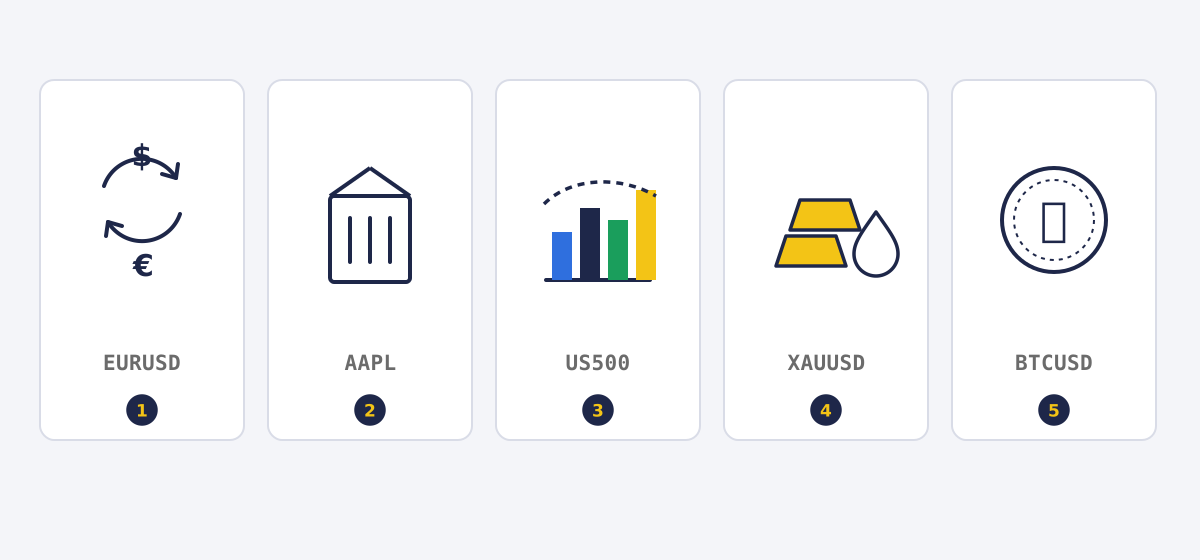
- Card 1, forex: two currencies swapped for each other, shown as EURUSD.
- Cards 2 and 3: one company (AAPL), then a basket of shares as one number (US500).
- Card 4, commodities: gold bars and an oil drop, shown as XAUUSD (gold).
- Card 5, crypto: a digital coin, shown as BTCUSD.
What are commodities?
Commodities are raw materials that are traded in bulk and are the same whoever produces them, such as gold, silver, crude oil, natural gas, wheat and coffee. Because one barrel of a given oil grade or one ounce of gold is like any other, they can be priced and traded on exchanges and through CFDs.
They fall into two groups:
| Group | What it covers | Examples | Typical symbols |
|---|---|---|---|
| Hard commodities | Mined or extracted | Gold, silver, copper, crude oil, natural gas | XAUUSD, XAGUSD, WTI, Brent |
| Soft commodities | Grown or raised | Wheat, corn, coffee, cocoa, sugar | Varies by broker |
As a CFD trader you never take delivery: you trade the price in US dollars and settle the difference in cash. Supply shocks, the US dollar and global growth drive most commodity prices, as crypto and commodity drivers explains. Oil and metal prices also move the currencies of the countries that export them; commodity currencies explains that link.
How do the main asset classes compare?
Forex, stocks, indices, commodities and crypto differ in what you are trading, how the price is quoted, what usually moves it and how it behaves. Symbols and details vary by broker, so check each instrument's contract specification on your platform.
| Asset class | What it is | How it is quoted | Example symbol | What typically drives it | What to plan for |
|---|---|---|---|---|---|
| Forex | One currency against another | Units of the second currency per one unit of the first, usually to 4 or 5 decimals (2 or 3 for yen pairs) | EURUSD | Interest rates, inflation, central bank decisions, economic data | Moves look tiny, but leverage makes them large on your deposit |
| Stocks (stock CFDs) | One company's share price | Price per share, in the currency of its exchange | AAPL | Company results and news, the wider market | Price can gap at the open after news while the market was closed |
| Indices | A basket of shares as one number | Index points | US500 | The economy, interest rates, overall market mood | Set trading hours; gaps after overnight news |
| Commodities (metals and energies) | Raw materials such as gold and oil | US dollars per unit, such as per troy ounce of gold | XAUUSD | Supply and demand, the US dollar, global events | Supply shocks can cause sudden, large moves |
| Crypto | Digital assets such as Bitcoin | Units of currency per one coin | BTCUSD | Sentiment, regulation, technology news | Extreme price swings; the tightest regulatory limits |
What moves crypto and commodity prices is covered in Module 8.
What about bonds, cash and property?
Bonds, cash and property are asset classes too, but they belong mainly to long-term investing rather than short-term trading on a platform. Investment guides usually list them first because they are the building blocks of a long-term portfolio. In short:
- Bonds (fixed income): Investor.gov describes a bond as a debt security, like an IOU. You lend to a government or company, which promises to pay interest and repay the face value when the bond matures.
- Cash and cash equivalents: money in the bank and very short-term, low-risk holdings such as money market funds.
- Property (real estate): land and buildings, owned directly or through funds.
A trading platform mostly shows the five asset classes above, because their prices are quoted and move throughout the day. Some brokers also list bond or property-related CFDs; check your platform's symbol list. The difference between holding assets for years and trading price moves is covered in trading vs investing.
When can you trade each asset class?
Each asset class trades on its own schedule, so check a symbol's trading hours before you open a position. Forex trades 24 hours a day on weekdays. Stocks and indices follow the opening hours of their exchange. Commodity and crypto hours depend on the instrument and your broker.
Forex stays open because the trading day passes from Sydney to Tokyo, London and New York. In MetaTrader 5, the symbol Specification window lists each symbol's quoting and trading sessions. How the forex sessions overlap is covered in forex market sessions.
How do you read a forex quote?
A forex quote shows how much of the second currency you need to buy one unit of the first. In EURUSD, the euro is the base currency and the US dollar is the quote currency. EURUSD at 1.1000 means one euro costs 1.10 US dollars. If the price rises, the euro has strengthened against the dollar.
What is a pip?
A pip is the standard unit for a small move in a currency pair. For EURUSD and most pairs, one pip is 0.0001, the fourth decimal place. A move from 1.1000 to 1.1001 is one pip. Many platforms show a fifth decimal, a fraction of a pip. Pips are explained fully in lots, pips and pip value.
Use the buttons below to move EURUSD up or down from 1.10000. Watch how many pips the price has moved, and whether that move would be for or against you if you had bought.
How do you work out what a price move is worth?
To work out what a price move is worth, multiply the size of the move by the size of your position. For a buy, a rise is a gain and a fall is a loss; for a sell, the sign flips. Each asset class measures the move differently: pips for forex, points for indices, and dollars per unit for gold.
The figures below are synthetic. Each position is a buy.
| Instrument | Position size | Price move | Result |
|---|---|---|---|
| EURUSD | 10,000 euros (0.10 lot), so 1 pip = $1 | 1.1000 to 1.1050 (+50 pips) | 50 × $1 = $50 gain |
| XAUUSD (gold) | 10 ounces | $2,000.00 to $1,990.00 (−$10) | 10 × −$10 = $100 loss |
| US500 (index) | $1 per index point | 5,000.0 to 5,050.0 (+50 points) | 50 × $1 = $50 gain |
Under half a percent in EURUSD made the same $50 as a 1% index move. Compare the move times your size, not the price.
To see what one pip is worth for your own position, use the pip value calculator. Lot sizes are explained in our guide to forex lot sizes.
What are the risks of trading different asset classes?
The risks of trading different asset classes come from how far each price swings, whether its market closes and reopens at a different price, and the leverage applied to it. Regulators reflect this by allowing less leverage on the more volatile assets.
When the European Securities and Markets Authority (ESMA) restricted CFDs for retail clients in 2018, it set leverage limits by underlying asset, lower for more volatile markets:
| Underlying asset | EU retail leverage limit |
|---|---|
| Major currency pairs | 30:1 |
| Non-major currency pairs, gold and major indices | 20:1 |
| Commodities other than gold, and non-major indices | 10:1 |
| Individual shares | 5:1 |
| Cryptocurrencies | 2:1 |
These are EU limits; your region and account may differ.
Two more mechanics apply to every asset class:
- Gaps and hours. You cannot close a position while its market is closed, and overnight news can make it reopen far from its close.
- Leverage. On every asset class, leverage magnifies gains and losses by the same factor. See leverage and margin.
Managing these risks, through position size and stop losses, is covered in Module 5, Risk Management.
Try it on demo
In MetaTrader 5, open Market Watch and add one symbol from each asset class: a currency pair, a share, an index, gold and a crypto pair, if your demo offers them. Right-click each one, choose Specification, and compare the contract size, the number of decimal places and the trading hours. Then watch how differently their prices move over one day.
This lesson is part of Market Basics.
Quick check
- What does the symbol EURUSD show?
- A stock index such as the S&P 500 is
- XAUUSD belongs to which asset class?
- EURUSD moves from 1.1000 to 1.1050. How many pips is that?
- Why do EU rules cap retail leverage on crypto CFDs at 2:1, lower than on major currency pairs?
Frequently asked questions
What are the main asset classes?
The traditional asset classes are stocks, bonds and cash, with property and commodities often added. Traders also count forex, stock indices and crypto. On a trading platform, the five you usually see are forex, stocks, indices, commodities and crypto.
How big is the forex market?
Very big. The BIS Triennial Survey found that FX trading reached $9.6 trillion per day in April 2025.
Is gold a commodity or forex?
Gold is a commodity, a precious metal. Its symbol, XAUUSD, looks like a currency pair because XAU is the code for gold and the price is shown in US dollars per ounce.
Can you trade stocks, forex and crypto from one account?
Often, yes. Many brokers offer CFDs on several asset classes in one MetaTrader 5 account, but the list depends on your broker, account and region.
Which asset class is best for beginners?
A practical starting point is one major forex pair, such as EURUSD: it trades 24 hours a day on weekdays, moves in pips you can measure easily and reacts to scheduled economic data. Learn how it is quoted, what moves it and what a price move is worth to you, then practise on a demo account.
Sources
- Bank for International Settlements (BIS), Global FX trading hits $9.6 trillion per day in April 2025 and OTC interest rate derivatives surge to $7.9 trillion: Triennial Survey, 30 September 2025: daily FX turnover in April 2025 and the US dollar's share of trades. https://www.bis.org/media-releases/20250930-global-fx-trading-hits-96-trillion-day-april-2025-and-otc-interest-rate-derivatives-surge-79
- LBMA, LBMA Gold Price FAQs (accessed 27 October 2026): the gold benchmark is set twice daily in US dollars, per troy ounce. https://www.lbma.org.uk/prices-and-data/lbma-gold-price/lbma-gold-price
- European Securities and Markets Authority (ESMA), ESMA agrees to prohibit binary options and restrict CFDs to protect retail investors, 27 March 2018: retail CFD leverage limits by underlying asset, varying with volatility. https://www.esma.europa.eu/press-news/esma-news/esma-agrees-prohibit-binary-options-and-restrict-cfds-protect-retail-investors
- MetaQuotes, MetaTrader 5 Help: Market Watch (accessed 27 October 2026): the symbol Specification window shows contract size, the number of decimal places and the symbol's quoting and trading sessions. https://www.metatrader5.com/en/terminal/help/trading/market_watch
- US Securities and Exchange Commission, Investor.gov, Asset Allocation and Diversification (accessed 27 October 2026): asset allocation divides investments among assets such as stocks, bonds and cash, and conditions that hurt one asset class may help another. https://www.investor.gov/introduction-investing/getting-started/asset-allocation
- US Securities and Exchange Commission, Investor.gov, Bonds - FAQs (accessed 27 October 2026): a bond is a debt security; the issuer pays interest and repays the face value at maturity. https://www.investor.gov/introduction-investing/investing-basics/investment-products/bonds-or-fixed-income-products/bonds
Practise what you learned
Open an account to use MetaTrader 5. Start on a demo account before risking real money.
Open Account