
Risk Management in Forex: A Beginner Module
Module 5
Lessons in this module
- 1Why beginners lose8 min
Most beginner traders lose money through a few fixable risk habits, such as risking too much per trade, using too much leverage, skipping the stop loss and chasing losses. Skilled traders fix each one with a rule set before the trade.
- 2Position sizing9 min
Position sizing in forex is working out how many lots to trade so that, if your stop loss is hit, you lose only the amount you chose to risk. The formula is lots = (account × risk %) ÷ (stop distance in pips × pip value per lot).
- 3Risk-reward ratio9 min
The risk reward ratio compares the loss you accept if your stop loss is hit with the gain you aim for if your take profit is hit. A 25-pip stop with a 50-pip target is 1:2, which needs at least one win in three just to break even before costs.
- 4Margin call and stop-out8 min
A margin call in forex trading is a warning that your account equity has dropped too low compared with the margin your open trades are using. If equity keeps falling to the lower stop-out level, the platform starts closing your positions for you, usually the biggest loss first.
- 5Pre-trade risk checklist8 min
A trading checklist before entering a trade is a short list of risk checks you answer every time, such as stop loss, position size, margin and news. It slows your decision and catches avoidable mistakes, so every trade you take is sized and planned.
About this module
Risk management in forex is deciding before a trade how much of your account you will risk, then sizing the position and placing the stop loss so a loss stays within that amount. Losses are normal in trading; risk management makes each one a planned, affordable cost, so the account keeps trading through a losing run.
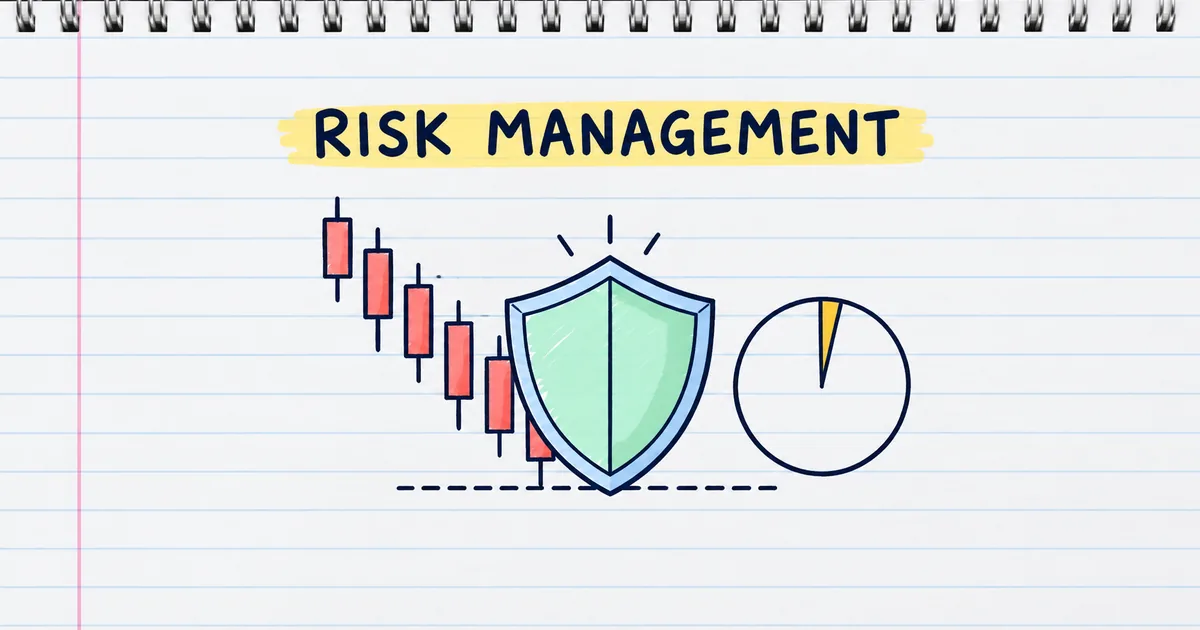
This module is the most important part of the Beginner level. You learn the habits that fix the common reasons beginners lose money, how to size a position from your account, your risk per trade and your stop distance, how to use a risk to reward ratio alongside your win rate, how margin calls and stop-outs close positions automatically (the margin level calculator lets you test your own account), and a short checklist skilled traders run before every trade.
You will use the arithmetic from Module 2, CFDs Explained, especially pip value and margin, and the stop loss skills from Module 3, MetaTrader 5 Basics. The position size calculator does the sums for you once you understand them.
What are the rules of risk management in forex?
The core rules of forex risk management are to risk a small fixed share of the account per trade, often 1-2%, set every stop loss before entry, size the position from that stop, and cap total open risk. Leverage then changes the margin used, not the money at risk.
- Fix the risk per trade as a percentage of the balance, decided before you look for a setup.
- Place the stop loss first, where the trade idea is proven wrong. The stop loss lesson shows how.
- Size the position from the stop, as the position sizing lesson explains.
- Check the reward against the risk with the risk reward ratio and your win rate.
- Watch margin and total exposure, so a margin call never closes positions for you.
How does forex risk management work on one trade?
On one trade, risk management turns a percentage into a lot size: multiply the balance by your risk percentage, divide by the stop distance in pips, then divide by the pip value per lot. The result is the largest position the plan allows.
A worked example: a $2,000 account at 1% risk can lose $20. With a 40-pip stop on EURUSD, that is $0.50 a pip. A standard lot is worth $10 a pip, so the size is 0.05 lot. If the stop is hit, the loss is $20. With an 80-pip target the gain is $40, a 1:2 risk to reward, which breaks even at a win rate of about 33%.
Why is risk management important in trading?
Risk management is important because losing runs happen to every method, and position size decides whether a run is survivable: at 1% risk, ten losses in a row cost under 10% of the account. At 10% risk, the same run costs about 65%.
Recovery is the reason. After ten 1% losses the account is down about 9.6% and needs about 10.6% to get back. After ten 10% losses it is down about 65% and needs about 187%. The why beginners lose lesson lists the habits that fix this, and the pre-trade risk checklist puts them into practice.
What do traders ask about risk management?
Traders ask four things first about forex risk management: what the 1% rule is, whether a stop loss is always needed, how leverage affects risk and how many trades to open at once. The answers below each stand alone, with links to the lessons that cover them.
What is the 1% rule in trading?
The 1% rule means risking no more than 1% of the account balance on any one trade. On $5,000 that is $50, so the position size is set so that hitting the stop loses $50 or less.
Do you always need a stop loss?
Yes, for risk you can measure. Without a stop the loss on a trade has no planned limit, and position size cannot be calculated. A stop loss sits on the broker's server, so it works with the platform closed.
How does leverage affect risk in forex?
Leverage sets how much margin a position needs, not how much you lose when the stop is hit; the lot size and stop distance decide that. High leverage lets you open larger positions than your plan allows, so size from risk first. The leverage and margin lesson has the arithmetic.
How many trades should you have open at once?
As many as keep total open risk within a cap, such as 3-5% of the account. Pairs that move together, such as EURUSD and GBPUSD, count as one larger position, as the correlation risk lesson shows.
Practise what you learned
Open an account to use MetaTrader 5. Start on a demo account before risking real money.
Open Account