
Market Basics: What Is Forex Trading? A Beginner Module
Module 1
Lessons in this module
- 1Trading vs investing12 min
Trading is buying and selling financial assets, such as currencies, shares or gold, to try to gain from price moves over minutes to weeks. Investors hold for years instead.
- 2Asset classes9 min
Asset classes are groups of investments that behave alike, such as stocks, bonds, cash, property, commodities, currencies and crypto. On a trading platform you mostly meet five: forex, stocks, indices, commodities and crypto, each quoted differently, moved by different news and usually traded as CFDs on the price.
- 3How forex brokers work10 min
A broker in forex is the firm that holds your trading account, gives you a platform and live prices, and fills your buy and sell orders. It keeps each trade’s risk or passes it to liquidity providers such as banks, earns mainly from the spread, commission and swap, and must follow its regulator’s rules on your money.
- 4Forex market sessions9 min
Forex trading sessions are the four overlapping windows when Sydney, Tokyo, London and New York are most active, keeping currencies trading 24 hours a day on weekdays. The busiest window is the London and New York overlap, about 13:00 to 17:00 UTC, which is 14:00 to 18:00 at UTC+1 and 21:00 to 01:00 at UTC+8.
- 5What moves market prices10 min
The forex market moves when demand for one currency changes against another, driven mainly by interest rates, economic data, trade flows, risk sentiment and news. Behind every move is a shift in the balance of buyers and sellers, and the biggest moves usually follow what the market did not expect.
About this module
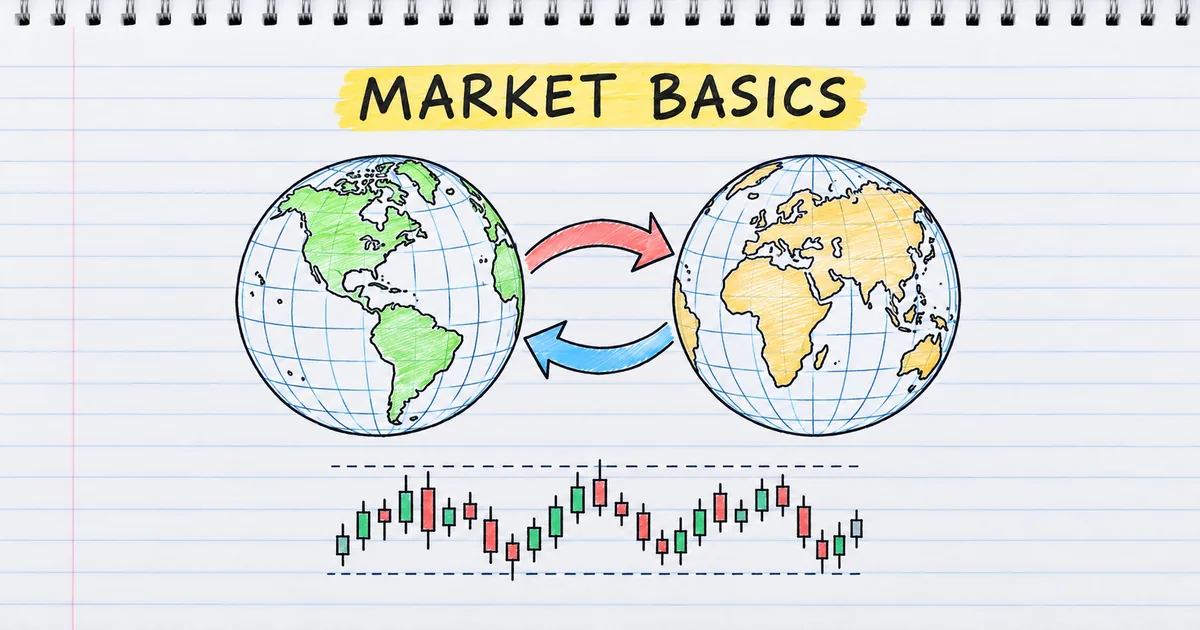
Forex trading is exchanging one currency for another, such as euros for US dollars, with the aim of gaining from a change in the exchange rate between them. Currencies are always quoted in pairs, so every forex trade buys one currency and sells the other at the same time.
Most retail traders do this through a broker, often with contracts for difference (CFDs), which let them take a position on the rate rising or falling.
This module is the starting point of the academy. It assumes no knowledge at all. In five short lessons you learn how trading differs from investing, which markets you can trade besides currencies, how a forex broker works and where its prices come from, when the trading sessions open and overlap, and what actually makes prices move. For how to start and trade from your country, see the country guides.
Work through the lessons in order. Each one answers a single question, includes a worked example and ends with a five-question quick check. When you finish, go on to Module 2, CFDs Explained, which covers the product most beginners trade and the arithmetic of leverage, pips and trading costs. For the whole route from the first lesson to a first live trade on one page, see how to trade forex online.
How does forex trading work?
Forex trading works by opening a position on a currency pair, buying if you expect the first currency to strengthen or selling if you expect it to weaken, and closing it later; the price difference is your profit or loss. A spread, the gap between the buy and sell price, is the main cost.
On EURUSD, buying 0.10 lot at 1.1000 and closing at 1.1050 gains 50 pips, and at $1 a pip that is $50. Closing at 1.0950 instead loses $50. The lessons below build each step: sizing a trade, costing it and managing it.
What do you need to start forex trading?
You need three things to start forex trading: a broker account, a trading platform such as MetaTrader 5, and enough knowledge to size and cost a trade. A free demo account with virtual money lets you practise all three before you fund a live one, and installing MetaTrader 5 takes a few minutes.
When is the forex market open?
The forex market is open 24 hours a day on weekdays, from the Sydney open on Sunday evening to the New York close on Friday night, and it is busiest when London and New York overlap. The forex market sessions lesson gives the times for each session, and the forex market hours tool shows them in your own time zone.
What do beginners ask about forex trading?
Beginners ask four things first: what forex trading is, whether it is the same as CFD trading, how much money they need and whether they can practise for free. The answers below each stand alone, with links to the lessons that cover them in full.
What is forex trading in simple terms?
Forex trading is exchanging one currency for another to gain from a change in their exchange rate. Because currencies are quoted in pairs, every trade buys one currency and sells the other, for example buying euros while selling US dollars on EURUSD.
Is forex trading the same as CFD trading?
Not exactly. Forex is the market for exchanging currencies, and a CFD is a contract that settles the price difference without delivering the asset. Most retail traders trade forex through CFDs, which the what is a CFD lesson explains.
How much money do you need to start forex trading?
Brokers set their own minimum deposit. At 0.01 lot of EURUSD a pip is worth about $0.10, so a small balance can trade at that size; how to trade forex online shows the arithmetic for a first account.
Can you practise forex trading for free?
Yes. A demo account trades virtual money at live prices, so you can practise every step before you trade with your own money.
Practise what you learned
Open an account to use MetaTrader 5. Start on a demo account before risking real money.
Open Account