
Why Do Most Beginner Traders Lose Money? Causes and Fixes
Most beginner traders lose money through a few fixable risk habits, such as risking too much per trade, using too much leverage, skipping the stop loss and chasing losses. Skilled traders fix each one with a rule set before the trade.
Module 5 · Lesson 1 of 5
What you'll learn
- The most common mistakes behind beginner losses, and the rule skilled traders use to fix each one.
- How the size of your risk per trade decides how long your account lasts.
- Why a large loss needs an even larger gain to recover.
- How a daily loss limit stops a losing run from becoming a deep drawdown.
Why do most beginner traders lose money?
Most beginner traders lose money because of a few fixable risk habits: positions that are too large, no stop loss, chasing losses, trading too often and no written plan. Skilled traders fix each one with a rule set before the trade, such as a small fixed risk per trade, a stop on every entry and a daily loss limit.
Each of these causes is a habit rather than a talent, so it responds to practice. The rest of this lesson takes each habit, gives the rule that fixes it, and shows with numbers why the rule works: how risk per trade decides how long an account lasts, why losses take bigger gains to recover, and how chasing losses deepens a drawdown.
What are the most common mistakes beginners make?
The most common beginner mistakes are about risk, not about picking direction: positions that are too large, no stop loss, chasing losses, trading too often and trading without a plan. Skilled traders answer each one with a simple rule, set before the trade, that keeps every loss to a small, planned size.
| Mistake | The fix skilled traders use | What the fix prevents |
|---|---|---|
| Too much leverage, position too large | Size each position from your account and stop distance | A small price move becoming a large share of the account |
| Risking too much per trade | Decide a small, fixed risk per trade before you enter | A short losing run taking a big part of the account |
| No stop loss, or moving it further away | Set a stop loss on entry and keep it where you set it | One loss growing far past what you planned |
| Closing winners early, holding losers | Set the stop and target before entry and follow them | Average losses ending up bigger than average gains |
| Chasing losses | Stop for the day after a set number of losses | A bigger next trade and a deeper next loss |
| Trading too often | Trade only setups your plan allows | Spread, commission and swap adding up on every trade |
| No written plan | Write entry, exit and risk rules before trading | Decisions made on emotion in the moment |
| Real money before practice | Practise on demo first and log every trade | Platform and planning mistakes costing real money |
| Unrealistic expectations | Treat early trading as learning, measured in habits | Bigger risks taken to hit an income target |
| Several open trades that move together | Add up total open risk before each new trade | Several stops being hit at once |
Leverage itself is explained in the leverage and margin lesson, and stop placement in the stop loss and take profit lesson.
What is risk per trade?
Risk per trade is the amount you would lose if the trade hits your stop loss, written as a percentage of your account. If a $1,000 account would lose $10 at the stop, the risk per trade is 1% of the account.
How does risking 10% compare with risking 1% per trade?
Risking 10% per trade can cost about 41% of an account in five straight losses, while risking 1% costs about 5%. Losing runs are a normal part of trading, so skilled traders keep each loss small and the account stays ready for the next setup.
A $1,000 account loses five trades in a row, each loss a fixed percentage of the balance at the time.
| Trade | Balance risking 10% | Balance risking 1% |
|---|---|---|
| Start | $1,000.00 | $1,000.00 |
| Loss 1 | $900.00 | $990.00 |
| Loss 2 | $810.00 | $980.10 |
| Loss 3 | $729.00 | $970.30 |
| Loss 4 | $656.10 | $960.60 |
| Loss 5 | $590.49 | $950.99 |
At 10% per trade, $409.51 is gone and the account needs a 69.35% gain to get back to $1,000. At 1% per trade, $49.01 is gone and it needs a 5.15% gain.
The position size calculator turns a chosen risk per trade into a position size. The full method is in the position sizing lesson.
Why are losses harder to recover than they look?
Losses are harder to recover because each gain is earned on a smaller balance. After a 10% loss, $900 has to grow by $100, which is 11.1% of $900. The deeper the loss, the faster the gain you need rises, so a 50% loss needs a 100% gain.
| Loss | Gain needed to get back to the start |
|---|---|
| 10% | 11.1% |
| 20% | 25.0% |
| 30% | 42.9% |
| 50% | 100.0% |
| 75% | 300.0% |
The formula is: gain needed = loss ÷ (100% − loss). For a 30% loss, 30 ÷ 70 = 42.9%.
What is drawdown?
Drawdown is the fall in your account from its highest point to its lowest point before it recovers, usually given as a percentage. An account that peaks at $1,000 and falls to $700 has a 30% drawdown, and needs a 42.9% gain to reach $1,000 again.
What happens when you chase losses?
Chasing losses means trading again quickly, often with a bigger position, to win back money you just lost. It is also called revenge trading. Because the position grows each time, every new loss is deeper than the last, so the account shrinks fast.
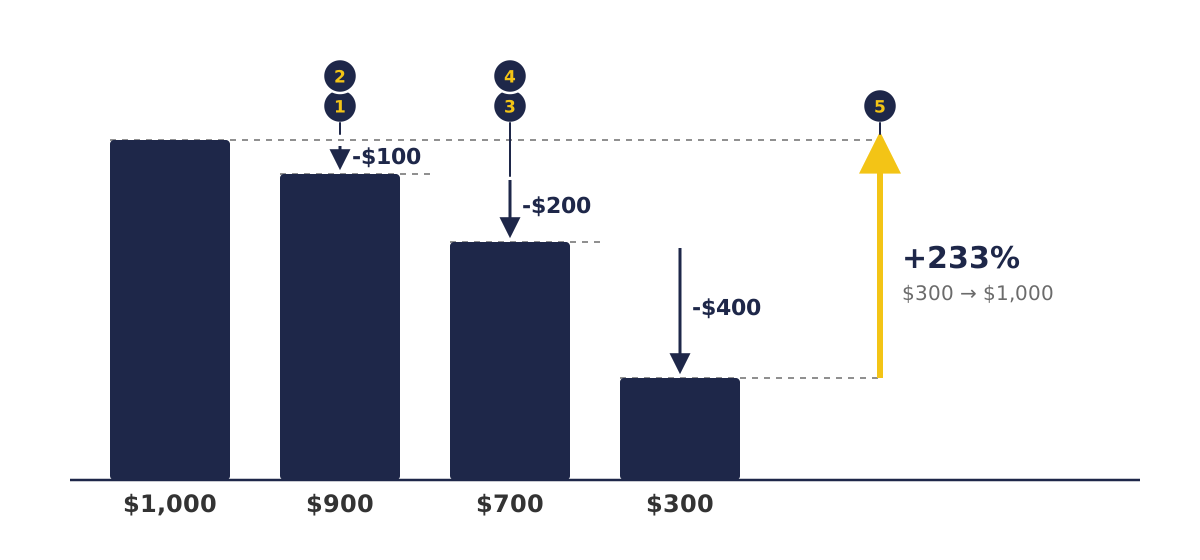
- An ordinary loss of $100, or 10%, takes the account from $1,000 to $900.
- The trader doubles the risk to $200 to win the loss back.
- That trade also loses, so the drop is twice as deep: $900 to $700.
- The risk doubles again to $400, and the third loss leaves $300.
- Getting from $300 back to $1,000 needs a gain of $700, which is 233%.
Three losing trades took 70% of the account. At 1% risk per trade, the same three wrong calls would have cost less than $30. The fix skilled traders use is a daily loss limit: after a set number of losses, they stop and review instead of trading again. Trading on emotion rather than a plan, including the fear of missing out, is covered later in Module 11, and the thinking errors behind it in Module 16.
How do trading costs add up when you trade often?
Trading costs add up because you pay the spread, and any commission, on every trade, whether it wins or loses. Swap is added for every night a position stays open. Each cost is small, but many trades a day add up to a steady drain.
The SEC notes that day traders have high expenses and should know how much they need to make just to cover them and break even. Skilled traders keep this drain small by taking only the setups their plan allows. How to work out these costs in money is in the spread, commission and swap lesson.
How do skilled traders handle losses that still happen?
Skilled traders handle losses by planning for them: every trade has a stop loss and a fixed risk, so each loss is a known, small cost. Five losses in a row at 1% risk cost about 5%. A stop can fill at a worse price in a fast or gapping market, so they allow for that around major news.
They also move from demo to live trading at a small size, because real money brings emotions a demo does not, and they keep the same rules they practised. The full route, from demo practice to sizing and placing a live trade, is laid out step by step in how to trade forex online. Every lesson in the Risk Management module builds on this one.
Try it on demo
On your MetaTrader 5 demo account, open the History tab in the Toolbox and look at your closed trades. For each one, write down the loss or gain as a percentage of the balance at the time. Large or uneven percentages show the habit this module helps you fix.
Quick check
- A $1,000 account would lose $10 if the stop loss is hit. What is the risk per trade?
- An account falls 50%. What gain does it need to get back to the start?
- A $1,000 account risks 10% of its balance on each trade and loses five in a row. What is left?
- Revenge trading means
- Why do frequent trades cost more over time?
Frequently asked questions
How do I stop losing money in trading?
Start with the risk habits, because they decide the size of every loss. Fix your risk per trade at a small percentage, set a stop loss on every entry, stop for the day after a set number of losses, and trade only the setups in your written plan. Log every trade so you can see which habit slips.
Why is trading so hard for beginners?
Trading feels hard for beginners because the biggest challenges are about money and emotion, not chart reading. Leverage magnifies results in both directions, costs are paid on every trade, and a loss creates pressure to trade bigger and faster. Fixed risk rules, set before the trade, take that pressure out of each decision.
How much should a beginner risk per trade?
A common rule of thumb is the 1% rule: risk no more than 1% of the account on any one trade, so a $1,000 account risks at most $10. This module uses 1% in its examples, and the position sizing lesson shows how to turn any percentage into a position size.
Should beginners practise on a demo account first?
Yes. A demo account lets you learn the platform and test your risk rules with virtual money. When you move to a live account, start with small sizes, because real money brings emotions a demo does not, and keep the same rules you practised.
Can you recover from a big trading loss?
Recovery is possible, but it takes a bigger gain than the loss looks, because the gain is earned on a smaller balance. A 50% loss needs a 100% gain and a 75% loss needs a 300% gain. Trading bigger to recover fast deepens the drawdown, so skilled traders keep their normal risk per trade.
Sources
- U.S. Securities and Exchange Commission (SEC), Day Trading: Your Dollars at Risk, 20 April 2005: day traders have high expenses and should know how much they need to make to cover them and break even. https://www.sec.gov/about/reports-publications/investor-publications/day-trading-your-dollars-at-risk
Practise what you learned
Open an account to use MetaTrader 5. Start on a demo account before risking real money.
Open Account