
What Is a CFD? CFD Trading Meaning, With Examples
CFD trading is buying or selling contracts for difference, agreements with a broker to settle in cash the change in an asset’s price, without owning the asset. You can take a position on a rise or a fall, and leverage magnifies gains and losses on the money you put down.
Module 2 · Lesson 1 of 5
What you'll learn
- What CFD trading is, in one sentence.
- How a CFD trade is opened, closed and settled.
- The difference between forex and CFDs, and how a CFD compares with shares and futures.
- How to work out the profit or loss and the costs of a CFD trade.
- Three worked CFD trades: gold, EURUSD and the US30 index.
- Whether forex and CFD trading is risky, and how traders manage leverage, gaps and margin.
- The steps to start trading CFDs.
What is CFD trading?
CFD trading is opening and closing contracts for difference (CFDs): agreements with a broker to settle in cash the change in an asset's price between when you open and close a trade. You never buy or own the asset. If the difference goes your way, the provider pays you; if it goes against you, you pay the provider.
Three terms come up straight away:
- Underlying asset: the thing whose price the CFD tracks, such as a currency pair, gold, a stock index or a company's share.
- Derivative: a contract whose value comes from something else. A CFD is a derivative because its value comes from the underlying asset, not from anything you hold.
- Position: an open CFD trade. It stays open until you close it, or until it is closed for you.
Think of settling a bet on tomorrow's temperature. You do not own the weather. You only settle the difference between where it started and where it ended.
CFDs are generally used to trade price moves rather than to buy and hold, which is why every lesson in this module works through the arithmetic of a trade from open to close.
How does a CFD trade work?
A CFD trade works in three steps: you open a position with a direction and a size, hold it while its result moves with the price, and close it for a cash settlement. The settlement is the price difference multiplied by your size, and nothing is delivered to you.
- Open. You choose an instrument, a direction and a size. Buying (going long) means you expect the price to rise. Selling (going short) means you expect it to fall.
- Hold. While the position is open, its profit or loss moves with the price of the underlying asset. You put down only a deposit, called margin, rather than the full value of the position.
- Close. You close the position, and the difference between the opening and closing price, multiplied by your size, is added to or taken from your account. Nothing is delivered to you.
Because you settle a difference rather than take delivery of an asset, a CFD lets you take a position on a falling price as easily as on a rising one. How selling first works is explained in going long and short.
Because you only put down margin, a CFD is also a leveraged product, covered in leverage and margin. To see how much margin a given position needs, try the margin calculator.
Why do people trade CFDs?
People trade CFDs to profit from falling as well as rising prices, to control a larger position with a smaller deposit, and to reach forex, gold, indices and shares from one account. Some also use them to hedge, offsetting possible losses on assets they already own.
Each reason comes with something to manage:
| Reason | What to manage |
|---|---|
| Take a view on a falling price (go short) | A rise works against a short for as long as it lasts, so plan the exit before you open |
| Smaller deposit (margin) | Profit and loss are worked out on the full position, so results are magnified on the money you put down |
| Many markets from one account | Each instrument has its own contract size, trading hours and costs to learn |
| Hedging an existing holding | The hedge has its own costs, and its size needs to match the holding it offsets |
A simple hedge: someone who owns shares and expects a short dip sells a CFD on the same share. If the price falls, the gain on the CFD offsets part of the fall in the shares. If the price rises, the loss on the CFD offsets part of the gain.
What can you trade as a CFD?
You can trade CFDs on forex pairs, metals such as gold, energies such as crude oil, stock indices and individual company shares. The exact list, contract sizes and trading hours depend on your broker and account. How these markets differ from one another is covered in trading asset classes.
- Forex: currency pairs such as EURUSD or USDZAR.
- Metals: such as gold (XAUUSD, covered in how to trade gold on MT5) and silver.
- Energies: such as crude oil.
- Indices: a single price that tracks a basket of shares, such as the S&P 500 or the Dow Jones CFD known as US30. What are indices explains how they are built.
- Shares: individual company shares, traded as stock CFDs.
Symbol names and specifications vary between brokers, and each symbol's specification on your platform lists its exact contract size, trading hours and costs. The KCM Trade Help Center explains what contract for difference (CFD) trading is at KCM, including contract specifications.
What is the difference between forex and CFDs?
Forex is the market for exchanging currencies, while a CFD is a contract that settles a price change in cash; many online brokers offer forex as CFDs on currency pairs. So trading EURUSD online usually means a CFD on the exchange rate: you settle the difference and no currency is delivered to you.
| Forex (exchanging currencies) | CFDs | |
|---|---|---|
| What it is | A market: buying one currency with another | A type of contract: it settles an asset's price change in cash |
| What you can trade | Currency pairs only | Currency pairs, gold, oil, indices, shares and more |
| What changes hands | The currencies themselves, as at a bank or exchange bureau | Only the cash difference between the opening and closing price |
| How you trade it online | Through a forex account with a broker, often as a CFD on the pair | Through a CFD account with a broker, on MetaTrader 5 |
The arithmetic is the same either way. On 0.10 lot of EURUSD, where a pip is worth $1, a 20-pip move is 20 × $1 = $20, gained or lost depending on your direction. Lots, pips and pip value shows the pip value for any size, and going long and short shows how the direction decides the sign.
How is a CFD different from shares and futures?
A CFD is a contract with your broker, while a share is part-ownership of a company and a future is an exchange contract with a fixed size and expiry date. With a CFD you get no voting rights, you can go short as easily as buy, you put down only margin, and you pay overnight swap.
| CFDs | Futures | Shares | |
|---|---|---|---|
| What you hold | A contract with your broker | A standardised contract traded on a futures exchange | Part-ownership of a company |
| Expiry | None on most forex, spot gold and cash index CFDs; CFDs based on futures expire | A fixed expiry date, often monthly or quarterly | None |
| Position size | Flexible; the minimum and the step are in each symbol's specification in MT5 | A fixed contract size set by the exchange | Whole shares, or fractions at some brokers |
| Leverage | Yes, through margin set per account | Yes, through margin set by the exchange and broker | Not usually |
| Going short | Yes, as easily as buying | Yes | Only by borrowing the shares, where offered |
| Cost of holding | Overnight swap for each night | No swap; moving to the next expiry (rolling) means closing one contract and opening another | None for holding |
| Dividends | A cash adjustment: credited on a buy, debited on a sell | Not paid; expected dividends are built into the futures price | Paid to you as the owner |
| Where you trade it | With your broker, on MetaTrader 5 | On the exchange, through a futures broker | On a stock exchange, through a stockbroker |
| Voting rights | No | No | Yes |
| Suited to holding for years | Rarely, as swap builds up | Only by rolling each expiry | Can be |
The US Commodity Futures Trading Commission defines a futures contract as an agreement to buy or sell a commodity for delivery in the future, at a price set when the contract starts, which can be settled by delivery or by an offsetting trade. A CFD never involves delivery, and on most symbols there is no date by which you must close. It is agreed directly with your broker over the counter (OTC), not on an exchange.
The key point: a CFD can track a share's price closely, but you never own the share, and every night you keep the position open adds a financing charge or credit.
How do dividends affect share and index CFDs?
A share CFD does not pay you the dividend itself; instead the broker makes a cash adjustment on the ex-dividend date, crediting a buy position and debiting a sell position. Index CFDs get the same kind of adjustment when companies in the index pay.
The share price usually drops by about the dividend when the share goes ex-dividend, so the adjustment keeps a CFD in step with owning the share. You hold a buy CFD on 200 shares and the company pays $0.40 a share: your account is credited 200 × $0.40 = $80. A sell CFD on the same 200 shares is debited $80. Some brokers credit a buy with less than the full dividend to reflect withholding tax, and your account terms state the rate.
Other corporate actions are handled by adjusting the position so its value does not change. In a 2-for-1 share split, a buy CFD on 200 units at $50 becomes 400 units at $25, still worth $10,000. Share CFDs around company results are covered in earnings and stock CFDs.
How do you work out profit or loss on a CFD?
To work out a CFD's profit or loss, multiply the price difference between opening and closing by the number of units, then take off the spread, commission and any swap. A buy gains when the price rises; a sell gains when it falls.
Profit or loss = (closing price − opening price) × number of units, for a buy. For a sell, use (opening price − closing price) × number of units.
A share is priced at $50. You expect a rise and buy a CFD on 100 units. The position is worth 100 × $50 = $5,000. Suppose the margin needed is 20% of the position's value (5:1 leverage), so $1,000 is set aside from your account.
| What happens | Price difference | Result on 100 units | As a share of the $1,000 margin |
|---|---|---|---|
| Price rises to $55 | +$5 | $500 gain | +50% |
| Price falls to $45 | −$5 | $500 loss | −50% |
| Price falls to $40 | −$10 | $1,000 loss | −100% |
The share only moved 10% in either of the first two rows, but the result was half of the money you put down. That is leverage at work, and it cuts both ways.
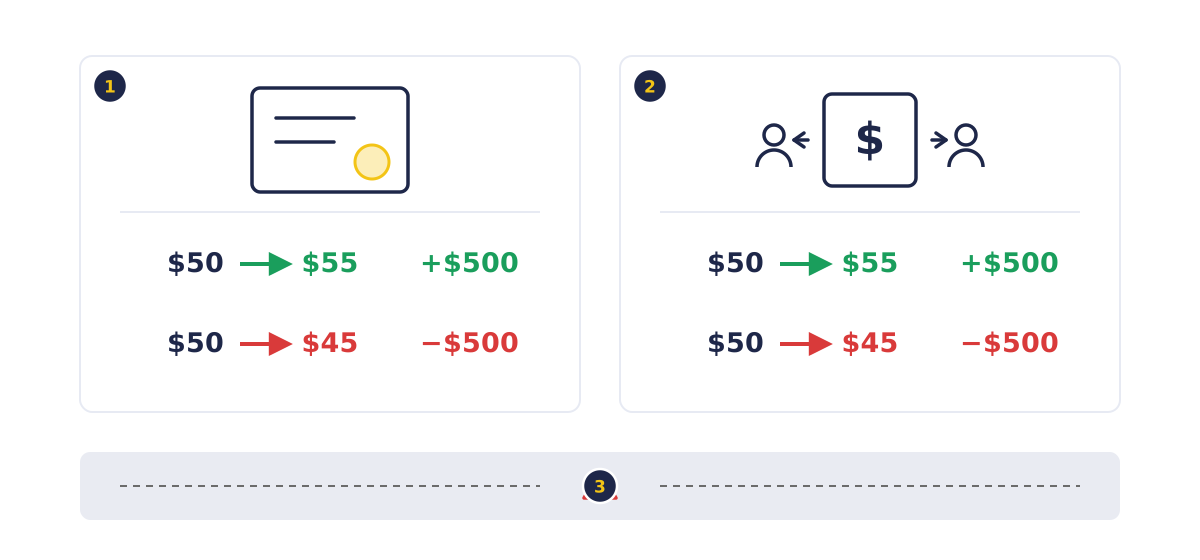
- Owning 100 shares bought at $50: a rise to $55 is a $500 gain, and a fall to $45 is a $500 loss.
- A CFD on 100 units opened at $50: the same moves give the same $500 gain or $500 loss, settled in cash, without owning the share.
- With the CFD you put down only margin, so the same $500 is a bigger share of the money you committed.
For forex pairs, the pip value calculator shows what each price step is worth in your account currency.
What are some CFD trading examples?
Three CFD trading examples, a gold buy, a EURUSD sell and a US30 index buy, show the same arithmetic: price move times size, minus costs, with margin set by leverage. Each uses a common contract size, and the net results are +$247, +$195 and −$125.
| Trade | Size | Margin set aside | Price move | Gross result | Costs | Net result |
|---|---|---|---|---|---|---|
| Buy gold (XAUUSD) at 4,000.00, close at 4,025.00 the same day | 0.10 lot = 10 ounces | $400 at 1:100 | +$25.00 an ounce | +$250 | $3 spread | +$247 |
| Sell EURUSD at 1.0850, close at 1.0810 the same day | 0.50 lot = €50,000 | $542.50 at 1:100 | 40 pips lower, in your favour | +$200 | $5 spread | +$195 |
| Buy US30 at 45,000, close at 44,880 the next day | 1 lot at $1 a point | $2,250 at 1:20 | 120 points lower | −$120 | $3 spread + $2 swap | −$125 |
Example 1: buying gold
You expect gold to rise and buy 0.10 lot of XAUUSD at 4,000.00. With 100 ounces per lot, you hold 10 ounces, so each $1 move is worth $10. The position is worth 10 × $4,000 = $40,000, and at 1:100 leverage $400 is set aside as margin. You close at 4,025.00: 10 × $25 = $250, less a $0.30 spread on 10 ounces ($3), is $247. A 0.6% move in gold was worth 62% of the margin. Gold sizes and costs are covered in how to trade gold on MT5.
Example 2: selling EURUSD
You expect the euro to weaken against the dollar and sell 0.50 lot of EURUSD at 1.0850. One standard lot is 100,000 euros, so you are short €50,000, and each pip (0.0001) is worth $5. The position is worth 50,000 × 1.0850 = $54,250, and at 1:100 the margin is $542.50. You close at 1.0810, 40 pips lower: 40 × $5 = $200, less a 1-pip spread ($5), is $195. Because you sold first, the fall is your gain. Pip values for other sizes are in lots, pips and pip value.
Example 3: buying an index
You buy 1 lot of US30 at 45,000 on a contract worth $1 per point. The position is worth $45,000, and at 5% margin (1:20) $2,250 is set aside. You hold one night and close at 44,880, 120 points lower: −120 × $1 = −$120, less a 3-point spread ($3) and one night's swap at −$2.00 per lot, is −$125. The index fell 0.27%, which was 5.6% of the margin. The contract is explained in the US30 guide.
The three trades show the pattern: the result is worked out on the full position, the costs are paid whether the trade wins or loses, and swap only appears when a position is held past the daily rollover. The margin calculator gives the margin for your own size, price and leverage.
What does CFD trading cost?
CFD trading costs the spread on every trade, commission on some accounts and instruments, and overnight financing, called swap, for each night a position stays open. The spread is the gap between the ask and the bid, and the spread and any commission are paid whether a trade wins or loses.
| Cost | When it applies |
|---|---|
| Spread | On every trade, built into the buy and sell prices |
| Commission | On some accounts and instruments, either per trade (opening and closing) or as a general charge |
| Overnight financing (swap) | Each night a position is held open |
| Other charges | Some providers charge account fees, and taxes depend on where you and the provider are based |
Skilled traders count these costs in every trade plan, and the trading cost calculator adds them up for one trade. How each one is worked out is covered in spread, commission and swap. Traders who ask whether paying swap is acceptable under Islamic rules can read is forex trading halal.
How long can you keep a CFD open?
Most CFDs on forex, spot gold and cash indices have no expiry date, so a position stays open until you close it or margin runs out. Swap is applied at each daily rollover. CFDs based on futures, such as some oil symbols, expire and are closed or rolled on a set date.
Swap is set per symbol, with separate rates for buy (long) and sell (short) positions, and it can be a charge or a credit. MT5 applies a multiplier for each weekday, and on many accounts Wednesday's rollover is charged three times to cover the weekend. Holding the gold buy from Example 1 from Monday to the following Monday at a long swap of −$6.00 per lot per night crosses five rollovers, one of them triple, so seven nights' charges: 7 × (−$6.00 × 0.10) = −$4.20.
In MetaTrader 5, right-click a symbol in Market Watch and choose Specification to see its swap long, swap short, the swap multiplier for each weekday and, for a futures-based CFD, its last trading day. How swap is worked out is covered in spread, commission and swap, and how traders use it in carry trade and swap.
Is forex and CFD trading risky?
Forex and CFD trading carries risk because leverage magnifies losses as well as gains on your margin, and traders control it with position size, a stop loss on every trade and spare margin. Each risk below has a matching control you set before the trade opens.
Here is each risk and how traders handle it:
- Leverage. A small move in the price is a large share of your margin. On the trade above, a 20% fall used up the whole $1,000. Position size is the control: a smaller position means a smaller swing.
- Losses beyond your deposit. A fast or gapping market can push a loss past the money in your account. Negative balance protection limits losses to the funds in the account; your account terms state whether yours has it.
- Positions closed for you. If your account no longer has enough margin, the provider closes positions at the current price, even if the price later recovers; margin call and stop out explains the levels. Keeping free margin in reserve keeps the exit decision with you, and the margin level calculator shows how much room you have.
- Costs over time. Spreads, commission and overnight financing come off every result, so they belong in every trade plan.
Position size and stop losses are the core tools, and they are the subject of Module 5, Risk Management. A stop loss caps the planned loss; when prices move very fast or a market is closed, it fills at the next available price, which can be beyond the level you set.
Try it on demo
In MetaTrader 5, open Market Watch, right-click any symbol and choose Specification. Note the contract size, the currency the profit is calculated in, the swap rates and the trading hours. These are the terms of a CFD, not a share certificate. Then open a small demo position on that symbol, watch the profit or loss change with the price, and close it.
This lesson is the first in CFDs Explained. Next, learn how to trade a falling price in going long and short.
How do you start trading CFDs?
To start trading CFDs, learn how leverage and margin work, practise on a free MetaTrader 5 demo account, then open a live account and trade the same plan at a small size. The seven steps below take you from the mechanics to your first live trade.
- Learn the mechanics. Finish this module: going long and short, leverage and margin and spread, commission and swap.
- Set up MetaTrader 5 with a demo account. Install MetaTrader 5 on your computer or phone and log in to a demo account, which trades live prices with practice money.
- Pick one market. Start with one symbol, such as EURUSD, gold or US30, and read its Specification: contract size, trading hours, spread and swap.
- Size the trade from your risk. Decide how much of your balance one trade can lose, then use the position size calculator to turn that and your stop distance into lots. The method is in position sizing.
- Set a stop loss and take profit on every trade. Place them in the order window before you click Buy or Sell, as place your first trade on MT5 shows, and see stop loss and take profit for where to put them.
- Practise and review. Run the same routine on demo for a few weeks and note each trade's entry, exit, size, costs and result.
- Open a live account. When the routine is second nature, open and fund a live account and trade the same plan at your smallest size. The Open Account button on this page takes you to the form.
Quick check
- What does a CFD settle when you close it?
- You open a CFD on a share. What do you hold?
- A CFD is called a derivative because
- You open a CFD on 200 units at $20 and close at $18. Before costs, the result is
- Compared with owning a share outright, a leveraged CFD on that share
Frequently asked questions
What does CFD stand for?
CFD stands for contract for difference. The name describes what the contract does: it settles the difference between the opening and closing price of an underlying asset in cash.
How do CFD providers make money?
CFD providers make money mainly from the costs you pay: the spread, commission, overnight financing and any account fees. How a broker sources prices and fills orders is covered in brokers and liquidity providers.
What is the smallest CFD trade you can open?
It depends on the symbol. In MetaTrader 5, each symbol's Specification lists its minimal volume and volume step; on forex pairs the minimum is often 0.01 lot, which is 1,000 units of the base currency. Gold, index and share CFDs have their own minimums.
Can you lose more than your deposit trading CFDs?
Yes, unless your account has negative balance protection. A fast or gapping market can take a leveraged loss past the money in your account. Your account terms state whether you have it.
Is CFD trading suitable for beginners?
Yes, when you learn the mechanics first. CFDs are complex products, so start with how leverage and margin work, how to size a position and how spread, commission and swap come off each result. Then practise every step on a MetaTrader 5 demo account before you trade a live account.
Sources
- Commodity Futures Trading Commission (CFTC), CFTC Glossary, accessed 26 October 2026: a futures contract is an agreement to buy or sell a commodity for delivery in the future, at a price set at the start of the contract, that may be satisfied by delivery or offset. https://www.cftc.gov/LearnAndProtect/AdvisoriesAndArticles/CFTCGlossary/index.htm
- Australian Securities and Investments Commission (ASIC), Moneysmart, Thinking of trading contracts for difference (CFDs)? (accessed 27 October 2026): CFD buyers are credited and sellers debited an amount mirroring dividends. https://static.moneysmart.gov.au/files/publications/thinking-of-trading-in-contracts-for-difference-cfds.pdf
- MetaQuotes, MetaTrader 5 Help: Market Watch (accessed 27 October 2026): the symbol Specification, opened from the Market Watch context menu, lists contract size, minimal volume and volume step, swap long and swap short, a swap multiplier for each weekday (the help's example triples Wednesday's swap), the last trade date and the trading sessions. https://www.metatrader5.com/en/terminal/help/trading/market_watch
Practise what you learned
Open an account to use MetaTrader 5. Start on a demo account before risking real money.
Open Account