
US30: What It Is and How the Dow Jones CFD Is Traded
US30 is the symbol many brokers use for a CFD on the Dow Jones Industrial Average, a price-weighted index of 30 large US blue-chip companies. It is quoted in index points, each worth a fixed amount per lot, and moves most around the New York open, earnings, Federal Reserve decisions and major US data.
US30 is the symbol many brokers use for a contract for difference (CFD) on the Dow Jones Industrial Average, an index that tracks 30 large US companies. Trading US30 means taking a position on the index rising or falling, settled in cash, without owning any of the 30 shares.
It is quoted in index points, and what each point is worth depends on the contract size your broker sets.
This guide explains the index behind the symbol, how a US30 price is quoted, when it is most active, what moves it, what it costs and how to place the trade in MetaTrader 5 (MT5). The usual path is to learn these, practise on an MT5 demo account, then trade live with the same steps. Contract size, margin and swap are set per account, and MT5's Specification window shows the figures for yours; the examples below use round numbers so the arithmetic is easy to follow.
What is US30?
US30 is a broker's name for a CFD that tracks the Dow Jones Industrial Average (DJIA), often just called the Dow. S&P Dow Jones Indices, which runs the index, describes it as a price-weighted measure of 30 US blue-chip companies covering all industries except transportation and utilities. The 30 in US30 is the number of companies.
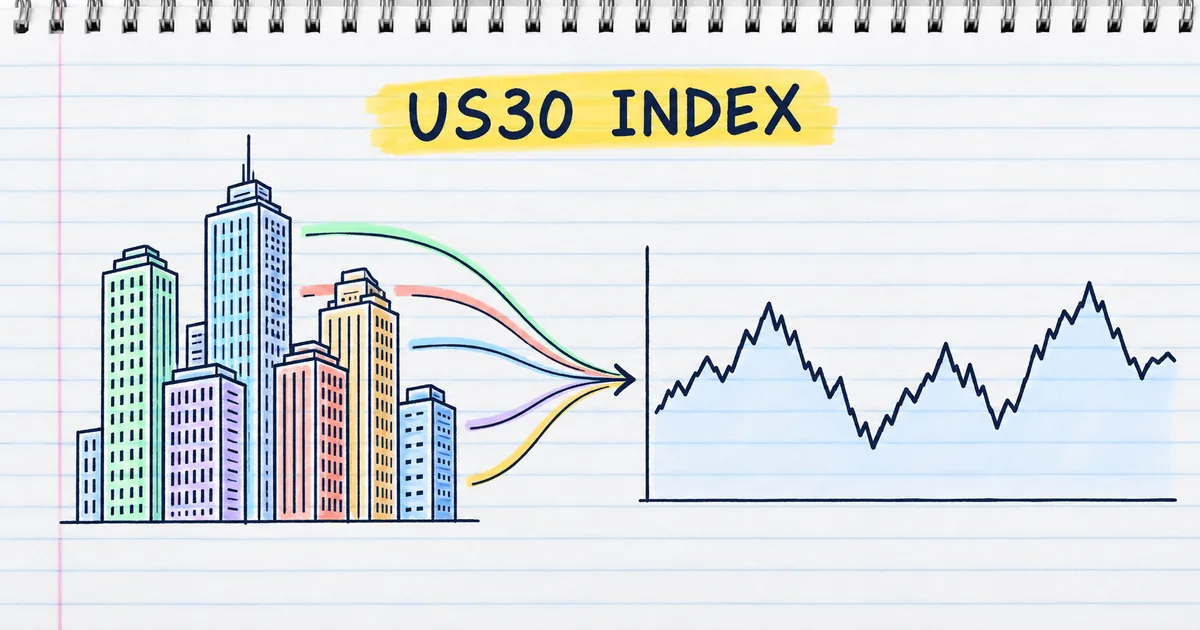
Some platforms label the same instrument DJ30, WS30 or Wall Street 30. The name is a broker convention, not an exchange ticker, so the symbol you see may differ from the one in this guide.
Like any CFD, a US30 position is a contract with your broker, not a holding of shares. You can take a long position (expecting a rise) or a short one (expecting a fall). How CFDs work in general is covered in what is a CFD, and how indices sit alongside forex, metals and shares is covered in asset classes. How US30 compares with US500, NAS100, GER40 and UK100 is set out in what are indices.
How is the Dow Jones calculated?
The Dow is calculated by adding up the share prices of its 30 companies and dividing the total by a number called the divisor. Because it uses share prices rather than company size, it is called price-weighted: a stock with a high share price moves the index more than a stock with a low one, regardless of company size.
S&P Dow Jones Indices adjusts the divisor when a company splits its shares or the list of companies changes, so that those events do not on their own move the index. The Dow Jones Averages methodology gives the index's first value as 40.94 on 26 May 1896.
An example of price weighting, using round share prices and a divisor of 0.16 (the real divisor is published by S&P Dow Jones Indices and changes over time):
| What happens | Price change | Effect on the index |
|---|---|---|
| A $500 stock rises 1% | +$5 | +$5 ÷ 0.16 ≈ +31 points |
| A $50 stock rises 1% | +$0.50 | +$0.50 ÷ 0.16 ≈ +3 points |
| Any stock rises by $1 | +$1 | +$1 ÷ 0.16 ≈ +6 points |
The same 1% move adds about ten times as many points when it happens in the higher-priced stock. That is why a single expensive share can push the Dow up or down on a day when most of the other 29 barely move.
Who chooses the 30 Dow companies?
The 30 companies are chosen by a committee, not by a formula. The methodology says the index is maintained by the Averages Committee, made up of three representatives of S&P Dow Jones Indices and two of The Wall Street Journal.
Stock selection is not governed by quantitative rules. A company is typically added if it has an excellent reputation, shows sustained growth and is of interest to a large number of investors. Because the index is price-weighted, the committee also looks at share price and monitors whether the highest-priced stock costs more than 10 times the lowest. When the list changes, a US30 CFD follows the index as it is from then on.
How is US30 quoted, and what is a point worth?
US30 is quoted in index points, and the profit or loss on a position is the number of points the price moves multiplied by the value of one point for your position size. The value of a point per lot is set by your broker: some set 1 lot to $1 per point, others to $10 or more.
Profit or loss = points moved × value per point per lot × number of lots, for a buy. For a sell, the sign flips. You find the value per point in the symbol's contract specification.
Worked example: one US30 trade in both directions
The example uses a contract where 1 lot is worth $1 per index point, a US30 price of 45,000 and margin of 5% of the position value (1:20 leverage).
You open 2 lots at 45,000. The position value is 45,000 × $1 × 2 = $90,000, and the margin set aside is 5% of that, $4,500. Each point is worth $2 on 2 lots. A buy gains when the index rises and a sell gains when it falls:
| US30 moves to | Points moved | Buy 2 lots | Sell 2 lots |
|---|---|---|---|
| 45,300 | +300 | +$600 | −$600 |
| 44,700 | −300 | −$600 | +$600 |
| 45,900 | +900 | +$1,800 | −$1,800 |
| 44,100 | −900 | −$1,800 | +$1,800 |
Costs come off every row. With a 3-point spread, 2 lots cost 3 × $2 = $6 to open, so a buy closed the same day at 45,300 nets $600 − $6 = $594, and one closed at 44,700 nets −$600 − $6 = −$606.
Margin, free margin and stop-out are explained in leverage and margin. To see the margin for your own size and contract, choose Other in the margin calculator and enter the contract size from your specification.
When does US30 trade?
The Dow is calculated during US exchange hours, 9:30 a.m. to 4:00 p.m. New York time on weekdays, but a US30 CFD may be quoted for longer, depending on your broker. The US Securities and Exchange Commission (SEC) gives 9:30 a.m. to 4:00 p.m. Eastern Time as regular trading hours for US exchange-listed stocks.
The NYSE closes early on some days, such as the day after Thanksgiving, and is shut on US market holidays. The offsets in the table below stay fixed all year, but US clocks change, from the second Sunday of March to the first Sunday of November. So the US regular session moves by an hour in local time twice a year:
| US clocks | 9:30 a.m. to 4:00 p.m. ET in UTC | UTC+1 (West and Central Africa) | UTC+2 (Southern Africa) | UTC+7 (mainland Southeast Asia) | UTC+8 (maritime Southeast Asia and East Asia) |
|---|---|---|---|---|---|
| Daylight time (March to early November) | 13:30 to 20:00 | 14:30 to 21:00 | 15:30 to 22:00 | 20:30 to 03:00 | 21:30 to 04:00 |
| Standard time (early November to March) | 14:30 to 21:00 | 15:30 to 22:00 | 16:30 to 23:00 | 21:30 to 04:00 | 22:30 to 05:00 |
Outside those hours, many brokers keep quoting US30, sometimes with a short daily break, with fewer people trading and wider spreads. Your platform's server clock may also differ from your local time. In MetaTrader 5, the symbol's Specification window lists its quoting and trading sessions for each day of the week. How the wider trading day fits together is covered in forex trading sessions.
Why does US30 move so much at the New York open?
US30 often moves sharply around 9:30 a.m. New York time because the 30 underlying shares start trading in full and orders and news that built up overnight are priced in at once. A CFD quoted before the open reflects early trading, so the first minutes bring a burst of volatility, fast moves and wider spreads.
The SEC notes that companies may announce important news outside regular trading hours and that thinner trading outside those hours tends to mean wider gaps between buy and sell prices. So the price at the open can be well away from the previous close. A stop loss becomes a market order once its level is reached, and in a gap it fills at the first available price, as slippage and gaps explains.
What moves the US30 price?
The US30 price moves with the share prices of its 30 companies, so anything that changes what investors expect from large US companies can move it: company earnings, Federal Reserve interest rate decisions, major US economic data and the general appetite for risk.
| Driver | Why it can move US30 | Where to learn more |
|---|---|---|
| Company earnings | Results and guidance from a Dow company change its share price, and a high-priced company moves the index most | How earnings reports affect stock prices |
| Federal Reserve decisions | Interest rates change the cost of borrowing and how investors value future company profits. The Federal Open Market Committee (FOMC) holds eight scheduled meetings a year | Major economic releases |
| US economic data | Jobs (NFP), inflation (CPI) and growth (GDP) reports change expectations for the economy and for rates. NFP and CPI come out at 8:30 a.m. New York time, an hour before the stock market opens | What is NFP? |
| Risk mood | In a broad sell-off, the 30 shares often fall together, and in calmer markets they can rise together | What moves market prices |
| Index changes | When a company joins or leaves the Dow, the divisor is adjusted, but the newcomer's moves count from then on | S&P Dow Jones Indices methodology |
Prices react to the gap between what was expected and what was announced, not to whether the news sounds good or bad. A strong result that was already expected can be followed by a fall.
What does it cost to trade US30?
Trading US30 as a CFD usually costs you the spread on every trade, an overnight financing charge (swap) for each night a position stays open, and a cash adjustment when a Dow company pays a dividend. Some accounts also charge commission.
| Cost | How it works | Example |
|---|---|---|
| Spread | The gap between the buy and sell price, paid when you open | A 3-point spread on 2 lots at $1 per point costs $6 |
| Swap | A daily financing charge or credit for holding overnight, set per lot for long and short positions | At −$2.00 per lot per night, 2 lots held for three single nights cost 3 × 2 × $2 = $12 |
| Dividend adjustment | When a Dow company goes ex-dividend, its share price drops by about the dividend, so the index drops too. Brokers usually credit long positions and debit short ones to offset this | A $1 dividend on one stock, with a divisor of 0.16, is about 6 index points |
| Commission | Charged on some accounts, per trade or per lot | Shown in your account terms |
The headline Dow is a price index: S&P Dow Jones Indices calculates its price return version without adding back regular cash dividends, which is why the price drops on ex-dividend dates. The Australian Securities and Investments Commission (ASIC) describes these dividend payments: a buyer of a CFD is credited an amount that mirrors the dividend, and a seller is debited a similar amount. How spreads, commission and swap are worked out in general is covered in spread, commission and swap.
How do you trade US30 on MetaTrader 5?
To trade US30 on MT5, add the symbol to Market Watch, read its Specification, press F9 to open the New Order window, enter the volume, stop loss and take profit, then click Buy or Sell. The open position appears in the Trade tab of the Toolbox, where you modify or close it.
- Add the symbol. If US30 is not in Market Watch, right-click the list, choose Symbols, search for US30 (or DJ30, WS30 or Wall Street) and click Show.
- Read the specification. Right-click the symbol and choose Specification. The MT5 Market Watch help lists what it shows: the contract size, the tick size and tick value, the swap rates for long and short positions and the trading sessions for each day of the week.
- Open the order window. Press F9, or right-click the symbol and choose New Order, as the MT5 help on executing trades describes.
- Set the size, stop loss and take profit. Enter the volume in lots, then the stop loss and take profit prices.
- Choose the direction. Click Buy if you expect the index to rise, Sell if you expect it to fall.
- Manage and close. In the Toolbox Trade tab, the Profit column shows the running result in your account currency. Right-click to modify the stop loss and take profit, or double-click and press Close.
To enter at a set level instead of now, set Type to Pending Order and choose a limit or stop order, as pending orders on MT5 explains. The full first-trade walkthrough, including the mobile app, is in place your first trade on MT5.
How do you size a US30 trade?
Size a US30 trade from the amount you choose to risk and the distance to your stop: lots = money at risk ÷ (stop distance in points × value per point per lot). With the index in the tens of thousands, a 1% move is hundreds of points, so the stop distance sets the size.
Example: a $5,000 account, 1% risk per trade ($50), a contract worth $1 per point per lot, and a stop loss 100 points from the entry. The size is $50 ÷ (100 × $1) = 0.5 lot. With a take profit 200 points away:
- If the price reaches the stop, the result is 100 × $1 × 0.5 = −$50.
- If the price reaches the target, the result is 200 × $1 × 0.5 = +$100.
On a contract worth $10 per point per lot, the same plan is $50 ÷ (100 × $10) = 0.05 lot, with the same $50 and $100 results. The method is set out in position sizing, and the margin calculator shows the margin that size needs.
Try it on demo
On an MT5 demo account, open the US30 specification and write down the contract size, tick value, swap long and short and the trading sessions. Then open the smallest US30 position a few minutes before 9:30 a.m. New York time with a stop loss and take profit, watch how the spread and the price behave as the regular session opens, and close it. Note how many points the price moved and what that was worth for your size.
Frequently asked questions
What does US30 stand for?
US30 stands for the 30 companies in the Dow Jones Industrial Average. It is a broker's symbol for a CFD that tracks that index, not an exchange ticker, so some platforms call it DJ30 or Wall Street 30.
Is US30 the same as the Dow Jones?
US30 tracks the Dow Jones Industrial Average, but it is a CFD on the index, not the index itself. Its price follows the Dow, while the spread, trading hours and contract size are set by your broker.
How much is 1 point on US30 worth?
It depends on your broker's contract size. On a contract where 1 lot is $1 per point, a 100-point move on 1 lot is $100; on a $10-per-point contract, it is $1,000. Check the tick value in the symbol's specification on your platform.
What time does US30 open?
The Dow's regular session opens at 9:30 a.m. New York time: 13:30 UTC while the US is on daylight time, which is 14:30 at UTC+1 and 20:30 at UTC+7, an hour later from early November to March. Many brokers quote US30 for longer, so check the sessions in your platform's specification.
Why does US30 drop on dividend dates?
The headline Dow is a price index, so when one of its companies goes ex-dividend, that share price falls by about the dividend and the index falls with it. Brokers usually offset this with a cash adjustment, crediting long positions and debiting short ones.
Sources
- S&P Dow Jones Indices, Dow Jones Industrial Average: Overview, accessed 19 October 2026 (archived copy of 11 October 2026): a price-weighted measure of 30 US blue-chip companies covering all industries except transportation and utilities. https://www.spglobal.com/spdji/en/indices/equity/dow-jones-industrial-average/
- S&P Dow Jones Indices, Dow Jones Averages Methodology, May 2026: the DJIA is a 30-stock price-weighted index; maintained by the Averages Committee of three S&P Dow Jones Indices and two Wall Street Journal representatives; selection not governed by quantitative rules (reputation, sustained growth, investor interest); the committee monitors whether the highest-priced stock exceeds 10 times the lowest; divisor methodology; launch and first value 40.94 on 26 May 1896; price return versions calculated without adjustment for regular cash dividends. https://www.spglobal.com/spdji/en/documents/methodologies/methodology-dj-averages.pdf
- U.S. Securities and Exchange Commission, Investor.gov, Market Indices, accessed 19 October 2026: the Dow Jones Industrial Average is an index of 30 blue-chip US company stocks. https://www.investor.gov/introduction-investing/investing-basics/glossary/market-indices
- U.S. Securities and Exchange Commission, Investor.gov, Extended-Hours Trading: Investor Bulletin, 6 June 2022: regular trading hours are 9:30 a.m. to 4:00 p.m. Eastern Time; companies may announce important news outside regular hours; reduced trading interest outside regular hours generally means wider spreads. https://www.investor.gov/introduction-investing/general-resources/news-alerts/alerts-bulletins/investor-bulletins-42
- New York Stock Exchange, Holidays and Trading Hours, accessed 19 October 2026: core trading 9:30 a.m. to 4:00 p.m. ET, with 1:00 p.m. early closes including 27 November and 24 December 2026. https://www.nyse.com/markets/hours-calendars
- National Institute of Standards and Technology (NIST), Daylight Saving Time, accessed 19 October 2026: US daylight saving time begins on the second Sunday of March and ends on the first Sunday of November. https://www.nist.gov/pml/time-and-frequency-division/popular-links/daylight-saving-time-dst
- Board of Governors of the Federal Reserve System, Meeting calendars and information, accessed 19 October 2026: the FOMC holds eight regularly scheduled meetings a year. https://www.federalreserve.gov/monetarypolicy/fomccalendars.htm
- Australian Securities and Investments Commission (ASIC), Moneysmart, Thinking of trading contracts for difference (CFDs)? (accessed 27 October 2026): CFD buyers are credited and sellers debited an amount mirroring dividends. https://static.moneysmart.gov.au/files/publications/thinking-of-trading-in-contracts-for-difference-cfds.pdf
- MetaQuotes, MetaTrader 5 Help: Market Watch, accessed 19 October 2026: adding symbols through the Symbols window; the symbol Specification window shows contract size, tick size and tick value, long and short swaps, and quoting and trading sessions for each day of the week. https://www.metatrader5.com/en/terminal/help/trading/market_watch
- MetaQuotes, MetaTrader 5 Help: Executing Trades, accessed 19 October 2026: opening the New Order window with F9 or the New Order command; the symbol, type, volume, stop loss and take profit fields; Buy and Sell; pending order types. https://www.metatrader5.com/en/terminal/help/trading/performing_deals
Practise what you learned
Open an account to use MetaTrader 5. Start on a demo account before risking real money.
Open Account