
Leverage in Forex: How Leverage and Margin Work
Leverage in forex lets you control a position larger than the money you put down. At 1:30, $1,000 of margin controls a $30,000 position, and every gain or loss is calculated on the full $30,000.
Module 2 · Lesson 3 of 5
What you'll learn
- What leverage and margin are, and how they relate.
- How to calculate the margin a position needs.
- Why the same market move is magnified equally in both directions.
- What balance, equity and free margin mean on your platform.
What does leverage mean?
Leverage means using a small amount of your own money to control a much larger position, so every price move counts on the full position, not just on the money you put in. In everyday finance, a mortgage is leverage: a 10% deposit buys a whole house, and the change in its value lands on that deposit.
In trading, the broker does not hand you cash. It lets you open a position worth a multiple of the deposit it holds, called margin. The next two sections show how that works in forex.
What is leverage in forex?
Leverage is the ratio between the size of a position and the money you must put down to open it. It is written as a ratio such as 1:30 or 1:100: at 1:30, every $1 of your money controls $30 of position, so $1,000 controls $30,000.
Leverage does not lend you profit. In forex and other CFD trading, your gain or loss is always calculated on the full size of the position, not on the deposit. That is why leverage magnifies losses exactly as much as it magnifies gains.
Think of a deposit on a rental car. The deposit is held, not spent, but you are now responsible for a vehicle worth far more than the deposit.
What is margin in forex?
Margin is the deposit your broker sets aside from your account while a leveraged position is open. It is not a fee, it is not spent and it is not a limit on what you can lose: it is released when you close the position. A position can lose more than the margin it ties up.
Leverage and margin are two views of the same thing. The margin percentage is 1 divided by the leverage:
| Leverage | Margin as % of position value |
|---|---|
| 1:10 | 10% |
| 1:30 | 3.33% |
| 1:100 | 1% |
How do you calculate the margin a trade needs?
Required margin = position value ÷ leverage. Position value is the number of lots × the contract size × the price, so one standard lot of EURUSD at 1.1000 is a $110,000 position and needs $3,666.67 of margin at 1:30, or $1,100 at 1:100.
One standard lot is 100,000 euros, so at 1.1000 it is worth $110,000. The margin that position and a 0.10 lot position need:
| Leverage | Margin for 1 lot (a $110,000 position) | Margin for 0.10 lot (an $11,000 position) |
|---|---|---|
| 1:10 | $11,000.00 | $1,100.00 |
| 1:30 | $3,666.67 | $366.67 |
| 1:100 | $1,100.00 | $110.00 |
To work out the margin for another instrument, price or leverage, use the margin calculator.
If your account is held in another currency, the arithmetic is the same: MT5 converts the $366.67 needed for 0. Contract sizes differ between instruments, so read the symbol's specification rather than assuming 100,000. Lot sizes are explained in our lots, pips and pip value lesson and in our guide to forex lot sizes.
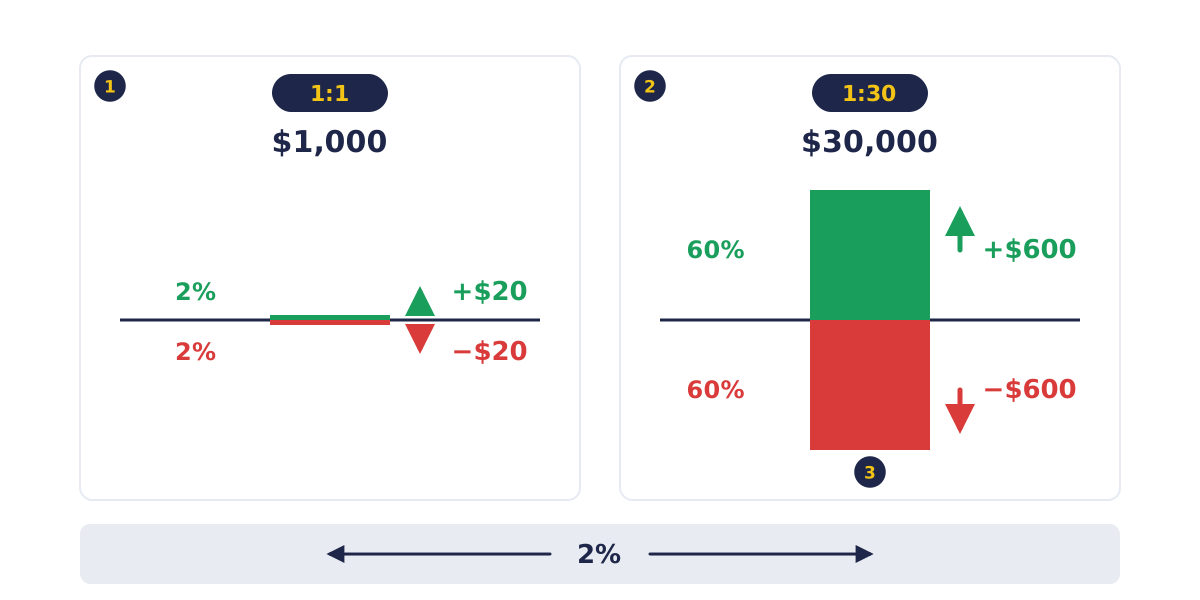
- Unleveraged: a 2% move changes your money by 2%.
- Leveraged at 1:30, fully used: the same 2% move changes it by 60%.
- The loss side is the exact mirror of the gain side.
Drag the leverage slider below. The market's move never changes; only what it is worth to you does, and it changes identically in both directions.
How does leverage magnify gains and losses?
Leverage magnifies gains and losses by the same multiple, because profit or loss is calculated on the full position, not on your deposit. At 1:30, $1,000 of margin controls $30,000, so a 2% market move is worth $600, which is 60% of your money, whether the market moves for you or against you.
Worked through: you have $1,000 and use all of it as margin at 1:30, so you control $30,000. The market moves 2%.
- Without leverage, you control $1,000. A 2% move is ±$20, which is 2% of your money.
- At 1:30, you control $30,000. The same 2% move is ±$600, which is 60% of your money.
Up 2% and you gain $600. Down 2% and you lose $600, leaving $400. The market moved the same amount both times. At 1:30, a move of about 3.33% against a fully used position equals your whole $1,000.
What are balance, equity and free margin?
Balance is your cash before open trades are counted, equity is balance plus or minus the profit or loss running on open trades, and free margin is the equity left after margin on open positions is set aside. Free margin is what you can use to open positions or absorb losses.
- Balance is your cash before open trades are counted.
- Equity is your balance plus or minus the profit or loss running on open trades.
- Free margin is the equity still available to open more positions or absorb losses, after margin on open positions is set aside.
Example: your balance is $1,000. You open 0.10 lot of EURUSD at 1:30, which ties up $366.67 of margin. The trade is showing a $50 loss, so your equity is $950 and your free margin is $950 − $366.67 = $583.33. If equity keeps falling, positions are closed automatically. The margin level calculator shows how close an account is to that point. That process, the margin call and stop-out, is covered in Module 5, Risk Management.
How do you manage the risk of leverage?
You manage the risk of leverage through position size, because leverage magnifies losses exactly as much as gains. Every result is worked out on the full position, so traders size each position so that a stop loss costs a set share of the account, and they keep free margin in reserve as a buffer against automatic close-outs.
A stop loss caps the planned loss, and after news or over a weekend a price can gap past it and fill at the next available level. If equity falls far enough, positions are closed automatically, a process covered in Module 5.
Costs follow the full position too. The spread, commission and swap on a $30,000 position are those of a $30,000 position, however little margin it ties up.
Who sets the maximum leverage?
Regulators and brokers set the maximum leverage, and it varies by region, account type and instrument. The leverage that applies to you is shown in your own account and symbol specification, and those are the figures to use in every margin calculation you make.
In the EU, for example, retail leverage has been capped since 2018, following ESMA's decision of 27 March 2018: 30:1 (1:30) for major currency pairs, 20:1 (1:20) for non-major pairs, gold and major indices, and 2:1 (1:2) for cryptocurrencies. Other regions set their own limits.
Try it on demo
In MetaTrader 5, open a symbol's specification and find its contract size. Then open the order window and change the volume. Watch the required margin change as the volume rises.
This lesson is part of the CFDs Explained module.
Quick check
- Margin is best described as
- At 1:100, how much margin does a $110,000 position need?
- Equity differs from balance because equity includes
- You control $30,000 with $1,000. The market falls 2%. You lose
- If you use higher leverage to open a bigger position, you increase
Frequently asked questions
What does 1:100 leverage mean?
1:100 leverage means every $1 of margin controls $100 of position, so the margin requirement is 1% of the position's value. A $110,000 position needs $1,100 of margin at 1:100, while the same position at 1:30 needs $3,666.67.
What is the difference between leverage and margin?
Leverage is the ratio; margin is the deposit that ratio requires. Margin as a percentage of the position equals 1 divided by the leverage, so 1:30 means 3.33% margin.
Does higher leverage mean more profit?
No. Leverage changes how much margin a position ties up, not how much each price move is worth. Profit or loss depends on the position size; higher leverage only lets you open a bigger position with the same deposit, which magnifies losses as much as gains.
Can you lose more than your deposit with leverage?
Yes, unless your account has negative balance protection. A fast or gapping market can take a leveraged position's loss past the money in your account. Some regulators, including in the EU, require negative balance protection for retail clients, which limits losses to the money in the account; your account terms state whether it applies to you.
What leverage should a beginner use?
The leverage setting matters less than position size, because profit or loss is worked out on the full position. A trader who sizes each position so a stop loss costs a small, fixed share of the account controls risk at any leverage setting. Position sizing is covered in Module 5, Risk Management.
Sources
- European Securities and Markets Authority (ESMA), ESMA agrees to prohibit binary options and restrict CFDs to protect retail investors, 27 March 2018: leverage limits for retail clients and negative balance protection. https://www.esma.europa.eu/press-news/esma-news/esma-agrees-prohibit-binary-options-and-restrict-cfds-protect-retail-investors
Practise what you learned
Open an account to use MetaTrader 5. Start on a demo account before risking real money.
Open Account