
What Is a Margin Call in Forex? Margin Level and Stop-Out
A margin call in forex trading is a warning that your account equity has dropped too low compared with the margin your open trades are using. If equity keeps falling to the lower stop-out level, the platform starts closing your positions for you, usually the biggest loss first.
Module 5 · Lesson 4 of 5
What you'll learn
- What margin level is and how to calculate it.
- What a margin call and a stop-out are, and how they differ.
- What happens to your account step by step as equity falls.
- How position size and stop-losses keep you away from both levels.
This lesson is part of the Risk Management module. It builds on margin, which is defined in the leverage and margin lesson.
What is a margin call in forex?
A margin call in forex trading is a warning that your equity has fallen to a level, set by your broker, compared with the margin your open trades are using. Your positions stay open, but MetaTrader 5 turns the account line red. If losses grow, the next level is a stop-out, where the platform starts closing trades.
Two terms matter here:
- Equity is your balance plus or minus the profit or loss on open trades.
- Used margin is the deposit your open positions hold while they are open.
What is margin level and how do you calculate it?
Margin level is your equity divided by your used margin, times 100, shown as a percentage. It tells you how much room your account has. A high margin level means plenty of equity behind your trades. As a trade loses, equity falls, so the margin level falls with it. To try your own numbers, use the margin level calculator.
Margin level = equity ÷ used margin × 100
MetaTrader 5's help on executing trades uses this formula and defines free margin as equity minus margin. Some readings:
| Equity | Used margin | Margin level | Free margin |
|---|---|---|---|
| $1,000 | $250 | 400% | $750 |
| $500 | $250 | 200% | $250 |
| $250 | $250 | 100% | $0 |
| $125 | $250 | 50% | −$125 |
At 100%, free margin is zero. You have no spare money left to open another position.
What is a stop-out in forex?
A stop-out is the margin level at which the platform starts closing your open positions automatically, without asking you. It sits below the margin call level. Its job is to stop the account from falling further, ideally before it goes below zero.
In MetaTrader 5's normal closing mode, a stop-out closes the position with the largest loss first. If the margin level is still below the stop-out level, the next position can be closed.
MetaTrader 5 allows a broker to set these levels either as a margin level percentage or as an amount of equity in money. Check which one your account uses.
How do a margin call and a stop-out differ?
A margin call is a warning, while a stop-out is an action: at a margin call your trades stay open, and at a stop-out the platform closes them. Both are triggered by your margin level, both are set by your broker, and the stop-out level is always the lower of the two.
| Margin call | Stop-out | |
|---|---|---|
| What it is | A warning level | A forced-closing level |
| Your positions | Stay open | Closed, biggest loss first |
| Example level | 100% | 50% |
| Who sets it | Your broker | Your broker |
The 100% and 50% levels in this lesson are examples; your broker sets its own, and they can differ by account type. In the EU, ESMA's 2018 measures require providers to close out a retail client's positions when the account falls to 50% of the minimum required margin. Other regions set their own rules.
What happens to your account as equity falls?
As a losing trade grows, equity falls, the margin level falls with it, and the account passes first the margin call level and then the stop-out level. The used margin stays roughly the same the whole time, because it depends on the size of the position, not on its profit or loss.
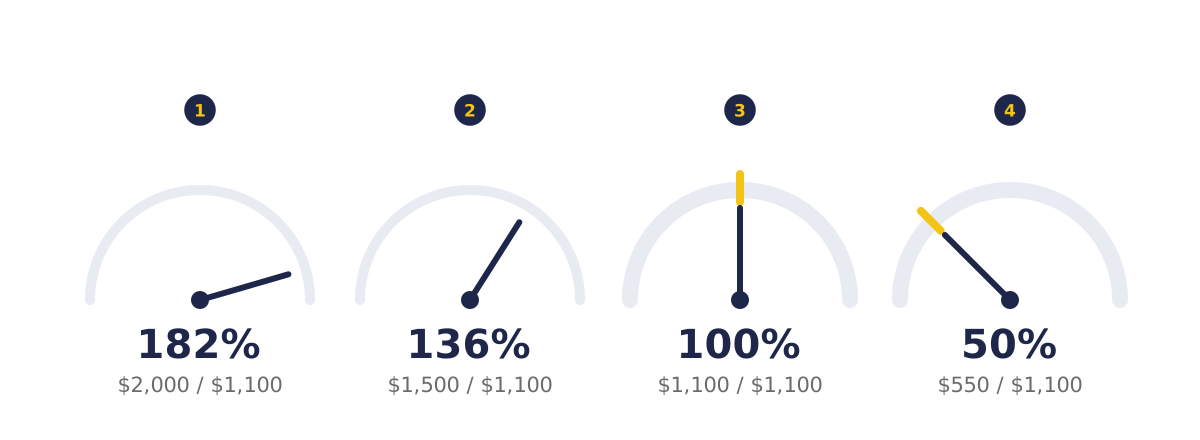
- This is a separate example account, not the worked example below: a $2,000 balance holding 1.00 lot of EURUSD bought at 1.1000, using $1,100 of margin at an example 1:100.
- Normal. Margin level starts at 182% ($2,000 ÷ $1,100) and is 136% after a $500 loss. You can open or close trades freely.
- Margin call (100%). After a $900 loss, equity equals used margin. Free margin is zero, so you cannot open new positions, but you can still close trades or reduce size.
- Stop-out (50%). After a $1,450 loss, the platform starts closing positions, biggest loss first. The 100% and 50% levels are example levels; brokers set their own.
How do you calculate when a margin call will happen?
To find when a margin call happens, work out the equity that equals the margin call level, subtract it from your current equity, and divide by the money each pip is worth. The answer is how many pips the market can move against you before the warning.
Worked example: a position that is too big
You have a $1,000 balance and an example leverage of 1:100. You want to buy 1.00 lot of EURUSD at 1.08500.
- One lot is 100,000 euros. At 1:100 the margin is 1,000 euros, worth 1,000 × 1.08500 = $1,085, following MetaTrader 5's forex margin formula.
- Margin level at open: $1,000 ÷ $1,085 × 100 = 92.2%.
That is below the 100% example margin call level before the price has moved. Free margin would be −$85, so a platform would normally refuse the order.
Worked example: a smaller position
Now try 0.30 lot instead.
- Margin: 0.30 × 100,000 ÷ 100 = 300 euros, worth 300 × 1.08500 = $325.50.
- Margin level at open: $1,000 ÷ $325.50 × 100 = 307%.
- Pip value: 0.30 lot of EURUSD is worth $3 per pip.
With example levels of 100% (margin call) and 50% (stop-out):
- Margin call: equity must fall to $325.50 (100% of $325.50). That is a loss of $1,000 − $325.50 = $674.50, or $674.50 ÷ $3 ≈ 224.8 pips.
- Stop-out: equity must fall to $162.75 (50% of $325.50). That is a loss of $837.25, or $837.25 ÷ $3 ≈ 279.1 pips.
| Pips against you | Loss | Equity | Margin level | What happens (example levels) |
|---|---|---|---|---|
| 0 | $0 | $1,000.00 | 307% | Normal |
| 100 | $300.00 | $700.00 | 215% | Normal, free margin $374.50 |
| about 224.8 | $674.50 | $325.50 | 100% | Margin call: warning, no new trades |
| about 279.1 | $837.25 | $162.75 | 50% | Stop-out: platform starts closing |
For simplicity the used margin is held at $325.50; on a real platform it shifts slightly as EURUSD moves, and spread and swap also reduce equity. The margin calculator works out the margin for other currency pairs and sizes.
MT5 shows the $325.
What happens at a stop-out when the price gaps?
When the price gaps, a stop-out closes positions at the next available price, not at the exact level, so equity can end below the stop-out level. A gap is a jump in price, for example after major news or over a weekend, that skips the prices in between, including the stop-out level itself.
In an extreme move the balance can go below zero. Some regulators require negative balance protection for retail clients. In the EU, ESMA's 2018 measures introduced it per account as a guaranteed limit on retail losses. Whether it applies depends on where your account is held, and your account terms say so.
Why do margin calls happen?
Margin calls usually happen because a position is too large for the account, so an ordinary price move uses up equity quickly. Other common causes are holding a losing trade without a stop-loss, opening several positions that use margin at the same time, and sudden moves or gaps after news.
How do you avoid a margin call?
You avoid a margin call by keeping each position small compared with your account and by placing a stop-loss well before the margin call level. A smaller position uses less margin and loses less per pip, so equity has far more room. A stop-loss closes the trade at a loss you chose in advance.
| 1.00 lot | 0.30 lot | 0.10 lot | |
|---|---|---|---|
| Used margin (example 1:100, EURUSD at 1.08500) | $1,085.00 | $325.50 | $108.50 |
| Margin level at open, $1,000 account | 92.2% | 307% | 922% |
| Money per pip | $10 | $3 | $1 |
In the 0.30 lot example, a stop-loss 30 pips away would cap the planned loss at about $90, far from the 224.8 pips that would trigger the margin call. In a gap a stop-loss fills at the next available price, as covered in the stop-loss and take-profit lesson.
How to choose a size from the amount you are willing to risk is covered in the position sizing lesson.
Try it on demo
On a MetaTrader 5 demo account, open one small position and find Margin Level on the account line in the Trade tab of the Toolbox. Write it down, then watch it change as the price moves. Close the position and check that free margin returns to equal your equity.
Quick check
- Margin level is calculated as
- Your equity is $650 and your used margin is $325. What is your margin level?
- At a stop-out, the platform
- Who sets the margin call and stop-out levels on your account?
- What keeps your margin level far from a margin call?
Frequently asked questions
What happens when you get a margin call?
Your positions stay open, but free margin is zero or negative, so you cannot open new trades, and the MetaTrader 5 account line turns red. If equity keeps falling to the stop-out level, the platform starts closing positions.
What is a good margin level?
The further above the margin call level it sits, the more room your trades have. A margin level of several hundred percent leaves a large buffer, while one drifting toward 100% means a margin call is close.
What does a 100% margin level mean?
It means equity equals the margin your open trades use, so free margin is zero. With $250 of used margin and $250 of equity, margin level is 250 ÷ 250 × 100 = 100%. Many brokers set their margin call at this level: you can still close or reduce trades, but you cannot open new ones.
How do you get out of a margin call?
Closing or reducing positions releases margin and raises your margin level. Adding money raises equity, but the trade itself is unchanged. Skilled traders size positions so the margin level never gets near the call.
Sources
- MetaQuotes, MetaTrader 5 Help: Executing Trades, accessed 19 October 2026: margin level is equity divided by margin times 100, free margin is equity minus margin, the account state line turns red in the Margin Call or Stop Out state, and in normal (non-FIFO) mode a stop-out closes the position with the largest loss first. https://www.metatrader5.com/en/terminal/help/trading/performing_deals
- MetaQuotes, MetaTrader 5 Build 2340 release notes, accessed 19 October 2026: the margin call level switches the account to the Margin Call state, the stop-out level closes positions, and the levels can be set in percent (margin level) or in money (equity). https://www.metatrader5.com/en/releasenotes/terminal/2125
- MetaQuotes, MetaTrader 5 Help: Margin Calculation for Retail Forex, Futures, accessed 19 October 2026: forex margin is volume in lots × contract size ÷ leverage (1 lot of EURUSD at 1:100 needs 1,000 EUR), converted to the deposit currency at the current exchange rate. https://www.metatrader5.com/en/terminal/help/trading_advanced/margin_forex
- European Securities and Markets Authority (ESMA), ESMA agrees to prohibit binary options and restrict CFDs to protect retail investors, 27 March 2018: margin close-out at 50% of minimum required margin per account, and negative balance protection per account for retail clients. https://www.esma.europa.eu/press-news/esma-news/esma-agrees-prohibit-binary-options-and-restrict-cfds-protect-retail-investors
Practise what you learned
Open an account to use MetaTrader 5. Start on a demo account before risking real money.
Open Account