
CFDs Explained: How CFD Trading Works for Beginners
Module 2
Lessons in this module
- 1What is a CFD12 min
CFD trading is buying or selling contracts for difference, agreements with a broker to settle in cash the change in an asset’s price, without owning the asset. You can take a position on a rise or a fall, and leverage magnifies gains and losses on the money you put down.
- 2Going long and short7 min
Going long means you buy and profit if the price rises, while going short means you sell first and profit if the price falls. Both directions lose by the same amount when the market moves the other way.
- 3Leverage and margin8 min
Leverage in forex lets you control a position larger than the money you put down. At 1:30, $1,000 of margin controls a $30,000 position, and every gain or loss is calculated on the full $30,000.
- 4Lots, pips and pip value9 min
A pip in forex is the standard unit for measuring how far a currency price has moved, usually 0.0001 on most pairs and 0.01 on yen pairs. What a pip is worth in money depends on your position size, so one pip on 1 standard lot of EURUSD is worth $10 and on 0.01 lot it is worth $0.10.
- 5Spread, commission and swap9 min
The spread in forex is the gap between the buy (ask) price and the sell (bid) price, and you pay it the moment you open a trade. On 0.10 lot of EURUSD, a 2-pip spread costs $2, and commission and overnight swap can add to that.
About this module
A contract for difference (CFD) is an agreement to settle the difference between the opening and closing price of a trade, so you can trade rising and falling prices without owning the asset. This module is for people who have never traded: five short lessons on going long and short, leverage, margin, pips and costs.
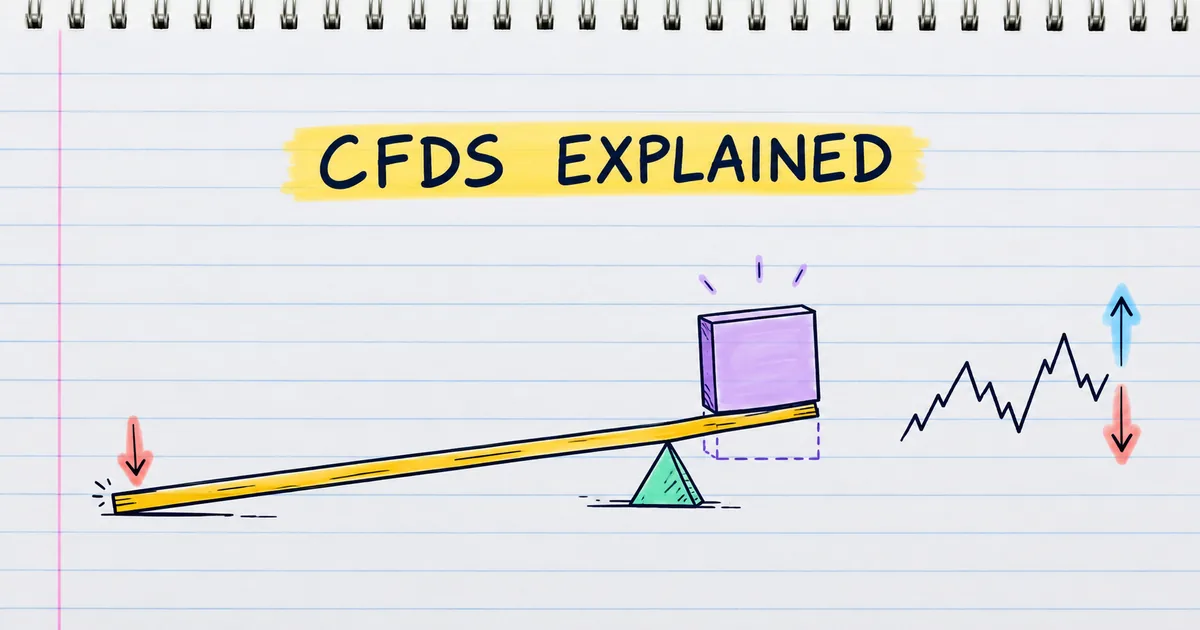
Start with what a CFD is, then work through going long and short, leverage and margin, lots, pips and pip value and spread, commission and swap in order. Each one has a worked example and a quick self-check. You need no prior knowledge beyond Module 1.
What should beginners learn first about CFD trading?
Beginners should learn five things first about CFD trading, in this order: what a CFD is, going long and short, leverage and margin, pips and pip value, and the costs of holding a trade. Each one is a lesson in this module, and each builds on the one before.
- What a CFD is: a contract settled in cash on the price difference.
- Going long and short: profiting from rises and from falls.
- Leverage and margin: how a small deposit opens a larger position.
- Lots, pips and pip value: turning a price move into money.
- Spread, commission and swap: what a trade costs to open and to hold.
What does one CFD trade look like from open to close?
One CFD trade has four numbers: the size, the opening price, the closing price and the costs, and the profit or loss is the size times the price move, minus the costs. Leverage changes only the margin you put up, not the result.
A worked example: buy 0.10 lot of EURUSD (10,000 euros) at 1.1000, the ask price. At 1:100 leverage the margin is 10,000 × 1.1000 / 100 = $110. Close at 1.1040, the bid price, and the trade gains 40 pips at $1 a pip, or $40; the spread is already inside those two prices. Held overnight, a swap charge or credit is added. Had you sold instead, the same move would cost $40.
Is CFD trading good for beginners?
CFD trading suits beginners who learn the arithmetic first, because one account gives access to forex, gold, indices and shares, in both directions, from small sizes such as 0.01 lot. Leverage magnifies results both ways, so this module covers margin and pip value before a first live trade.
Practise each lesson's example on a demo account, then check your numbers with the margin calculator and the pip value calculator.
What do beginners ask about CFD trading?
Beginners ask four things first about CFD trading: whether they own the asset, which markets they can trade, how much they need to start and what they pay to hold a trade. The answers below each stand alone, with links to the lessons that cover them.
Do you own the asset when you trade a CFD?
No. A CFD is a contract on the price, settled in cash, so you never take delivery of the currency, gold or share. That is what lets you go short as easily as long, as what is a CFD explains.
Which markets can you trade with CFDs?
Forex pairs, metals such as gold, energies, stock indices, shares and more, all from one account. The asset classes lesson compares them.
How much money do you need to start CFD trading?
Brokers set their own minimum deposit. The margin on a small trade is low: 0.01 lot of EURUSD at 1.1000 and 1:100 leverage needs about $11. Leave room above the margin for the stop loss, as margin call and stop out explains.
What do you pay to hold a CFD overnight?
A swap, also called the overnight financing charge, which can be a cost or a credit depending on the interest rates of the instrument and the direction of your trade. The spread, commission and swap lesson shows how it is calculated.
Practise what you learned
Open an account to use MetaTrader 5. Start on a demo account before risking real money.
Open Account