
Slippage in Trading: Gaps, Spreads and Fills Around News
Slippage in trading is the difference between the price you expected for an order and the price it actually fills at, and it can be worse or better. It tends to grow around news and weekend gaps, when a stop loss closes at the first available price past your level.
Module 10 · Lesson 4 of 5
What you'll learn
- What slippage is, and why it can be negative or positive.
- Why gaps, wider spreads and requotes cluster around news and weekends.
- How each order type behaves in a fast market, and how skilled traders plan for slippage.
- What the Swiss franc shock of January 2015 shows about stop losses.
What is slippage in trading?
Slippage in trading is the difference between the price you expected for an order and the price it actually fills at. It is measured in pips or points. Negative slippage means a worse fill; positive slippage means a better one, for example a market buy sent at 1.08500 that fills at 1.08480. It is most common when prices move fast.
It is not a separate fee. It mostly affects market orders, which fill at the price available when executed, and stop orders, including a stop loss, which become market orders once your level is reached. The basics are in the stop loss and take profit lesson.
What causes slippage?
Slippage is caused by the price changing between the moment you send an order and the moment it fills. When liquidity thins, meaning fewer buyers and sellers are quoting, prices can jump from one level to the next with nothing in between. That is most likely around releases, surprise announcements and the weekly open.
- Fast prices. News moves the price while your order travels to the server.
- Thin liquidity. Fewer quotes mean bigger jumps between prices.
- Order size. If one quote does not cover your full volume, MetaTrader 5 can fill the order as several deals at different prices.
What the releases themselves are is covered in major economic releases.
What is a gap in trading?
A gap is a jump from one price to the next with no trading in between. On a chart it shows as empty space between two candles. An order waiting inside that space cannot fill at its own level, because no price was ever available there, so it fills at the first price after the gap.
What is a weekend gap in forex?
A weekend gap in forex is a difference between Friday's last price and the first price when trading reopens. News keeps arriving over the weekend, so Monday's first quote can open well away from Friday's close. A stop loss inside the gap fills at that first available price.
How do you calculate slippage?
Slippage in pips = the difference between your requested price and your fill price ÷ the pip size. Slippage cost = slippage in pips × pip value per lot × lots. For EURUSD the pip size is 0.0001, and 0.20 lot is worth about $2 per pip. The pip value calculator works this out for other pairs and sizes.
A stop loss during a release. You are long 0.20 lot of EURUSD from 1.08600, with a stop loss at 1.08300: a planned risk of 30 pips × $2 = $60. A release comes out and the bid jumps straight from 1.08320 to 1.08180.
- The stop fills at the first available price, 1.08180.
- Slippage: 1.08300 − 1.08180 = 12 pips × $2 = $24, so the loss is $84, not $60.
A Monday gap. Same position, held over the weekend. Friday's last bid is 1.08450; Monday's first bid is 1.08100, so the stop fills there: 20 pips × $2 = $40 of slippage, a $100 total loss.
| Scenario | Fill price | Slippage | Total loss |
|---|---|---|---|
| Normal market | 1.08300 | 0 | $60 |
| Fast release | 1.08180 | 12 pips = $24 | $84 |
| Monday gap | 1.08100 | 20 pips = $40 | $100 |
Why do spreads widen around news?
Spreads widen around news because fewer buyers and sellers are quoting, and those still quoting set their buy and sell prices further apart. The spread is the gap between the ask (buy) and bid (sell) price, so a wider spread costs more to open or close.
On 0.20 lot of EURUSD, a 1-pip spread costs $2; at an assumed 8 pips during a release it costs $16. A wider spread can also trigger a short position's stop loss, which closes at the ask, even when the bid on the chart never reaches it.
What is a requote in MetaTrader 5?
A requote is a new price offered by the broker's server when the price changes too much while your order is processed. In MetaTrader 5 it happens in Instant Execution mode. The new prices are valid for a few seconds, and you accept or reject them.
In Instant Execution, the MetaTrader 5 Deviation field sets the largest difference from your requested price you accept. Within it, the order fills at the new price without a message.
Market Execution has no requotes: sending the order is advance consent to the broker's price, as covered in placing your first trade in MT5.
How do order types behave in a fast market?
In a fast market, stop and market orders can fill at worse prices, while limit orders keep their price but may not fill. The table follows MetaQuotes' order descriptions; your broker's execution policy sets the exact details for your account.
| Order type | Fills at | Can it slip? | Can it fail to fill? |
|---|---|---|---|
| Market order, Market Execution | The broker's price | Yes, either way | Check your broker's policy |
| Market order, Instant Execution | Your price, or within your Deviation | Only within your Deviation | Yes, you may get a requote |
| Stop order or stop loss | Your level or worse | Yes | No, once triggered it is executed |
| Limit order | Your level or better | No | Yes, the price may never trade there |
| Stop limit order | The limit price or better | No worse than the limit | Yes, if the price jumps past the limit |
How can you reduce slippage?
You reduce slippage by using orders that cap the fill price, trading in the most active hours and choosing in advance whether to hold through releases and weekends. Each method has a trade-off. A stop loss still fills at the next available price once triggered, so skilled traders also size every position for a worse fill.
| Method | What it does | Trade-off |
|---|---|---|
| Limit or stop limit order | Caps the fill price | May never fill |
| Small Deviation in Instant Execution | Limits how far the fill can move | More requotes |
| Smaller position size | Lower cost per pip slipped, fewer split fills | Smaller exposure to every move |
| No open position through a scheduled release or the weekend | Avoids the release spike and the Monday gap | Your plan must allow for the time out |
| Trading in the most active hours | More quotes, so smaller jumps | Fewer hours to trade |
What happened to EUR/CHF in January 2015?
On 15 January 2015, the Swiss National Bank (SNB) removed its minimum exchange rate of CHF 1.20 per euro, and the euro fell sharply against the franc within a day. The SNB had set that floor on 6 September 2011, saying it was prepared to buy foreign currency in unlimited quantities to defend it.
Its press release of 15 January 2015 discontinued the minimum rate and cut its sight deposit rate to −0.75%. On the European Central Bank's daily reference rate, EUR/CHF went from 1.2010 on 14 January to 1.0280 on 15 January, a 14.4% fall.
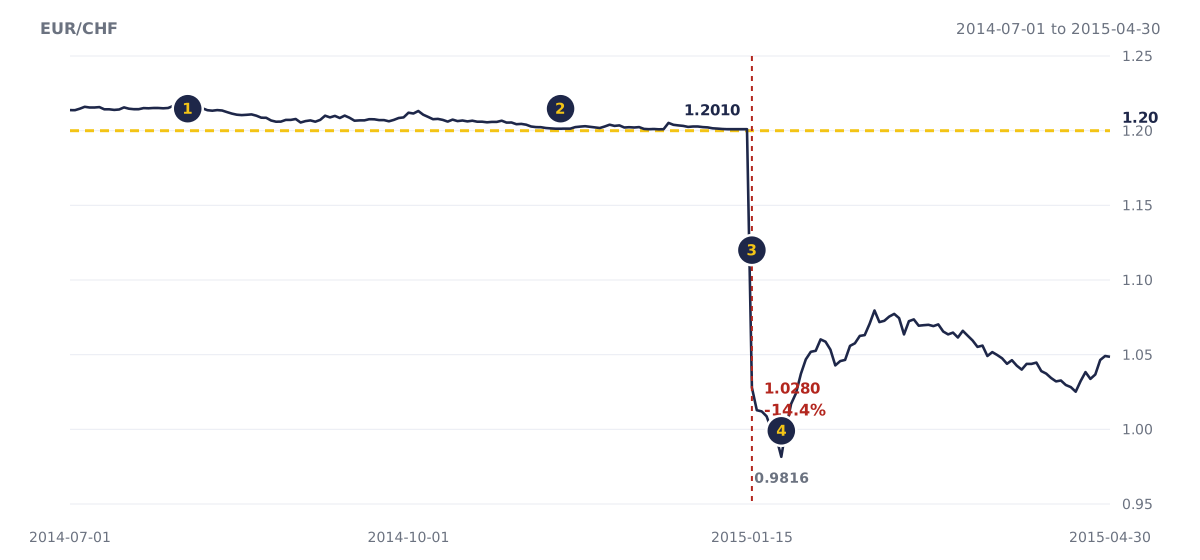
- The dashed line is the CHF 1.20 minimum rate, in place since September 2011.
- From July 2014 to 14 January 2015, the daily rate stays at or just above 1.20.
- On 15 January 2015 the floor is removed and the rate is 1.0280, 14.4% lower.
- It keeps falling to 0.9816 on 23 January, then partly recovers.
The reference rate is one rate per business day, not every traded price. A stop just below 1.20 could not fill there, because the market jumped far past it. The lesson traders took from it: in a gap, position size, not the stop level alone, sets the size of the result.
How do traders plan for slippage and gaps?
Skilled traders plan for slippage and gaps by treating the stop loss as an instruction to close, not a fixed price, and sizing each position so a worse fill still fits their risk budget. They check the calendar before holding through a release and decide in advance whether a position stays open over the weekend.
- Before the trade, size it with position sizing, then check what a fill 12 or 20 pips past the stop would cost, as in the table above.
- Before a scheduled release, decide whether to close, reduce or hold, using the release time on the economic calendar.
- Before the weekend, make the same decision for the Monday open.
A large gap can move a leveraged position past the account balance. Since 2018, ESMA has required negative balance protection on a per-account basis for retail CFD clients in the EU; your own account terms set what applies to you. How traders approach news itself is covered in Module 13.
Try it on demo
On a MetaTrader 5 demo account, add the Spread column to Market Watch before a major release. Note the EURUSD spread ten minutes before and in the first minute after, then multiply the difference by your usual pip value.
This lesson is part of the Trade Management module.
Quick check
- Slippage is
- A long 0.20 lot EURUSD position ($2 per pip) has a stop loss at 1.08300 that fills at 1.08180. The slippage costs
- Which order type never fills at a worse price than its level?
- In Instant Execution, the price moves by more than your Deviation setting. What can happen?
- A weekend gap is when
Frequently asked questions
What does slippage mean in forex?
Slippage in forex means your order filled at a different price from the one you requested. It is most common around major news and at the weekly open.
Is slippage good or bad?
It can be either: negative slippage gives a worse price, positive slippage a better one. For stop losses, the negative kind matters most.
Is slippage the same as the spread?
No. The spread is the gap between the buy and sell price before you trade; slippage is the gap between the price you requested and the price you got. Both tend to grow around news.
Does a stop loss work during news?
Yes, a stop loss still triggers during news, but it may fill past your level. It closes at the next available price, which can be several pips away in a fast or gapping market.
Sources
- MetaQuotes, MetaTrader 5 Help: Executing Trades, accessed 19 October 2026: limit orders fill at the specified price or better with no slippage but execution is not guaranteed; stop orders fill at the specified price or worse; stop limit orders limit slippage; Instant Execution uses a Deviation setting and can bring a requote valid for a few seconds; Request Execution quotes are valid for a few seconds; Market Execution is advance consent to the broker's price; one order can be filled as several deals when one market offer does not cover its volume; the execution mode depends on the instrument and broker. https://www.metatrader5.com/en/terminal/help/trading/performing_deals
- Swiss National Bank, Swiss National Bank sets minimum exchange rate at CHF 1.20 per euro, 6 September 2011: the SNB will no longer tolerate a EUR/CHF rate below CHF 1.20 and is prepared to buy foreign currency in unlimited quantities. https://www.snb.ch/public/asset/en/www-snb-ch/publications/communication/press-releases/2011/pre_20110906/publications0_en/pre_20110906.en.pdf
- Swiss National Bank, Swiss National Bank discontinues minimum exchange rate and lowers interest rate to –0.75%, 15 January 2015: the SNB discontinues the minimum exchange rate of CHF 1.20 per euro and lowers the interest rate on sight deposit balances above the exemption threshold to −0.75%. https://www.snb.ch/public/asset/en/www-snb-ch/publications/communication/press-releases/2015/pre_20150115/publications0_en/pre_20150115.en.pdf
- European Central Bank, Euro foreign exchange reference rates, Swiss franc (EXR.D.CHF.EUR.SP00.A), July 2014 to April 2015: EUR/CHF 1.2010 on 14 January 2015, 1.0280 on 15 January 2015 and 0.9816 on 23 January 2015; no rate below 1.20 from 1 July 2014 to 14 January 2015. https://data-api.ecb.europa.eu/service/data/EXR/D.CHF.EUR.SP00.A?startPeriod=2014-07-01&endPeriod=2015-04-30&format=csvdata
- European Securities and Markets Authority (ESMA), ESMA agrees to prohibit binary options and restrict CFDs to protect retail investors, 27 March 2018: negative balance protection on a per-account basis for retail CFD clients. https://www.esma.europa.eu/press-news/esma-news/esma-agrees-prohibit-binary-options-and-restrict-cfds-protect-retail-investors
Practise what you learned
Open an account to use MetaTrader 5. Start on a demo account before risking real money.
Open Account