
Hawkish vs Dovish: How Central Banks Move Currencies
Hawkish means a central bank leans towards higher interest rates or tighter policy to fight inflation; dovish means it leans towards lower rates or looser policy to support growth. Currencies tend to move most when a decision or its tone differs from what the market expected.
Module 8 · Lesson 3 of 5
What you'll learn
- What hawkish and dovish mean, and how to spot each in a statement.
- What central banks do, and how central banks such as the Fed and ECB make decisions.
- Why the surprise against expectations matters more than the decision itself.
- How to put a central bank move into pips and money, and how prices behave on decision day.
What is the difference between hawkish and dovish?
Hawkish means a central bank leans towards higher interest rates or tighter policy to bring inflation down; dovish means it leans towards lower rates or looser policy to support jobs and growth. A bank can hold its rate and still sound hawkish or dovish, depending on what it says about the future.
| Hawkish | Dovish | |
|---|---|---|
| Main worry | Inflation too high | Growth or jobs too weak |
| Typical policy | Raise rates, or keep them high for longer | Cut rates, or keep them low for longer |
| Typical tone | Warns that further tightening may be needed | Says policy can become less restrictive |
| What markets may price | More or longer high rates ahead | Cuts sooner or more of them |
| Currency, all else equal | Tends to be supported if the tone is tougher than expected | Tends to weaken if the tone is softer than expected |
| Risk if pushed too far | Slower growth and job losses | Inflation stays high or rises |
"All else equal" matters: inflation, growth, risk mood and other countries' rates change too, so read each row as a tendency within the wider picture. A bank leaning neither way is often called neutral, and individual committee members are also labelled hawks or doves by how they tend to vote.
What does a central bank do?
A central bank runs monetary policy for a currency: it sets a policy interest rate that anchors other interest rates in that economy, with the main aim of keeping prices stable. It does not trade for profit, and its decisions follow a published mandate.
What is a mandate?
A mandate is the goal a central bank is set by law. Most aim at price stability, meaning low and steady inflation, usually measured by the consumer price index (CPI):
- The US Federal Reserve has a dual mandate: maximum employment and stable prices, with inflation of 2% over the longer run judged most consistent with stable prices.
- The European Central Bank says its main aim is price stability, with a 2% inflation target.
How do central banks make rate decisions?
A committee meets on a published schedule, reviews economic data, votes on the policy rate and then announces the decision with a statement. Rates change often, so read the current rate from the bank or your economic calendar. The table below shows each bank's decision body and how often it decides.
| Central bank | Currency | Decision body | How often it decides (from its own site) |
|---|---|---|---|
| Federal Reserve | US dollar | Federal Open Market Committee (FOMC) | Eight scheduled meetings a year, plus others as needed |
| European Central Bank | Euro | Governing Council | Every six weeks |
What do statements, minutes and press conferences tell you?
They explain why the bank decided what it did and hint at what it may do next, which is often what moves prices. The statement gives the decision and the reasons, the press conference adds answers to questions, and minutes show the debate weeks later.
| Communication | When it comes | What it shows |
|---|---|---|
| Decision and statement | At the announcement time | The rate, plus the bank's view of inflation and growth |
| Press conference | Soon after the decision | Answers to questions; tone can shift in real time |
| Minutes or accounts | Later | How the discussion went. The Fed releases minutes three weeks after the decision; the ECB publishes accounts of its policy meetings |
What is forward guidance?
Forward guidance is what a central bank says about its likely future policy. A line such as "rates may need to stay high for some time" is guidance. It can move markets more than the decision, because the decision is often expected and the wording is not.
How do central banks affect currencies?
Central banks affect currencies by changing the return on holding that currency and by changing what the market expects that return to be. A tighter path tends to support a currency and a looser one tends to weaken it, all else equal, as introduced in what moves market prices.
How interest rate differences between countries drive currencies over months and years is covered in Module 12, Global Macro. This lesson focuses on the decision day itself.
What are quantitative easing and tightening?
Quantitative easing (QE) is when a central bank buys large amounts of bonds to push longer-term interest rates down. Quantitative tightening (QT) is the reverse: the bank shrinks those holdings. QE is a dovish tool and QT a hawkish one.
What is currency intervention?
Currency intervention is when a central bank buys or sells currencies directly to move its exchange rate. To support the dollar, the New York Fed buys dollars and sells foreign currency; since the mid-1990s the US has done this only on occasion.
Why do expectations matter more than the decision?
Markets usually price in the expected decision before it happens, so the currency reacts to the gap between what the bank did or said and what traders expected. A fully expected rate rise can leave a currency flat, or even weaker.
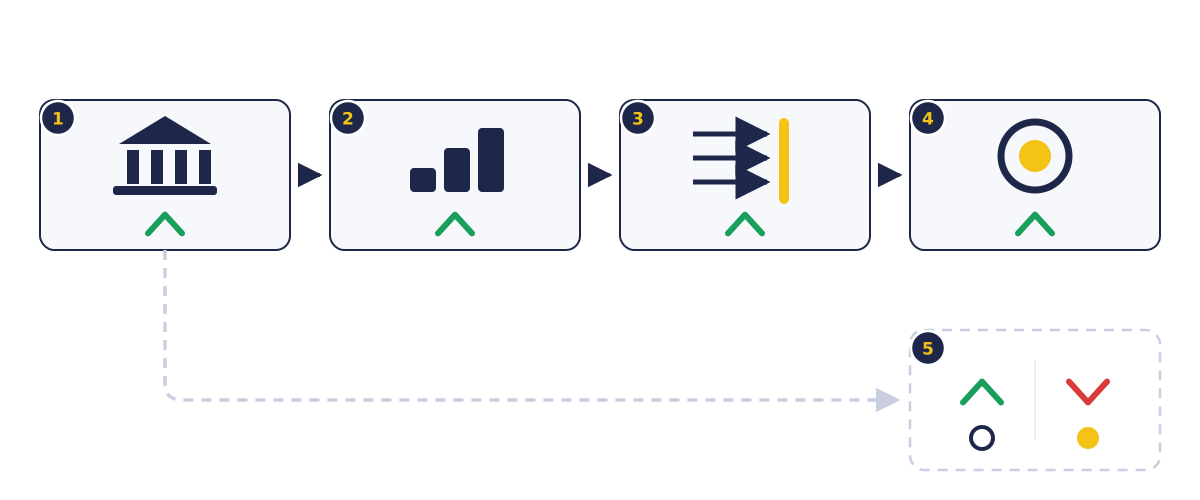
- Box 1: the central bank raises its policy rate.
- Boxes 2 and 3: deposits and bonds in that currency pay more, and capital tends to flow towards the higher return.
- Box 4: demand for the currency rises, so it tends to strengthen.
- Box 5, dashed: if the rise was already expected, steps 2 to 4 happened before the announcement, so the currency can rise or fall on the day.
What does a hawkish surprise look like on EURUSD?
A hawkish surprise is a central bank that holds rates as expected but signals more increases, which can strengthen its currency even though the decision changed nothing. The steps below follow one decision day from expectation to a 60-pip move on EURUSD and show what that move is worth on 0.10 lot.
- Expectation: traders expect the bank that sets US dollar rates to hold at 5.00%.
- Decision: it holds at 5.00%. No surprise in the number.
- Statement: it adds that further increases may be appropriate. That is a hawkish surprise in tone.
- Reaction: suppose the dollar strengthens and EURUSD falls 60 pips, from 1.1000 to 1.0940.
On 0.10 lot of EURUSD one pip is worth $1, as shown in lots, pips and pip value:
| Position (0.10 lot EURUSD) | 60-pip fall | Result |
|---|---|---|
| Long (bought) | 60 × $1 | −$60 |
| Short (sold) | 60 × $1 | +$60 |
Had traders expected an even tougher message, EURUSD could instead have risen 60 pips, reversing both results. Check pip values for other currency pairs with the pip value calculator.
How do prices behave around central bank decisions?
Around a central bank announcement, prices can jump, reverse and cost more to trade, so skilled traders set their size and stops before the release. The decision time is known in advance, which lets you prepare; the direction comes from the surprise, and the first move is often not the last.
- Wider spreads: spreads often widen around big announcements, so trades cost more to open.
- Slippage and gaps: price can jump past your stop, filling it at a worse price. Gaps and slippage are covered in Module 10, Trade Management.
- Whipsaw: the first move after the statement can reverse during the press conference.
- Reading tone takes practice: two traders can read the same sentence differently, so compare the wording with the previous statement.
Try it on demo
Before the next scheduled decision from any bank above, open a EURUSD chart (or USDZAR, if your broker offers it) on the M5 timeframe in a MetaTrader 5 demo account. Afterwards, write down one hawkish and one dovish sentence from the statement, then measure how many pips price moved each way in the next hour. This builds the skill of reading tone in real time.
This lesson is part of the Fundamental Analysis module.
Quick check
- A hawkish central bank leans towards
- Forward guidance is
- The market expects a hold. The bank holds but signals possible future hikes. This is
- On 0.10 lot of EURUSD, where 1 pip is worth $1, a 60-pip move is worth
- A central bank raises rates and its currency falls. The most likely reason is
Frequently asked questions
What does hawkish mean in forex?
In forex, hawkish means a central bank is signalling higher interest rates or tighter policy, usually to bring inflation down. A tone tougher than the market expected tends to support that currency, all else equal.
Is hawkish good or bad for a currency?
A hawkish surprise tends to support a currency, but a hawkish message that was already expected may not move it at all. What matters is how the tone compares with what traders had already priced in.
Why do central banks switch from hawkish to dovish?
A central bank usually turns dovish when inflation is falling back towards its target or growth and jobs are weakening, and turns hawkish when inflation is rising above target. The shift often shows first in the wording of statements, before the rate itself changes.
How often do central banks meet?
It depends on the bank: the Fed's FOMC holds eight scheduled meetings a year and the ECB decides every six weeks. Each bank publishes its dates in advance, and an economic calendar lists them all.
Sources
- Board of Governors of the Federal Reserve System, What economic goals does the Federal Reserve seek to achieve through its monetary policy?, last updated 22 August 2025: the dual mandate of maximum employment and stable prices; 2% inflation over the longer run. https://www.federalreserve.gov/faqs/what-economic-goals-does-federal-reserve-seek-to-achieve-through-monetary-policy.htm
- Board of Governors of the Federal Reserve System, Meeting calendars and information (accessed 27 October 2026): the FOMC holds eight regularly scheduled meetings a year and other meetings as needed; minutes are released three weeks after the policy decision. https://www.federalreserve.gov/monetarypolicy/fomccalendars.htm
- European Central Bank, Overview of monetary policy and markets (accessed 27 October 2026): main aim of price stability; 2% target; decisions every six weeks; press conference after decisions; accounts of Governing Council policy meetings. https://www.ecb.europa.eu/mopo/html/index.en.html
- Federal Reserve Bank of New York, Foreign Exchange Operations, updates dated to 13 August 2026: to support the dollar the desk buys dollars and sells foreign currency; since the mid-1990s the US has intervened in FX markets only on occasion. https://www.newyorkfed.org/markets/international-market-operations/foreign-exchange-operations
Practise what you learned
Open an account to use MetaTrader 5. Start on a demo account before risking real money.
Open Account