
What Moves Crypto and Commodity Prices? Oil, Gold and Bitcoin Drivers
Commodity prices move mainly on supply, demand, inventories and the US dollar, while crypto prices move on supply rules, regulation news and risk sentiment. Both can move sharply, and futures expiry and weekend trading add mechanics that most currency pairs do not have.
Module 8 · Lesson 5 of 5
What you'll learn
- What moves commodity prices: supply, inventories, OPEC+, the US dollar and the weather.
- How futures expiry, contango and backwardation work, and why oil went below zero in April 2020.
- What moves gold and crypto, including weekend gaps.
- How to work out what a price move costs on an oil or Bitcoin CFD.
What moves crypto and commodity prices?
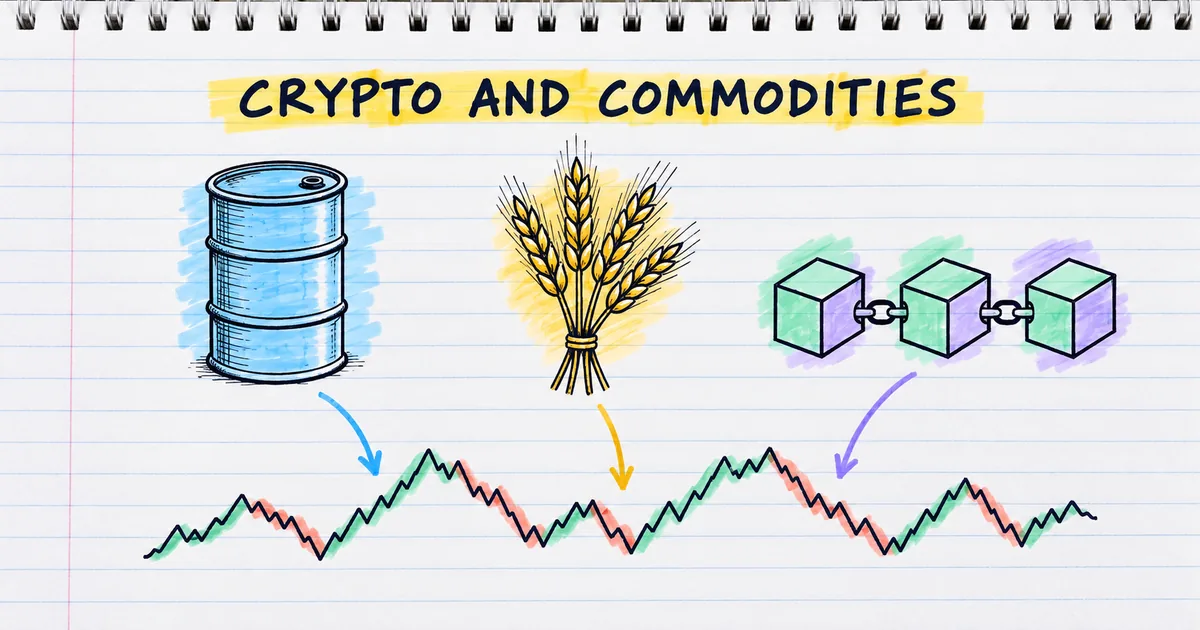
Commodity prices move mainly on supply, demand, stored inventories and the US dollar, while crypto prices move mainly on supply rules, regulation news and risk sentiment. Both react to news against expectations. Both can move far more in a day than a major currency pair, so the same risk budget usually means a smaller position.
Key terms:
- Commodity: a raw material traded in bulk, such as crude oil, natural gas, gold or wheat.
- Underlying: the real market a CFD's price follows, such as a crude oil futures contract or Bitcoin.
- Risk sentiment: how willing investors are, overall, to hold riskier assets at a given moment.
If the asset classes themselves are new to you, start with what you can trade: forex, stocks, indices, commodities and crypto.
What is commodity trading?
Commodity trading is buying and selling raw materials, or contracts on their price, such as oil, gold and natural gas. Producers and large users trade exchange futures to manage price risk. With a CFD that follows a commodity's price, you can instead take a position on a rise or fall without ever owning or receiving the commodity.
What is a futures contract?
A futures contract is an agreement to buy or sell a set amount of a commodity at a set price on a future date, when the contract expires.
What moves oil and other commodity prices?
Oil and other commodity prices move on the balance between supply and demand, which traders track through inventories, producer decisions, the US dollar and the weather. Supply can change suddenly through outages, conflict or production decisions, which is why commodity prices can jump.
- Inventories. These are stocks held in storage. The US Energy Information Administration (EIA) describes inventories as the balancing point between supply and demand: a build suggests production is outpacing use. Its Weekly Petroleum Status Report publishes US crude oil and fuel stocks each week, and oil often moves when the figure surprises.
- OPEC+ decisions. OPEC, a group of oil-exporting countries, sets production targets for its members, and works with allied producers in the wider OPEC+ group. The EIA notes that oil prices have historically tended to rise when OPEC cuts its targets, and that members not meeting targets can also move prices.
- The US dollar. Because commodities are priced in dollars, a stronger dollar makes them dearer in other currencies. The EIA says the dollar and oil prices have tended to move in opposite directions.
- Economic growth. Transport uses large amounts of oil, so demand follows economic activity. The EIA notes that oil prices tend to rise when economic activity is growing strongly.
- Weather and seasons. Cold winters raise gas demand, hurricanes can shut oil platforms, and droughts change crop supply.
How do futures expiry and contango affect commodity CFDs?
Futures expiry matters because many commodity CFDs follow a futures contract that must be replaced, or rolled, before it expires, and the next contract usually trades at a different price. Whether later contracts sit above or below the near one is described as contango or backwardation. Your broker's rollover terms decide how that price difference reaches your account.
Contango and backwardation
- Contango: later-dated futures are priced above nearer ones. The EIA notes that when later prices sit well above the nearest month, storing oil to sell later becomes more attractive.
- Backwardation: later-dated futures are priced below nearer ones, often when supply is tight now.
Check the symbol specification and your account terms for rollover dates and treatment. Overnight financing on CFDs is covered in spread, commission and swap.
Why did oil prices go negative in April 2020?
Oil prices went negative in April 2020 because the expiring May WTI futures contract required buyers to take physical oil when storage was scarce and costly, so holders paid others to take their contracts. WTI (West Texas Intermediate) is a US crude oil benchmark delivered at Cushing, Oklahoma.
The EIA's daily futures series shows the front-month WTI contract settled at −$37.63 a barrel on 20 April 2020, after $18.27 on 17 April. The EIA reported it traded as low as −$40.32 that afternoon, the first negative price since trading began in 1983. It linked the fall to the timing of the May contract's expiry, low liquidity and limited storage.
The lesson is about futures mechanics: near expiry, a contract can behave unlike the commodity it tracks. A CFD is not a futures contract, but if yours follows one, know its expiry dates.
What moves the gold price?
The gold price is moved mainly by interest rates, the US dollar and risk sentiment. Gold pays no interest, so higher rates raise the income given up by holding it; it is priced in dollars, so dollar strength matters; and as a safe haven its demand tends to rise when investors grow cautious.
To see how the gold CFD itself is placed and sized, read how to trade gold (XAUUSD) on MT5.
What moves crypto prices?
Crypto prices are moved mainly by supply rules, regulation news and risk sentiment, and they trade around the clock, including weekends. Many cryptocurrencies issue new coins under rules written into their software and published in advance. Regulation news, such as a ban or an approval, can move prices within minutes.
- Supply rules. Bitcoin's own FAQ says new bitcoins are created at a fixed rate that is halved over time, until issuance stops at 21 million coins. Each cut, called a halving, is known in advance.
- Regulation and approvals. On 10 January 2024 the US Securities and Exchange Commission (SEC) approved the listing and trading of spot bitcoin exchange-traded products, funds that trade on a stock exchange.
- Risk sentiment. The IMF found that the correlation between Bitcoin and the S&P 500 rose from 0.01 in 2017-19 to 0.36 in 2020-21, so crypto increasingly moved with stocks. Correlation runs from −1 to 1 and measures how closely two prices move together.
- Leverage limits. The European Securities and Markets Authority (ESMA) set EU retail leverage limits by asset in 2018: 2:1 for cryptocurrencies, 10:1 for commodities other than gold and 20:1 for gold.
What is a weekend gap?
A weekend gap is a jump between the last price before a market pause and the first price after it. Crypto trades all weekend while forex and most commodity markets are closed. If your crypto CFD pauses at weekends, it can reopen far from Friday's price.
How do commodity and crypto drivers compare?
Commodity and crypto drivers differ mainly in where supply comes from, which scheduled data matters and when each market trades. Oil reacts to inventories and producer decisions, gold to interest rates and the dollar, and crypto to regulation and sentiment around the clock. The table sets them side by side.
| Driver | Oil and energy | Gold | Crypto |
|---|---|---|---|
| Supply | Production, outages, OPEC+ targets | Mine supply, changes slowly | Issuance rules in software, known in advance |
| Demand | Economic growth, seasons | Investment demand, risk mood | Investor demand and sentiment |
| Scheduled data | EIA weekly inventories | Interest rate decisions | Few scheduled releases |
| US dollar | Priced in dollars | Priced in dollars | Usually quoted in dollars |
| Regulation | Sanctions, export rules | Rarely a direct driver | Bans, approvals, enforcement |
| Trading hours | Set sessions, futures expiry | Set sessions | 24 hours, 7 days on crypto exchanges |
| Typical volatility | High at times | Moderate | Extreme |
How do you calculate what a price move costs?
Profit or loss on a commodity or crypto CFD equals position size × price change. For a commodity, size is in units such as barrels or ounces; for crypto, in coins. A $2 move on 100 barrels is 100 × $2 = $200, before spread and swap. The figures below are synthetic.
| Position | Move | Calculation | Result |
|---|---|---|---|
| Buy 100 barrels of an oil CFD | $80.00 to $76.00 after a surprise inventory build | 100 × −$4.00 | −$400 |
| Buy 0.10 BTC on a crypto CFD | 8% fall from $60,000 to $55,200 over a weekend | 0.10 × −$4,800 | −$480 |
Check: 0.10 × $60,000 = $6,000 of exposure, and 8% of $6,000 = $480. Leverage does not change these losses, only the margin set aside, as leverage and margin explains.
To size a position so a loss like this stays within your plan, use the position size calculator.
How do you manage commodity and crypto trades?
To manage commodity and crypto trades, size each position for sudden supply shocks, futures expiry effects and gaps when a market reopens, because leverage magnifies all three. A standard stop loss fills at the next available price, so in a gap it can close beyond its level, as stop loss and take profit explains.
Check each symbol's sessions and expiry dates before you hold it.
Try it on demo
In MetaTrader 5, add an oil, a gold and a crypto symbol to Market Watch, if your demo offers them. Right-click each, choose Specification, and note the contract size, trading sessions and any expiry date.
This lesson is part of the Fundamental Analysis module.
Quick check
- A weekly report shows US crude oil inventories rose far more than expected. Traders often read this as
- Contango means
- Why did the May 2020 WTI futures contract settle below zero on 20 April 2020?
- You hold 0.10 BTC on a CFD and Bitcoin falls 8% from $60,000. Your loss is
- In the EU, the retail leverage limit ESMA set for cryptocurrency CFDs in 2018 was
Frequently asked questions
Why does the US dollar affect oil and gold?
Because oil and gold are priced in US dollars. A stronger dollar makes them dearer in other currencies, which can weigh on demand.
Does crypto trade at weekends?
Yes, on crypto exchanges it trades 24 hours a day, seven days a week. A crypto CFD may follow different hours, so check its trading sessions in the symbol specification.
Can oil go negative again?
A futures contract can settle below zero when storage and liquidity run short, as WTI did on 20 April 2020. Whether a CFD can quote below zero depends on its terms, so check your contract specification.
Sources
- US Energy Information Administration (EIA), Low liquidity and limited available storage pushed WTI crude oil futures prices below zero, 27 April 2020: WTI traded as low as −$40.32 on 20 April 2020, the first negative price since trading began in 1983, linked to the May 2020 contract's expiry, low liquidity and scarce storage at Cushing. https://www.eia.gov/todayinenergy/detail.php?id=43495
- US Energy Information Administration (EIA), Cushing, OK Crude Oil Future Contract 1 (Dollars per Barrel), daily series: settlement of $18.27 on 17 April 2020 and −$37.63 on 20 April 2020. https://www.eia.gov/dnav/pet/hist/RCLC1D.htm
- US Energy Information Administration (EIA), Weekly Petroleum Status Report (accessed 27 October 2026): weekly US stocks of crude oil and petroleum products. https://www.eia.gov/petroleum/supply/weekly/
- US Energy Information Administration (EIA), What drives crude oil prices: Balance (accessed 27 October 2026): inventories as the balancing point between supply and demand; a wider gap between later and nearer futures prices adds incentive to store oil. https://www.eia.gov/finance/markets/crudeoil/balance.php
- US Energy Information Administration (EIA), What drives crude oil prices: Supply OPEC (accessed 27 October 2026): OPEC sets production targets, and prices have tended to rise when it cuts them. https://www.eia.gov/finance/markets/crudeoil/supply-opec.php
- US Energy Information Administration (EIA), What drives crude oil prices: Financial Markets (accessed 27 October 2026): crude oil is primarily priced in US dollars, and the dollar and oil prices have tended to move in opposite directions. https://www.eia.gov/finance/markets/crudeoil/financial_markets.php
- US Energy Information Administration (EIA), What drives crude oil prices: Demand Non-OECD (accessed 27 October 2026): transportation is directly tied to economic activity, and oil prices tend to rise when economic activity and oil demand grow strongly. https://www.eia.gov/finance/markets/crudeoil/demand-nonoecd.php
- Bitcoin.org, Frequently Asked Questions (accessed 27 October 2026): new bitcoins are created at a fixed rate, the number created each year is automatically halved over time, and issuance halts at 21 million bitcoins. https://bitcoin.org/en/faq
- US Securities and Exchange Commission (SEC), Statement on the Approval of Spot Bitcoin Exchange-Traded Products, 10 January 2024: the Commission approved the listing and trading of a number of spot bitcoin ETP shares. https://www.sec.gov/newsroom/speeches-statements/gensler-statement-spot-bitcoin-011023
- International Monetary Fund (IMF) Blog, Crypto Prices Move More in Sync With Stocks, Posing New Risks, 11 January 2022: Bitcoin and S&P 500 returns had a correlation coefficient of 0.01 in 2017-19 and 0.36 in 2020-21. https://www.imf.org/en/blogs/articles/2022/01/11/crypto-prices-move-more-in-sync-with-stocks-posing-new-risks
- European Securities and Markets Authority (ESMA), ESMA agrees to prohibit binary options and restrict CFDs to protect retail investors, 27 March 2018: retail leverage limits of 2:1 for cryptocurrencies, 10:1 for commodities other than gold and 20:1 for gold. https://www.esma.europa.eu/press-news/esma-news/esma-agrees-prohibit-binary-options-and-restrict-cfds-protect-retail-investors
Practise what you learned
Open an account to use MetaTrader 5. Start on a demo account before risking real money.
Open Account