
What Is DXY? The US Dollar Index Explained
DXY is the ICE U.S. Dollar Index, a single number that measures the US dollar against a fixed basket of six currencies, weighted so the euro makes up 57.6%. It started at 100 in March 1973, so a reading above 100 means the dollar is stronger against that basket than it was then.
Module 12 · Lesson 3 of 5
What you'll learn
- What DXY is, its six currencies and their fixed weights.
- How it is calculated, and why the euro dominates it.
- How DXY differs from the Federal Reserve's broad dollar index.
- How DXY relates to EURUSD and other USD pairs.
What is DXY?
DXY is the common ticker for the ICE U.S. Dollar Index, which measures the value of the US dollar against a fixed basket of six currencies. It was set at 100.00 in March 1973: a reading of 105 means the dollar is about 5% stronger against that basket than in 1973, and 95 means about 5% weaker.
A strong dollar in this sense is not the same as a high-valued one: by value per unit, the Kuwaiti dinar tops the list, as the strongest currencies guide shows. Its currencies were chosen as the top US trading partners in 1973 (ICE FX Indexes methodology). March 1973 is when the major trading nations let their currencies float freely. The US Federal Reserve developed the index; ICE Futures U.S. has maintained it since futures trading began in 1985 and recalculates it about every 15 seconds from spot exchange rates (ICE Futures U.S. FAQ).
Key terms
- Basket: the group of currencies the dollar is measured against.
- Weight: how much each currency counts. The six DXY weights add up to 100%.
Is the US dollar index the same as DXY?
Yes: in everyday use, "the US dollar index", "the dollar index" and "DXY" all mean the ICE U.S. Dollar Index. ICE's own exchange symbol is DX; ICE notes that DXY is Bloomberg's symbol, which is why traders call the index "Dixie" (ICE Futures U.S. FAQ).
Which currencies are in DXY, and what are their weights?
DXY holds six currencies with fixed weights: the euro 57.6%, yen 13.6%, pound 11.9%, Canadian dollar 9.1%, Swedish krona 4.2% and Swiss franc 3.6%. ICE publishes these weights and states there are no regularly scheduled adjustments or rebalancings (ICE Futures U.S. FAQ).
| Currency | Weight in DXY | Exchange rate used in the formula |
|---|---|---|
| Euro (EUR) | 57.6% | EURUSD |
| Japanese yen (JPY) | 13.6% | USDJPY |
| British pound (GBP) | 11.9% | GBPUSD |
| Canadian dollar (CAD) | 9.1% | USDCAD |
| Swedish krona (SEK) | 4.2% | USDSEK |
| Swiss franc (CHF) | 3.6% | USDCHF |
How is DXY calculated?
DXY multiplies the six exchange rates together, each raised to the power of its weight, then scales the result with a fixed constant. Because it multiplies rather than adds (a geometric average), each rate moves the index in percentage terms. ICE publishes the formula:
DXY = 50.14348112 × EURUSD^−0.576 × USDJPY^0.136 × GBPUSD^−0.119 × USDCAD^0.091 × USDSEK^0.042 × USDCHF^0.036
The sign of each power depends on where the dollar sits in the currency pair. With the dollar first (USDJPY), the power is positive: a higher USDJPY is a stronger dollar, so DXY rises. With the dollar second (EURUSD), the power is negative: a higher EURUSD is a weaker dollar, so DXY falls. In plain words, a 1% move in one rate moves DXY by roughly that currency's weight times 1%. That ratio is the index's elasticity to that rate.
Why does the euro dominate DXY?
The euro dominates DXY because it replaced five European currencies that together carried 57.6% of the 1973 basket, and the weights have never been rebalanced. So DXY still reflects US trade patterns from 1973 and is mostly a euro-versus-dollar gauge.
Before 1999 the index held ten currencies, including the German mark, French franc, Italian lira, Dutch guilder and Belgian franc. The euro took over their combined share, the only adjustment the index has had.
How is DXY different from the Fed's broad dollar index?
The Federal Reserve's nominal broad dollar index measures the dollar against a much wider group of US trading partners, with weights revised each year. The Fed describes it as a weighted average against a broad group of major US trading partners, with weights updated annually (Federal Reserve H.10 indexes).
| ICE U.S. Dollar Index (DXY) | Fed nominal broad dollar index (H.10) | |
|---|---|---|
| Published by | ICE | Federal Reserve Board |
| Currencies | 6 | 26 economies, euro area counted as one |
| Weights | Fixed; changed once, in 1999 | Revised annually from trade data |
| Euro weight | 57.6% | 21.0% (2026 weights) |
| Mexico and China | Not included | 14.8% and 10.9% |
| Canada | 9.1% | 12.8% |
| Japan | 13.6% | 5.2% |
| Futures contract | Yes, on ICE (symbol DX) | None; published daily and monthly as a statistic |
Fed weights: H.10 currency weights, 2 February 2026.
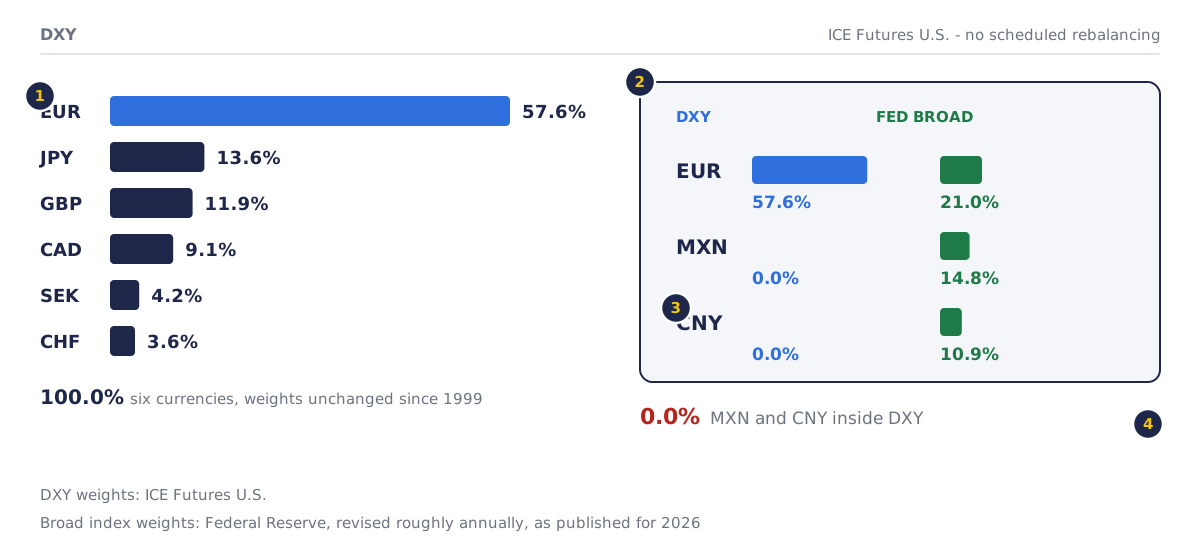
- The six fixed DXY weights, adding up to 100%.
- The euro: 57.6% of DXY, 21.0% of the Fed's index.
- Mexico and China: 14.8% and 10.9% in the Fed's index.
- Both carry 0% in DXY.
How does DXY relate to EURUSD and other USD pairs?
DXY tends to move opposite to pairs where the dollar is quoted second, such as EURUSD and GBPUSD, and in the same direction as pairs where the dollar comes first, such as USDJPY. A pair can still break from DXY when news hits its other currency, which is what makes the comparison useful.
For EURUSD the link is close by construction, so checking one against the other adds little. For USDCAD the link is looser, because the Canadian dollar is only 9.1% of the index. How related positions stack up into one larger bet is covered in the forex pair correlation lesson. DXY also leaves out emerging-market currencies, so a USD pair against one of them can move on local news DXY never sees.
How do you calculate the effect of a 1% euro move on DXY?
Multiply the euro's weight by the size of the move: a 1% rise in EURUSD moves DXY down by roughly 0.576 × 1%, or about 0.57%, if the other five rates stay still. The steps below use round starting numbers to show the arithmetic.
- Start with DXY at 100.00 and EURUSD at 1.1000.
- EURUSD rises 1%, to 1.1110. That is 110 pips (a pip is 0.0001 on EURUSD).
- DXY changes by a factor of 1.01^−0.576, which is about 0.9943. DXY falls to about 99.43.
- Compare a 1% rise in USDCAD: 1.01^0.091 is about 1.0009, so DXY rises only to about 100.09.
Now a hypothetical position: long 0.10 lot of EURUSD, where one pip is worth $1. A 110-pip move is worth 110 × $1 = $110: a gain if EURUSD rose, a loss of the same size if it fell. Pip value is explained in the lots, pips and pip value lesson, and the pip value calculator works it out for other pairs and sizes.
What moves DXY?
DXY moves only when its six exchange rates move, so anything that shifts those rates moves the index. Broad dollar moves are often linked to changing US interest rate expectations, US and euro-area economic data, and shifts between risk appetite and caution. Because the euro is 57.6% of the basket, euro-area news can move DXY as much as US news.
Rates are covered in how interest rates affect currencies, and market stress in the risk-on, risk-off lesson.
How do traders use DXY as context?
Traders use DXY as background to ask whether a dollar move is broad or specific to one pair. If USDJPY rises while DXY is flat, the move is more likely about the yen than the dollar. If DXY and most USD pairs move together, the driver is more likely the dollar itself.
That split, a dollar move or a local move, tells you which news to read next.
Can you trade DXY?
DXY itself is an index, not a spot currency pair, so you cannot buy or sell it the way you trade EURUSD. ICE lists U.S. Dollar Index futures, which have traded since November 1985, with a contract worth $1,000 times the index value (ICE Futures U.S. FAQ).
Some brokers offer CFDs based on these futures. Whether such a symbol exists, and how it is priced and charged, depends on your broker, so check its symbol list and contract specification.
What are the limits of DXY?
DXY's main limits are its old, euro-heavy weights and its narrow basket of six currencies, based on 1973 trade and changed only once, in 1999. It is a precise summary of the dollar against those six, and traders who use it well keep four points in mind:
- Old weights: it leaves out Mexico, China and every emerging-market currency.
- Mostly euro: it often says more about EURUSD than about the dollar overall.
- Context, not a signal: it summarises where the six rates have been, and any single pair can move on its own news.
- Futures differ: futures prices also reflect interest rate differences, so they do not match the index exactly.
Try it on demo
In MetaTrader 5, search the symbol list for a dollar index symbol and note whether your demo account offers one. Then put EURUSD and USDJPY on daily charts side by side for a month. Each week, write one sentence on whether the dollar moved the same way against both.
This lesson is part of the Global Macro module.
Quick check
- The largest weight in DXY belongs to
- How often are DXY's weights rebalanced?
- If EURUSD rises 1% and the other five rates do not move, DXY falls by about
- Which currencies carry no weight in DXY but a large weight in the Fed's broad dollar index?
- A falling DXY means
Frequently asked questions
What does DXY stand for?
DXY is a ticker symbol, not an abbreviation: it is Bloomberg's symbol for the ICE U.S. Dollar Index, nicknamed "Dixie". ICE's own exchange symbol is DX.
What happens when DXY goes up?
When DXY goes up, the dollar has strengthened against its six-currency basket on average. EURUSD has usually fallen and USDJPY usually risen, though any single pair can differ.
Who controls DXY?
No central bank or government sets DXY. ICE Futures U.S. maintains the index and calculates it from market exchange rates; the Federal Reserve created it in 1973 but does not run it today.
Is DXY a good measure of the dollar's strength?
DXY measures the dollar well against the euro and five other major currencies, but not against the whole world. The Federal Reserve's broad index gives a wider view, weighting 26 economies by current trade.
Sources
- ICE Futures U.S., U.S. Dollar Index Contracts FAQ, June 2015: the six currencies and weights, the formula, no scheduled rebalancing, the 1999 euro change, the DX and DXY symbols, the Fed's 1973 origin and ICE's role since 1985, the floating-rate base of March 1973, calculation about every 15 seconds from spot prices, and futures since 20 November 1985 at $1,000 times the index. https://www.ice.com/publicdocs/futures_us/ICE_Dollar_Index_FAQ.pdf
- ICE Data Indices, ICE FX Indexes Methodology, version 3.0, valid from 2 April 2018: geometric average, base level 100.00, base date March 1973, top six US trading partners as measured in 1973. https://www.nyse.com/publicdocs/nyse/indices/ICE_FX_Indexes_Methodology.pdf
- Federal Reserve Board, H.10 Currency Weights, 2 February 2026: 2026 trade weights for the euro area, Mexico, China, Canada and Japan in the broad dollar index. https://www.federalreserve.gov/releases/h10/weights/
- Federal Reserve Board, H.10 Nominal/Real Indexes (accessed 27 October 2026): definition of the nominal broad dollar index and annual weight revisions. https://www.federalreserve.gov/releases/h10/summary/
Practise what you learned
Open an account to use MetaTrader 5. Start on a demo account before risking real money.
Open Account