
How Do Interest Rates Affect Currencies? Rates, Inflation and Policy
Higher interest rates tend to strengthen a currency, all else equal, because they raise the return on its deposits and bonds compared with other countries and attract capital. What moves prices most is a change in expected rates, real rates after inflation and the gap between two central banks.
Module 12 · Lesson 1 of 5
What you'll learn
- How interest rate differentials and capital flows move exchange rates.
- Why real rates, after inflation, can tell a different story from nominal rates.
- Why currencies often move before a decision, and what policy divergence looks like.
- Where the link between rates and currencies breaks down.
How do interest rates affect currencies?
Interest rates affect currencies by changing the return on holding them: when one country's rates rise relative to others, its currency tends to strengthen, all else equal. Its deposits and bonds pay more, so foreign investors need more of that currency to buy them. Lower relative rates work the other way.
The Reserve Bank of Australia says that, all else being equal, an increase in interest rates contributes to the exchange rate being higher than otherwise, and calls the interest rate differential a key driver of demand for its currency.
"All else equal" matters: inflation, growth and risk mood change too, so a currency pair responds to the balance of all of them.
What is monetary policy?
Monetary policy is how a central bank sets interest rates to meet its goal, usually low and steady inflation. How banks decide, and what hawkish and dovish mean, is covered in hawkish vs dovish. This lesson, part of the Global Macro module, looks at what rates do to currencies over months.
The link runs both ways. The ECB notes that exchange-rate changes can affect inflation directly where households buy imported goods, so central banks watch the currency as part of the inflation picture.
What are interest rates?
An interest rate is the price of borrowing money, shown as a percentage of the amount borrowed per year: the borrower pays it, and the saver or lender earns it. At 20% a year, borrowing $10,000 for one year costs $2,000 in interest; at 4%, a $1,000 deposit earns $40.
Every economy has many interest rates, for loans, deposits and bonds, and they move with one anchor: the central bank's policy rate. In the US, for example, that is the Federal Reserve's federal funds rate. When a central bank raises its policy rate, the other rates in its currency usually follow, and that is what moves the currency.
What is an interest rate differential?
An interest rate differential is the difference between the interest rates of two countries, and for a currency pair it compares the rates behind the two currencies. If one country pays 5% and another pays 1%, the differential is 4 percentage points in favour of the first.
Rate differential = rate of currency A − rate of currency B
It matters because it drives capital flows: money moving across borders to buy deposits and bonds. The RBA explains that when its rates rise, assets such as government bonds attract foreign investors, so more money flows into Australia. Buying those assets means buying the currency first. Short-term money that chases the higher rate is often called hot money, and it can leave as quickly as it arrived.
What is the difference between nominal and real rates?
A nominal interest rate is the rate as quoted; a real interest rate is the nominal rate minus expected inflation, so it shows what the return is worth after rising prices. Two countries with very different nominal rates can offer much closer real rates once inflation is counted. For example, 5% with 4% inflation is about 1% in real terms.
Real rate ≈ nominal rate − expected inflation
Quoted real rates often use recent inflation instead of expected inflation, a weak stand-in when inflation moves fast.
How do you calculate a rate differential?
To calculate a rate differential, subtract one country's rate from the other's; for the real differential, first subtract each country's inflation from its own rate. The table below uses two hypothetical countries to show the arithmetic step by step: Country A pays 5.00% and Country B pays 1.00%, with inflation at 4.00% and 1.00%.
| Country A | Country B | Differential | |
|---|---|---|---|
| Policy rate (nominal) | 5.00% | 1.00% | 4.00 points |
| Inflation | 4.00% | 1.00% | |
| Real rate (approx.) | 1.00% | 0.00% | 1.00 point |
On nominal rates, currency A looks 4 points ahead. After inflation the gap is only 1 point, so a high rate mostly eaten by inflation may attract far less capital than its headline suggests.
What does the differential mean for overnight swap?
Swap is the overnight financing adjustment on a position held past the daily rollover, and its direction usually follows the rate differential. As explained in spread, commission and swap, it reflects the two currencies' interest rates plus your provider's charge.
Suppose 1 lot of pair A/B is worth $100,000. A rough gross figure for a 4-point gap is $100,000 × 4% ÷ 365 ≈ $10.96 a night.
| Position on A/B | You effectively hold | Swap direction, in general |
|---|---|---|
| Long (bought) | The higher-rate currency A | Tends to be credited, less the provider's charge |
| Short (sold) | The lower-rate currency B | Tends to be charged |
Your symbol's specification shows the actual swap long and swap short after the provider's charge, and both can be negative. Holding the higher-rate currency to collect the differential is the carry trade, covered in the carry trade and swap.
Why do currencies move before central bank decisions?
Currencies often move before a decision because markets price in the rates they expect, so by the meeting the expected move is usually already in the exchange rate. What moves the price on the day is the surprise: the gap between what the bank did or signalled and what traders had expected.
The ECB notes that longer-term rates depend in part on market expectations of future short-term rates, and that policy moves feed into asset prices and the exchange rate.
| Outcome against expectations | Typical currency reaction, all else equal |
|---|---|
| Rise expected, rise delivered | Little reaction; it was already priced |
| Rise expected, smaller rise or none | Tends to weaken |
| Hold expected, rise delivered | Tends to strengthen |
| Rate unchanged, outlook for more rises | Can strengthen on the change in expected path |
What is the monetary policy cycle?
The monetary policy cycle is the run of rate decisions a central bank makes in one direction, from easing through holding to tightening and back. Cycles, rather than single meetings, tend to shape currency trends that last for months, because each phase changes what markets expect the next decisions to be.
| Phase | What the bank does | Usual reason | Pressure on the currency, all else equal |
|---|---|---|---|
| Easing | Cuts rates | Weak growth, inflation below target | Downward |
| Holding | Leaves rates unchanged | Waiting for data | Depends on what comes next |
| Tightening | Raises rates | Inflation above target | Upward |
A terminal rate is market shorthand for where traders expect the policy rate to end a cycle; changes in that expected end point often matter more than any single decision.
What is policy divergence?
Policy divergence is when two central banks move rates in opposite directions or at very different speeds, so the differential between their currencies widens or narrows quickly. A pair can trend strongly for months while the gap is changing, and the trend tends to end when markets expect the gap to stop widening.
2022 is a textbook historical case. The Federal Reserve raised its target range seven times, from 0-0.25% to 4.25-4.50%. The Bank of Japan kept a negative interest rate of minus 0.1 percent all year.
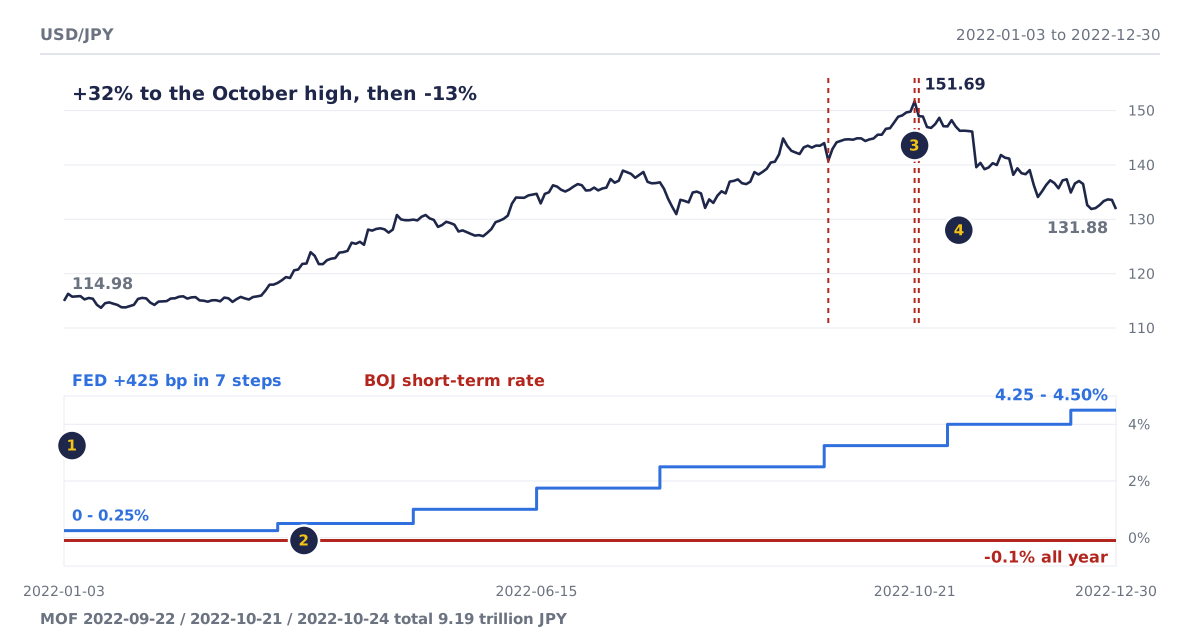
- Markers 1 and 2: the Fed's seven rises, and the Bank of Japan's rate flat at minus 0.1%.
- Marker 3: USD/JPY rose from 114.98 on 3 January to 151.69 on 21 October, about 32%, then ended the year at 131.88, about 13% lower. Prices are derived from ECB euro reference rates, a daily snapshot, not traded prices.
- Marker 4, dashed lines: Japan's Ministry of Finance sold US dollars and bought yen on 22 September and 21 and 24 October, about 9.19 trillion yen in total.
The pip value calculator turns such moves into money for a given position size.
What else moves a currency besides interest rates?
Risk sentiment, growth expectations and direct intervention can each outweigh the rate differential for days or months, so skilled macro traders read rates alongside them rather than alone. The differential sets the backdrop over months; these forces often decide the timing of the moves you see on the chart.
- Risk sentiment: in a sell-off, money can rush into perceived safe havens whatever their rates, as covered in risk-on and risk-off.
- Growth: high rates can slow the economy, and the currency can weaken on growth fears.
- Intervention: authorities can buy or sell their currency directly, causing sharp moves.
- Relationships shift: a link that held for years can fade when inflation, debt or politics change.
- Swap can change: when rates move, swap on an open position can shrink or flip.
Try it on demo
On a MetaTrader 5 demo account, open the symbol specification for two pairs whose currencies have different policy rates and compare swap long and swap short. Check again after the next central bank decision and note whether the figures changed.
Quick check
- All else equal, when one country's interest rates rise relative to another's, its currency tends to
- Country A pays 5% with 4% inflation. Country B pays 1% with 1% inflation. The real rate differential is about
- A central bank raises rates and its currency falls. The most likely reason is
- Policy divergence means
- In 2022, Japan's intervention days
Frequently asked questions
Do higher interest rates strengthen a currency?
Yes, all else equal. Higher relative rates attract capital and support a currency. The exceptions come when the rise was already expected, inflation eats the real return or markets fear a slowdown; then the currency can stay flat or weaken.
Why does a currency fall when interest rates rise?
Usually because the market had expected more. Expected rises are priced in beforehand, so a smaller rise, or a signal that no more are coming, can leave the currency weaker.
How do interest rates affect forex trading?
Interest rates affect forex trading in two ways: they shape the longer-run direction of pairs through differentials and capital flows, and they set the overnight swap on positions held past the rollover.
Does inflation weaken a currency?
High inflation tends to weaken a currency over time, because it lowers the real return on holding it. In the short run, a high reading can support it if traders expect the central bank to raise rates.
What happens to a currency when interest rates are cut?
It tends to weaken, all else equal, because deposits and bonds in that currency now pay less and capital can move elsewhere. If the cut was fully expected, or markets read it as support for growth, the currency may barely move.
Sources
- Reserve Bank of Australia, Drivers of the Australian Dollar Exchange Rate (education explainer) (accessed 27 October 2026): the interest rate differential is a key driver of the demand for and supply of Australian dollars; all else being equal, an increase in Australian interest rates contributes to the exchange rate being higher than otherwise; higher rates make interest-paying assets more attractive to foreign investors and more money flows into Australia. https://www.rba.gov.au/education/resources/explainers/drivers-of-the-aud-exchange-rate.html
- European Central Bank, Transmission mechanism of monetary policy (accessed 27 October 2026): longer-term interest rates depend in part on market expectations about the future course of short-term rates; policy changes may lead to adjustments in asset prices and the exchange rate; exchange-rate changes can affect inflation directly insofar as imported goods are used in consumption. https://www.ecb.europa.eu/mopo/intro/transmission/html/index.en.html
- Board of Governors of the Federal Reserve System, Open Market Operations: seven increases in the federal funds target range in 2022, from 17 March (0.25-0.50%) to 15 December (4.25-4.50%). https://www.federalreserve.gov/monetarypolicy/openmarket.htm
- Bank of Japan, Statement on Monetary Policy, 22 September 2022: a negative interest rate of minus 0.1 percent applied to Policy-Rate Balances (the same rate appears in every 2022 statement, including 20 December 2022). https://www.boj.or.jp/en/mopo/mpmdeci/state_2022/k220922a.htm
- Ministry of Finance Japan, Foreign Exchange Intervention Operations (historical data, April 1991 onwards): US dollar sold and Japanese yen bought on 22 September 2022 (28,382 hundred million yen), 21 October 2022 (56,202) and 24 October 2022 (7,296), about 9.19 trillion yen in total. https://www.mof.go.jp/english/policy/international_policy/reference/feio/foreign_exchange_intervention_operations.csv
- European Central Bank, Euro foreign exchange reference rates: reference rates published for information purposes only, from a daily concertation around 14:10 CET; USD/JPY in this lesson is derived from the EUR/USD and EUR/JPY reference rates for 2022. https://www.ecb.europa.eu/stats/policy_and_exchange_rates/euro_reference_exchange_rates/html/index.en.html
Practise what you learned
Open an account to use MetaTrader 5. Start on a demo account before risking real money.
Open Account