
Good Decision vs Good Outcome in Trading: Process Over Outcome
A good decision in trading is one that followed your written rules using the information you had at the time, while a good outcome is simply a trade that made money. The two are separate because any single trade is partly luck, so a good decision can lose and a bad decision can win.
Module 16 · Lesson 3 of 4
What you'll learn
- The difference between a good decision and a good outcome, with all four combinations in a 2x2 table.
- Why a good decision can lose and a bad decision can win, with the arithmetic of variance.
- What outcome bias is and what the original research found.
- How to grade every trade by process in your journal.
This lesson is part of the Trading Mindset module.
What is a good decision versus a good outcome in trading?
A good decision follows your written rules using the information you had when you entered; a good outcome is a trade that made money. The decision is the part you control. The outcome is the decision plus everything you do not control, including the next price move.
If a trade closes in profit, you know the outcome. You cannot know from the profit alone whether the decision was sound. A trade that made money can break every rule you wrote, and a trade that lost can follow all of them.
Definitions
- Process: the steps you take for every trade, written before you trade: what qualifies as a setup, how much to risk, where the stop goes, and when you stay out.
- Decision quality: whether a trade followed that process, judged with only the information available at entry.
- Outcome: the money result of the trade after costs, often written as an R-multiple (result divided by the money risked).
- Variance: how widely results spread when the same process is repeated. Even a fixed method produces runs of wins and runs of losses.
- Outcome bias: judging the quality of a decision by how it turned out.
Why can a good decision lose and a bad decision win?
A single trade is one draw from a range of possible results, so a sound decision can lose and an unsound one can win. The more trades you take, the more a process shows in the results. Over a handful of trades, luck dominates.
Take an invented method that wins 40% of its trades. Calculated from the binomial distribution, 10 trades from that method produce the following.
| Wins in 10 trades | Chance |
|---|---|
| 2 or fewer | 16.7% |
| 3 to 5 | 66.6% |
| 6 or more | 16.6% |
So about one stretch of 10 trades in three lands at 2 or fewer wins, or at 6 or more, with nothing about the method changed. In 20 trades, a run of 5 losses in a row happens at least once about 48% of the time. These figures are pure probability for an invented method, and they show how wide variance is.
If you judged this method on its last 10 trades, you could call it broken or brilliant, and be wrong either way. The fair test of the method is a larger sample, covered in trading performance metrics.
What is outcome bias in trading?
Outcome bias is the tendency to judge a decision by its result instead of by the quality of the thinking behind it. It was documented by Jonathan Baron and John Hershey in a 1988 paper in the Journal of Personality and Social Psychology.
In five studies, participants read descriptions of decisions made by others under uncertainty, either medical choices or monetary gambles, and were told the decision maker had all the relevant information. They rated the thinking as better, and the decision maker as more competent, when the outcome was favourable than when it was unfavourable. Participants who were asked said they should not take outcomes into account, yet they did.
That is the trap in trading. You know your own result, and the result colours how the decision looks afterwards. A profit makes a rushed entry feel like good instinct, and a stop-out makes a careful entry feel like a mistake. The other biases that distort trading decisions are covered in the cognitive biases in trading lesson.
Is a winning trade always a good trade?
No. A winning trade is a good trade only if the decision behind it was also good, and the two can come apart in all four combinations. The 2x2 table below puts one trade in each cell, using synthetic trades on an invented $2,000 demo account.
The written rule is to risk 1% ($20) per trade, enter only at a setup from the trading plan, place the stop with the order and write the reason before entry. Pip values are from the lots, pips and pip value lesson: 0.04 lot on EURUSD is $0.40 per pip.
| Good outcome (made money) | Bad outcome (lost money) | |
|---|---|---|
| Good decision (followed the rules) | Trade A. Buy the EURUSD currency pair at a retest of 1.1000 support, 0.04 lot, stop 50 pips below, target 100 pips above. Target hit: +$40 (+2R). | Trade B. The same setup on another day, same size, same stop. Stop hit: −$20 (−1R). |
| Bad decision (broke the rules) | Trade C. Buy GBPUSD on impulse after a news spike, no setup in the plan, 0.08 lot with a 50-pip stop, which risks $40 (2%). Price rises 60 pips: +$48. | Trade D. Sell GBPUSD straight after Trade B to win the money back, no setup, 0.08 lot, no stop. Closed by hand at −70 pips: −$56. |
The arithmetic: Trade A, 100 pips × $0.40 = $40, and $40 ÷ $20 = +2R. Trade B, 50 × $0.40 = $20 lost, −1R. Trade C, 0.08 lot is $0.80 per pip, so a 50-pip stop risks $40 and 60 pips gains $48. Trade D, 70 × $0.80 = $56 lost.
Read the table by cell:
- Good decision, good outcome (A): nothing to fix. Repeating it is what the process is for.
- Good decision, bad outcome (B): a planned loss. It is a cost of the method, and changing the plan because of one loss would be reacting to variance.
- Bad decision, good outcome (C): the cell to study first. The profit pays you for breaking the rule, and a behaviour that is paid for tends to come back.
- Bad decision, bad outcome (D): painful, but the cause is clear. It is the pattern in the revenge trading lesson.
Add the four results: +$40 − $20 + $48 − $56 = +$12. The total looks fine, and it hides that two of the four trades broke the rules. A profit-and-loss line cannot tell you that; only grading each trade can.
How do you grade a trade by process in your journal?
Add a process score to each journal entry: a short yes or no checklist, filled in as you enter, with the result added after the close. The decision grade then comes from the checklist, and the outcome grade from the money result, and the two never overwrite each other.
The base journal is in the trading journal lesson, and the rules the checklist tests are written as in the writing trading rules lesson.
A five-question process check, using the rules from the table above:
- Is the setup one the written plan allows?
- Is the risk within the rule (1% or less)?
- Was the stop loss placed with the order?
- Was the reason written before entry?
- Was I free of a trigger, such as entering straight after a loss or a news spike?
Count the yes answers for a process score out of five. Call the decision good only when the score is 5 of 5; any "no" makes it a bad decision, whatever the result. Then add the result in R and a quadrant label (A, B, C or D).
| Trade | Q1 | Q2 | Q3 | Q4 | Q5 | Process score | Result | Quadrant |
|---|---|---|---|---|---|---|---|---|
| A | Yes | Yes | Yes | Yes | Yes | 5 of 5 | +$40 | Good decision, good outcome |
| B | Yes | Yes | Yes | Yes | Yes | 5 of 5 | −$20 | Good decision, bad outcome |
| C | No | No | Yes | No | No | 1 of 5 | +$48 | Bad decision, good outcome |
| D | No | No | No | No | No | 0 of 5 | −$56 | Bad decision, bad outcome |
When you review, read the process score column first and the result column second. The review routine is covered in the trade review cycle lesson. Trade C is the entry to read most carefully, because it is the only one a result-based review would praise.
What do twenty trades look like graded by process?
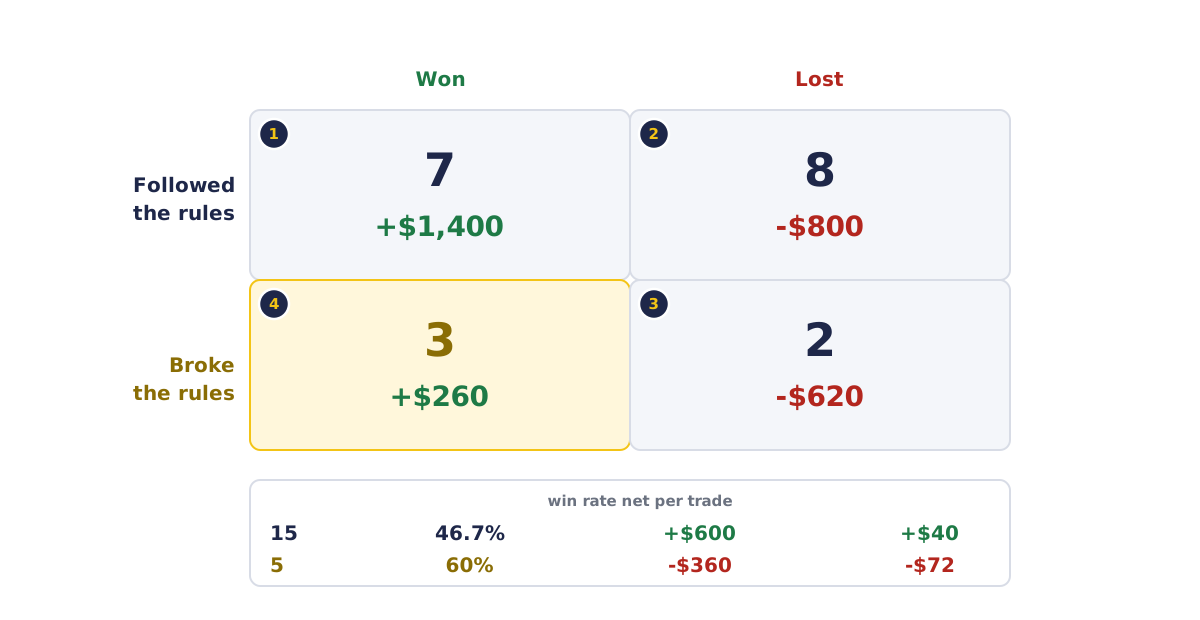
Grading the same twenty trades by rules and by result gives two different readings of the record. In this synthetic record, 15 trades followed the rules and made +$600, while 5 broke them and lost $360, even though the rule-breakers won more often.
| Won | Lost | Total | |
|---|---|---|---|
| Followed the rules | 7 trades, +$1,400 | 8 trades, −$800 | 15 trades, +$600 |
| Broke the rules | 3 trades, +$260 | 2 trades, −$620 | 5 trades, −$360 |
- Rule-following trades: 7 wins ÷ 15 trades = 46.7%, and +$600 ÷ 15 = +$40 per trade.
- Rule-breaking trades: 3 wins ÷ 5 trades = 60%, and −$360 ÷ 5 = −$72 per trade.
- All twenty trades: +$600 − $360 = +$240.
Judged on win rate alone, the rule-breaking trades look better, at 60% against 46.7%. Judged on money, they lost $72 per trade while the rule-following trades made $40 per trade. The five rule-breaking trades turned a +$600 record into a +$240 one. Five trades is too few to conclude anything about a method, but sorting them by whether you followed your own plan is available immediately.
How does judging by process compare with judging by outcome?
Judging by outcome asks "did it make money?", while judging by process asks "did I decide the way I said I would?". The table compares what each one teaches in the four situations from the 2x2, from the rule-breaking win (Trade C) to the rule-following loss (Trade B), and how soon each gives a reading.
| Judging by outcome | Judging by process | |
|---|---|---|
| Question asked | Did the trade make money? | Did the trade follow the rules? |
| Rule-breaking win (C) | Praised, so it can repeat | Flagged as the entry to study |
| Rule-following loss (B) | Treated as a mistake, so rules get changed | Recorded as a planned cost of the method |
| What can change the plan | One result | A review of many trades |
| Time to a reading | After the close, and noisy | At entry, and complete |
How do you test the process itself?
Grading by process separates luck from behaviour; testing the process means measuring your rules over a larger sample of trades. A process score of 5 of 5 says you did what you wrote. Whether what you wrote works shows up in the results of many rule-following trades, read with the measures in trading performance metrics.
- Test the rules on a sample. Read the rule-following trades as a group, and change a rule at a scheduled review, never after one result.
- Sort a bad month. A readable record splits a losing stretch into bad luck and bad discipline, and each has a different fix.
- Keep hindsight out. If you fill in the checklist after the close, the result colours your answers. Complete questions 1 to 5 before the order.
- Judge on the information at entry. A decision is graded on what you knew when you placed it. A surprise nobody could have foreseen does not make the decision bad.
- Count costs. The examples above ignore spread, commission and swap, which come off every result, so include them when you test the rules.
Try it on demo
On a MetaTrader 5 demo account, add the five process questions and a quadrant column to your journal. Fill in the questions before you place each order, and add the result after the close. After ten trades, count the four quadrants. Then read the rule-breaking trades first, starting with any that made money, and write one sentence on what triggered each. The habits of consistent traders lesson shows how to turn this into a daily and weekly routine.
Quick check
- Which trade is a bad decision with a good outcome?
- A method wins 40% of its trades. Across 10 trades, how often would you expect 2 or fewer wins?
- A trade passed all five process checks and hit its stop loss for −$20. In the journal it is
- In Baron and Hershey's 1988 studies, people who rated the same decision judged the thinking as better when the outcome was
- Every trade this month scored 5 of 5 on your process checklist. What does that tell you?
Frequently asked questions
Is a winning trade always a good trade?
No. A winning trade is a good trade only if the decision behind it followed your rules. A trade that broke the risk rule and made money is a bad decision with a good outcome, and it is the entry most likely to teach the wrong lesson.
What is outcome bias in trading?
Outcome bias is judging a decision by its result instead of by the thinking behind it. In Baron and Hershey's 1988 studies, people rated the same decisions better when the outcome was favourable, even though they said outcomes should not count.
How do you judge a trade without looking at profit or loss?
You judge a trade against a written checklist completed before entry: is the setup in the plan, is the risk within the rule, is the stop placed with the order, was the reason written first, and was there no trigger such as a recent loss. If every answer is yes, the decision was good whatever the result.
Can you make good decisions and still lose money?
Yes. Every trade has a range of possible results, so a sound decision can lose. With an invented 40% win rate, 2 or fewer wins in 10 trades happens about 16.7% of the time. Over a larger sample, the process is what shows in the results.
How many trades does it take to judge a trading method?
More than a handful. Ten trades cannot separate a sound method from a lucky or unlucky run, as the variance table shows. Judge your behaviour against your rules on every trade, and judge the method only over a larger sample, using the measures in the performance metrics lesson.
Sources
- Jonathan Baron and John C. Hershey, American Psychological Association, Outcome bias in decision evaluation, Journal of Personality and Social Psychology 54(4), 569-579, 1988, accessed 19 October 2026: in five studies, participants rated the thinking behind a decision as better, and the decision maker as more competent, when the outcome was favourable than when it was unfavourable, although they understood they had all the relevant information and said outcomes should not be considered. https://doi.org/10.1037/0022-3514.54.4.569
Practise what you learned
Open an account to use MetaTrader 5. Start on a demo account before risking real money.
Open Account