
Global Macro Forex: How the Big Picture Moves Currencies
Module 12
Lessons in this module
- 1Interest rates and currencies8 min
Higher interest rates tend to strengthen a currency, all else equal, because they raise the return on its deposits and bonds compared with other countries and attract capital. What moves prices most is a change in expected rates, real rates after inflation and the gap between two central banks.
- 2Risk-on and risk-off8 min
Risk on and risk off describe whether investors are moving money toward riskier assets, such as shares, or toward assets seen as safer, such as the yen. The labels describe flows across many markets at once, and in a severe shock even safe havens can be sold for cash, as in March 2020.
- 3US Dollar Index (DXY)8 min
DXY is the ICE U.S. Dollar Index, a single number that measures the US dollar against a fixed basket of six currencies, weighted so the euro makes up 57.6%. It started at 100 in March 1973, so a reading above 100 means the dollar is stronger against that basket than it was then.
- 4Commodity currencies8 min
Commodity currencies are the currencies of big raw-material exporters, such as the AUD (iron ore, coal, LNG), CAD (crude oil) and NZD (dairy). Their link to commodity prices runs through the terms of trade, and its strength shifts over time, so skilled traders measure it with rolling correlations.
- 5Geopolitics and shocks8 min
Geopolitical risk is the threat that wars, conflicts, elections, sanctions or trade disputes disrupt markets, often moving currency prices sharply and without warning. Skilled traders do not forecast these shocks; they decide in advance how much exposure they hold when one arrives.
About this module
Global macro forex is the study of how large economic and political forces, such as interest rates, global risk appetite, the US dollar, commodity prices and geopolitical events, move currencies across many markets at once. It explains the backdrop behind individual charts and why several pairs move together, teaching the mechanics rather than forecasts.
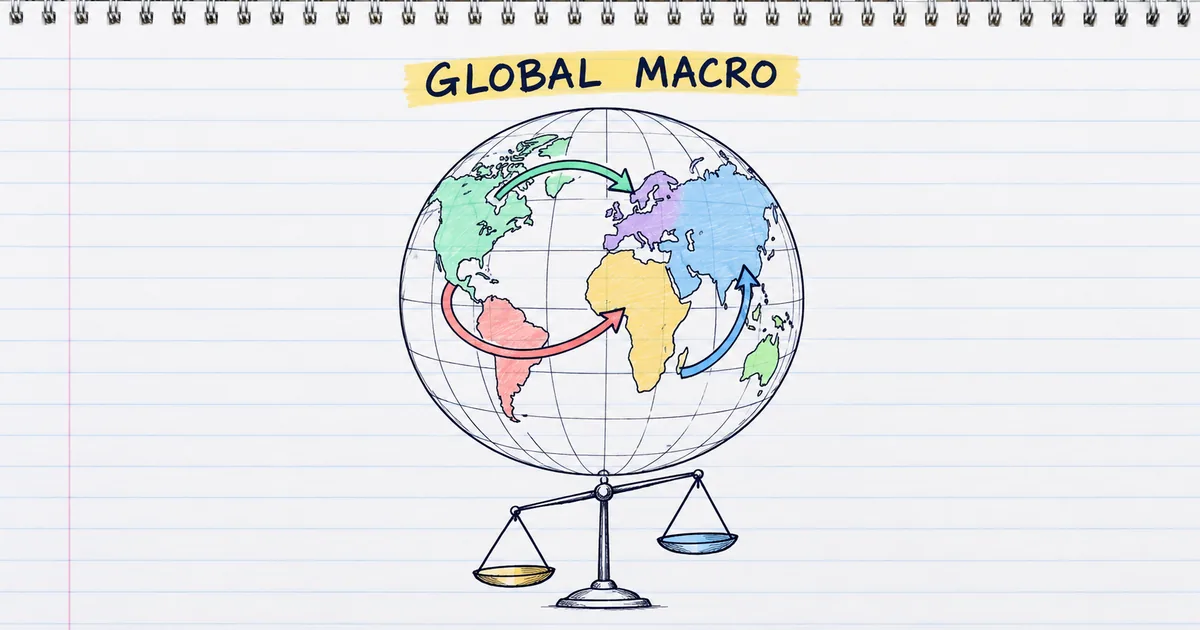
In this module you learn how interest rate differentials and the policy cycle affect currencies, what risk-on and risk-off mean for safe-haven and higher-yielding currencies, what the US Dollar Index measures and what it leaves out, why the Australian, Canadian and New Zealand dollars are called commodity currencies, and how geopolitical risk reaches the forex market through shocks and gaps.
It builds on the Intermediate fundamentals, especially central banks and currencies in Module 8, Fundamental Analysis, and on forex pair correlation from Module 10.
How does global macro affect forex?
Global macro affects forex through four channels: interest rate differentials, shifts between risk-on and risk-off sentiment, broad US dollar strength or weakness, and commodity prices that feed into the currencies of exporting countries. Geopolitical shocks act through all four at once, often within minutes.
| Channel | What moves | Lesson |
|---|---|---|
| Interest rate differentials | Money flows toward the currency whose rates are rising faster | Monetary policy and currencies |
| Risk sentiment | Safe havens gain in risk-off, higher-yielding currencies in risk-on | Risk on, risk off |
| The US dollar | One USD move shows up across every USD pair | US Dollar Index (DXY) |
| Commodities | Oil, metals and farm prices feed AUD, CAD and NZD | Commodity currencies |
What is intermarket analysis?
Intermarket analysis is reading related markets together, such as bond yields, stock indices, oil, gold and the US dollar, to understand why a currency pair is moving and to check whether other markets agree. Rising US yields alongside a falling USDJPY, for example, is a mismatch worth noticing.
A worked example: Canada is a major oil exporter, so when oil rises the Canadian dollar tends to strengthen and USDCAD tends to fall. If oil jumps 5% and USDCAD barely moves, something else is driving the pair, often the US dollar itself. Bond yields and market sentiment are the other inputs most traders check.
How do traders use global macro in forex?
Traders use global macro as a backdrop for each trade: they note which central banks are raising or cutting rates, whether markets are in risk-on or risk-off mode and what the dollar index is doing, then favour trades that agree with that backdrop. Several pairs often move on one theme.
That last point matters for risk. A long AUDUSD and a long NZDUSD are largely one bet on risk appetite and a weaker dollar, so correlation risk counts them as one larger position. A wide rate gap between two currencies is also what a carry trade is built on.
What do traders ask about global macro forex?
Traders ask four things first about global macro forex: what global macro means, which data matters most, how long macro themes last and whether macro works for short-term trading. The answers below each stand alone, with links to the lessons that cover them.
What does global macro mean in trading?
Global macro is an approach that takes positions based on broad economic and political views across countries and markets: interest rates, growth, inflation, currencies, bonds and commodities. In forex it means reading currencies as part of that bigger picture.
Which macro data matters most for currencies?
Central bank rate decisions and inflation come first, because they set the path of interest rates. Employment and growth follow. The major economic releases lesson covers each one.
How long do macro themes last?
Months to years. The US Federal Reserve raised rates from near zero in March 2022 to a 5.25-5.50% range by July 2023, and the dollar's interest-rate advantage shaped forex markets through that period.
Is global macro useful for short-term trading?
Yes, as context. A short-term trader who knows a rate decision is due, or that markets are in risk-off mode, avoids trading against the main flow and expects sharper moves. The geopolitics and market shocks lesson covers sudden events.
Practise what you learned
Open an account to use MetaTrader 5. Start on a demo account before risking real money.
Open Account