
Fundamental Analysis: Economic Data, Central Banks and Earnings
Module 8
Lessons in this module
- 1Economic calendar7 min
To read an economic calendar, check each event’s time, currency and importance, then compare the actual figure with the forecast when it is released. The gap between them, the surprise, is what markets tend to react to, not the number itself.
- 2Major economic releases8 min
NFP, or non-farm payrolls, is the monthly US employment report from the Bureau of Labor Statistics, showing how many jobs employers outside farming added or cut. With CPI inflation, GDP and central bank rate decisions, it is one of the scheduled releases markets watch most, because prices react to the gap between forecast and result.
- 3Central banks and currencies8 min
Hawkish means a central bank leans towards higher interest rates or tighter policy to fight inflation; dovish means it leans towards lower rates or looser policy to support growth. Currencies tend to move most when a decision or its tone differs from what the market expected.
- 4Earnings and stock CFDs8 min
Earnings reports affect stock prices by changing what the market expects a company to earn, so prices react to results and guidance versus forecasts, not to profit alone. Because many reports land outside regular trading hours, a stock CFD can open at a very different price from its last close.
- 5Crypto and commodity drivers8 min
Commodity prices move mainly on supply, demand, inventories and the US dollar, while crypto prices move on supply rules, regulation news and risk sentiment. Both can move sharply, and futures expiry and weekend trading add mechanics that most currency pairs do not have.
About this module
Fundamental analysis is studying the economic and financial information behind a price, such as interest rates, inflation, employment, company earnings and supply and demand for a commodity, to understand why a market moves. It explains the forces behind price changes, and its core skill is comparing each release with expectations, because that gap is what markets react to.
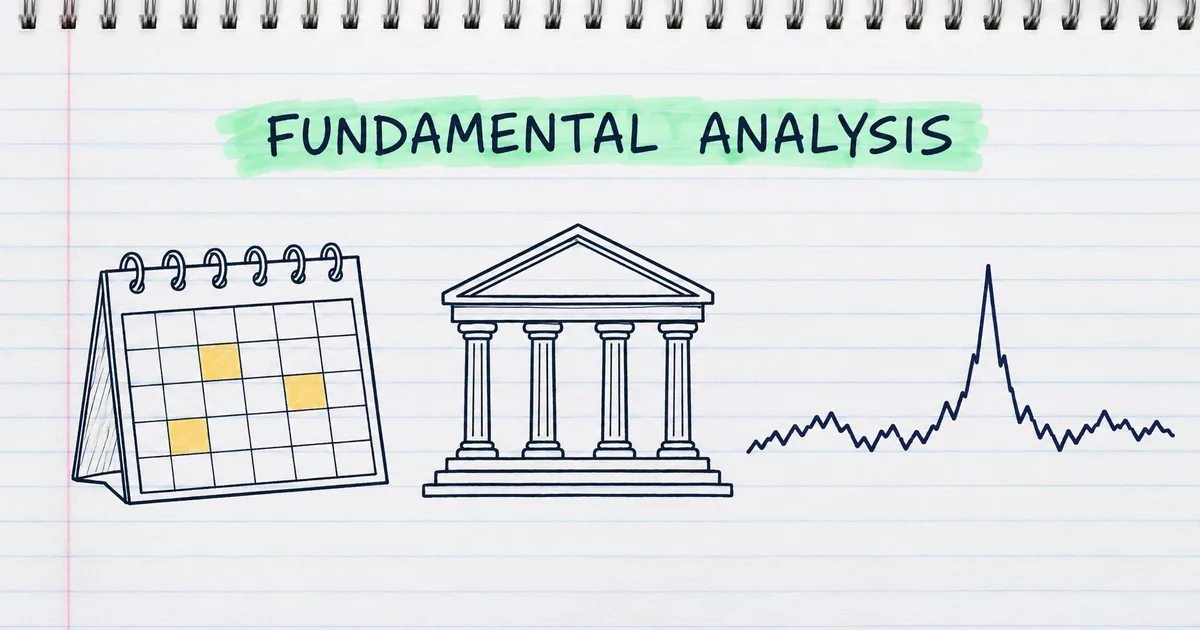
In this module you learn how to read an economic calendar, what the major releases such as non-farm payrolls (NFP), inflation (CPI) and GDP measure, how central banks set policy and what hawkish and dovish mean, how earnings reports affect stock CFDs, and what tends to drive crypto and commodity prices.
It builds on what moves market prices from Module 1, Market Basics. Managing trades around news, including gaps and slippage, is covered in Module 10, Trade Management.
What is fundamental analysis?
Fundamental analysis in forex compares the economies behind two currencies: interest rates, inflation, growth and employment, set against what traders expected. A currency tends to move when a release or a central bank decision changes the expected gap between the two economies' interest rates. The monetary policy and currencies lesson explains how rate gaps work.
How do traders use fundamental analysis?
Traders use fundamental analysis to know when and why a market may move: they check the economic calendar, compare each result with the forecast, and read central bank decisions for the direction of interest rates. The gap between result and forecast is what markets react to, so a strong number that was expected moves price very little.
How do you do fundamental analysis in forex?
To do fundamental analysis in forex, list the week's high-impact releases for both currencies in a pair, note the forecast for each, then compare the actual figure with the forecast and with the central bank's latest guidance. A result far from the forecast is what moves the pair.
A worked example: US CPI inflation is forecast at 3.0% a year and comes in at 3.4%. Hotter inflation raises expectations of higher US interest rates, so the US dollar tends to strengthen and EURUSD tends to fall. Had CPI come in at 3.0%, as forecast, the price would usually move far less. The economic calendar lesson shows where to find the forecast and the actual figures.
Which economic indicators matter most in forex?
The main fundamental indicators for forex are interest rate decisions, inflation (CPI), employment such as US non-farm payrolls, GDP growth, PMI surveys and retail sales. Rates matter most, and the others matter because they shape where central banks set rates next, which is why markets watch them closely.
The major economic releases lesson explains each one and when it is published, and hawkish and dovish central banks shows how a rate decision is read.
What do traders ask about fundamental analysis?
Traders ask four things first about fundamental analysis: whether it works for short-term trading, whether it beats technical analysis, how it applies to stock CFDs and where to find release times. The answers below each stand alone, with links to the lessons that cover them.
Does fundamental analysis work for short-term trading?
Yes, as timing and context. A short-term trader checks which releases are due today, avoids opening a trade seconds before one, and knows why a pair is moving fast. The trading the news lesson covers the approaches traders take around releases.
Is fundamental or technical analysis better?
Neither replaces the other. Fundamental analysis explains why a market moves and when it may move sharply; technical analysis shows where to enter, place the stop and take profit. Most traders use both.
How does fundamental analysis apply to stock CFDs?
For a stock CFD, the company matters as much as the economy: earnings per share, revenue and guidance against analysts' forecasts. The earnings and stock CFDs lesson shows how a report moves a share price.
Where do you find economic release times?
On an economic calendar, which lists each release with its time, the forecast, the previous figure and the actual result once published. Set it to your own time zone, as the economic calendar lesson shows.
Practise what you learned
Open an account to use MetaTrader 5. Start on a demo account before risking real money.
Open Account