
Trading Plan: What to Include and How to Write One
A trading plan is a written, dated document that fixes what you trade, when, how much you risk and when you stop, before any trade is open. It turns your rules, checklist and journal into one set of limits that every trade can be checked against.
Module 15 · Lesson 1 of 4
What you'll learn
- What a trading plan is, and how it differs from rules, a checklist and a journal.
- The six sections a complete plan needs, with an outline you can copy into a document.
- A worked example of a plan on a demo account, including a day that breaks it.
- How and when to review and change the plan.
This is the first lesson of the Business of Trading module.
What is a trading plan?
A trading plan is a written, dated document that says what you trade, when you trade, how much you risk and when you stop, all decided before any trade is open. It is not a forecast and it is not a strategy on its own.
It is the one place where your rules, your risk limits and your routine are written down together, so a trade can be checked against it afterwards.
Definitions
- Trading plan: the full written document: markets, entry and exit conditions, risk limits, routine, records and review.
- Risk per trade: the money you lose if the stop loss is hit, often written as a percentage of the account.
- Daily loss limit: the total loss in a day after which you open no new trades.
- Portfolio heat: the total you would lose if every open position hit its stop loss, explained in the correlation risk lesson.
- Plan version: a number and date on the document, so each past trade can be judged against the plan that applied at the time.
Why do you need a trading plan?
You need a trading plan because decisions made before a trade are made calmly, and a written plan gives your results something to be compared against. Without one, a losing month proves nothing either way: you cannot tell a plan that failed from a plan that was ignored.
Research on goals in general supports writing decisions as if-then statements in advance. A meta-analysis of 94 independent tests found that forming if-then plans that spell out when, where and how to act had a medium-to-large positive effect on goal attainment (d = .65), according to Gollwitzer and Sheeran (2006). The research covers goals in general, and it backs the core trading habit of deciding first. A plan also makes your own behaviour visible: every trade either followed it or did not.
How does a plan differ from rules, checklists and journals?
A trading plan is the full document; rules are the limits inside it, a checklist is the quick test before each order, and a journal is the record of what you actually did. Each answers a different question, and the plan is the one that holds the other three together.
| Trading rules | Pre-trade checklist | Trading journal | Trading plan | |
|---|---|---|---|---|
| Question it answers | What must always or never be true? | Is this trade within my limits right now? | What did I do, and did I follow the rules? | What do I trade, when, with what limits, and how do I review? |
| Written | Before trading | Before each order | At the time of each trade | Before trading, revised at reviews |
| Example | If today's loss reaches $60, I stop | Is the stop placed? Is the size right? | Entry, result, rule check | All of these, plus markets and routine |
| Lesson | Writing trading rules | Pre-trade checklist | Trading journal | This lesson |
What should a forex trading plan include?
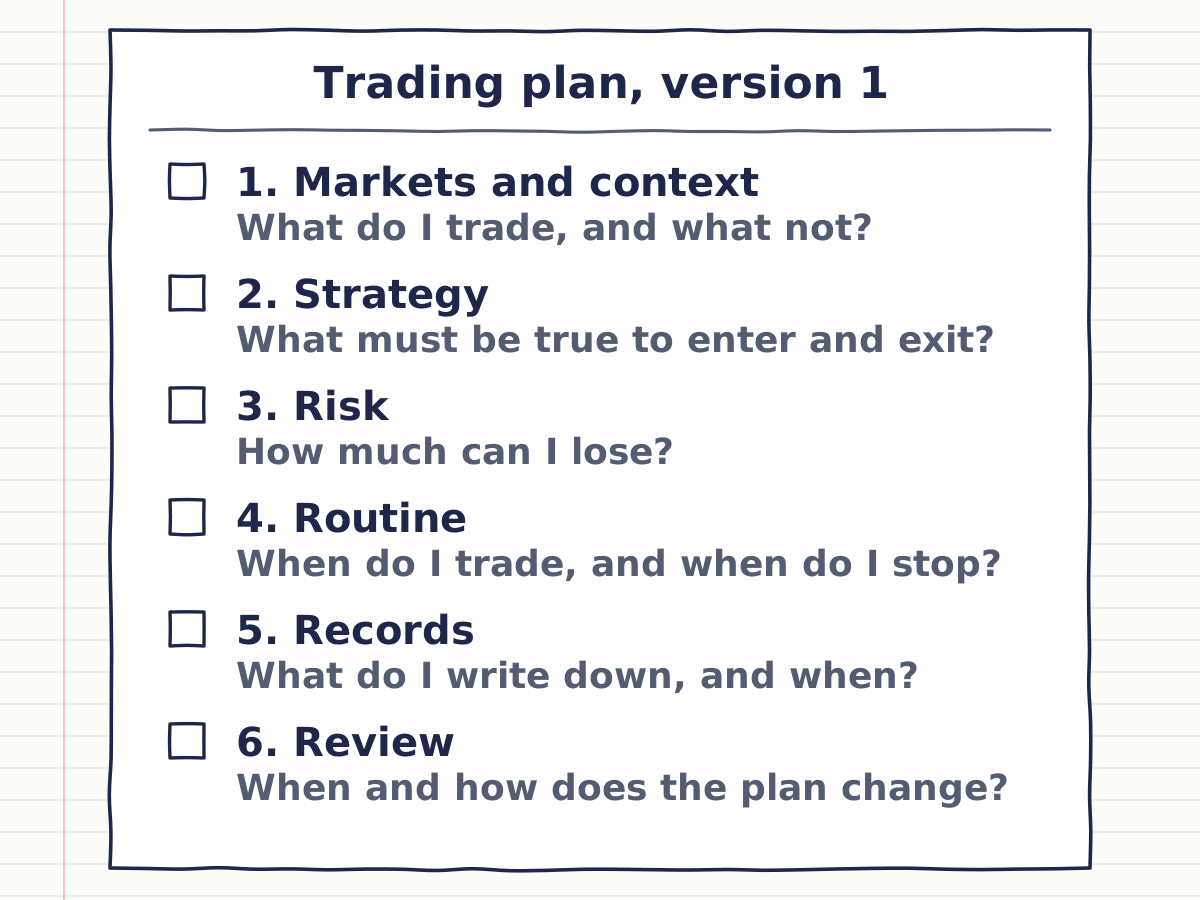
A forex trading plan should include six sections: markets and context, strategy, risk, routine, records, and review. This outline works as a trading plan template: copy the headings into a document, then fill each one with your own entries. Most of them you have already written as separate pieces; the plan joins them.
The example column shows the format; your own numbers and setups go in the brackets.
| Section | What it answers | Example entry (format only) |
|---|---|---|
| 1. Markets and context | What do I trade, and what will I not trade? | Instruments I have studied: EURUSD, GBPUSD. Not traded: anything I cannot size |
| 2. Strategy | What must be true to enter and to exit? | If [my conditions A and B] on [timeframe], I may enter; exit at stop, target or [time] |
| 3. Risk | How much can I lose? | Risk per trade [X]%; open risk cap [Y]%; daily loss limit [Z]%; risk capital stated |
| 4. Routine | When do I trade, and when do I stop? | Sessions [hours]; no new trade within [N] minutes of listed news; stop at the daily limit |
| 5. Records | What do I write down, and when? | Journal entry before the order and after the close; screenshots saved |
| 6. Review | When and how does the plan change? | Review every [day]; change numbers only then, as a dated new version |
Three points about the sections:
- Strategy is yours to write. The entry conditions are the one part the academy cannot supply. Write them as if-then statements so that anyone could check them on a chart.
- Risk needs two numbers. A per-trade number sizes one trade (position sizing turns it into lots). A portfolio number limits all open trades together, since several correlated trades can act like one large one.
- Capital is a line in the plan. State the amount the account trades with, that it is never borrowed, and that it is never topped up to recover losses. The trading capital lesson covers this section in full.
How do you write a trading plan?
To write a trading plan, collect what you already have, fill in the six sections, test every line against the question "would this ever stop me doing something?", and date it as version 1. A line that never stops you from doing anything is decoration.
- Paste in your written trading rules, your pre-trade checklist and your journal template under the matching headings.
- Mark every heading with nothing under it as a gap.
- Choose your own numbers for risk per trade, the portfolio cap and the daily loss limit, and write why.
- Add the review date to your diary.
- Put the version and date at the top. Use it for a period on a demo account before any live use.
Most first plans are missing the risk cap and the review date. That is an unfinished document, not a verdict on you. Version 1 only needs to be complete enough to be checked.
What does a written plan look like on a real day?
A written plan turns your risk rules into numbers you can check: risk per trade, an open risk cap, a daily loss limit and a position size for each stop. This plan is for a synthetic $2,000 demo account, with round numbers chosen for easy arithmetic.
Plan v2, dated 19 October 2026
| Line | Plan entry | Calculation |
|---|---|---|
| Risk per trade | 1% of the account | 1% × $2,000 = $20 |
| Open risk cap | 3% of the account | 3% × $2,000 = $60, so at most three $20 trades open together |
| Daily loss limit | 3% of the account | 3% × $2,000 = $60 |
| Size, 25-pip EURUSD stop | $20 ÷ (25 pips × $10 per pip per lot) | 0.08 lot |
| Review | Every Sunday | Journal first, then rules |
Check the size: 0.08 lot × 25 pips × $10 = $20. A fourth open trade would bring open risk to 4 × $20 = $80, which is 4% and above the cap, so the plan says no.
One day's journal against the plan
| Trade | Result | Running total | Plan check |
|---|---|---|---|
| 1 | −$20 | −$20 | Followed |
| 2 | −$20 | −$40 | Followed |
| 3 | −$20 | −$60 | Followed. The 3% limit is reached, so the day is over |
| 4 | −$20 | −$80 | Broken: no setup, taken to win it back |
The plan's worst case for the day was −$60, or 3%. The actual loss was −$80, or 4%, because trade 4 was taken after the limit. A day of +$40 and −$20 would instead finish at +$20, or 1%, with the plan followed throughout.
The point is what the plan shows: three of the four losses were the plan working as written, while the fourth was a breach. The revenge trading lesson covers why trade 4 happens, and the trading discipline lesson covers how to prevent it.
How do you review and change a trading plan?
Review a trading plan at a fixed, scheduled time, away from open trades, using journal evidence, and record every change as a new dated version. Never edit the plan during a trade: a change made mid-trade is an exception, not a version.
A review compares two things: what the plan said and what the journal shows. For example, the synthetic journal behind plan v2 might show that three of four rule breaks happened after 15:00. Version 3 could then add "no new trades after 15:00". Four breaks are a small sample, so a skilled reviewer tests such a pattern on demo before making it permanent. The siblings of this lesson cover the numbers and the schedule: trading performance metrics and the trade review cycle.
| Version | Date | Change | Evidence (synthetic) |
|---|---|---|---|
| v1 | 12 Oct 2026 | First complete plan | None yet |
| v2 | 19 Oct 2026 | Added the 3% open-risk cap | Journal showed two correlated trades open together |
What makes a trading plan work?
A trading plan works when it is specific, tested and followed: every line can be checked, the numbers have been run on demo, and the rules hold on losing days as well as winning ones. It governs your behaviour, not the market, so a trade that follows every line is a good trade at its target or its stop.
- Write behaviour, not forecasts. Every line should be something you can check on a chart or in the journal afterwards.
- Test the numbers. Run each new version on a demo account before it governs live trading.
- Close decisions in advance. The worked example shows a breach after the daily limit. The trading discipline lesson covers how skilled traders hold their rules after a losing run.
- Plan for gaps. A stop loss caps the planned loss, and in a volatile market or a gap it fills at the next available price, so an actual loss can be larger than the figure in the plan.
Try it on demo
Create one document with the six headings. Paste in the rules, checklist and journal columns you already have, and mark every empty heading as a gap. Choose your own risk per trade, open-risk cap and daily loss limit, write the date and "v1", and trade a MetaTrader 5 demo account under it for two weeks. At the end of the first week, review it as described above.
Quick check
- A trading plan is best described as
- A $2,000 demo plan risks 1% per trade and caps open risk at 3%. Trades 1 to 3 are open. May a fourth be opened?
- Which section of a plan decides when you stop for the day?
- When should you change a written trading plan?
- The plan risks $20 per trade. With a 25-pip EURUSD stop and $10 per pip per lot, the position size is
Frequently asked questions
Do you need a trading plan?
Yes. A written plan lets you tell a plan that failed from a plan you did not follow, and it gives every result something to be checked against. It also fixes your risk limits before any trade is open, when decisions are made calmly.
What is the difference between a trading plan and a trading strategy?
A trading strategy is the part of a plan that sets entry and exit conditions; a trading plan also covers risk, routine, records and review. A strategy says when to enter. A plan says that, plus how much to risk, when to stop and when to change it.
How long should a trading plan be?
A trading plan should be as short as it can be while still completing all six sections, and most fit on one or two pages. If a line has never stopped you doing something, remove it or make it specific.
How often should you change your trading plan?
Change your trading plan only at a scheduled review, and only when the journal gives a reason. Small samples mislead, so many traders review weekly and change numbers less often. Each change should be a new dated version.
What is the 1% rule in trading?
The 1% rule is a common way to write the risk section of a plan: the loss if the stop loss is hit is capped at 1% of the account. In the worked example, 1% of $2,000 is $20, which on a 25-pip EURUSD stop is 0.08 lot. Other traders write 0.5% or 2%; the plan states the number and applies it every time.
Sources
- Gollwitzer, P. M. and Sheeran, P., Implementation Intentions and Goal Achievement: A Meta-analysis of Effects and Processes, Advances in Experimental Social Psychology 38, 2006, accessed 19 October 2026: across 94 independent tests, forming if-then plans had a medium-to-large positive effect (d = .65) on goal attainment. https://doi.org/10.1016/S0065-2601(06)38002-1
Practise what you learned
Open an account to use MetaTrader 5. Start on a demo account before risking real money.
Open Account