
How to Handle a Drawdown in Trading: Write the Plan First
To handle a drawdown in trading, decide in advance what you will do at each level of loss, such as cutting position size or pausing, and follow that written protocol instead of reacting in the moment. A protocol keeps a losing run small, lowers the gain needed to recover and takes in-the-moment decisions off the table.
Module 16 · Lesson 2 of 4
What you'll learn
- What a drawdown is and why every method has them.
- How to write a drawdown protocol with thresholds that cut size or pause trading.
- Why a deeper loss needs a much larger gain to recover.
- How to tell normal variance from a method that has stopped working.
- Why skilled traders keep deposits out of a drawdown.
This lesson is part of the Trading Mindset module.
What is a drawdown, and is it normal?
A drawdown is the fall in your account equity from its highest point to a later low, and it is a normal part of every trading method. Any approach that loses some trades will sometimes lose several in a row, so a losing run says little by itself about whether your method is broken.
The measurement is covered in the performance metrics lesson. In short, MetaTrader 5 describes maximal drawdown as the largest drop from a local high to the next lowest value, and shows it as a percentage (MetaTrader 5 Help: Trading Report). This lesson is about what you do while one is happening.
Definitions
- Peak equity: the highest your account equity has reached. Drawdown is measured down from here.
- Expected drawdown: the fall your own win rate and trade sizes make ordinary.
- Behavioural drawdown: the extra loss you add by reacting, such as raising size, breaking rules or revenge trading.
- Drawdown protocol: a written rule saying what changes at each level of loss.
How likely is a long losing run?
A long losing run is likely over enough trades, even for a method that makes money on average. At a 40% win rate, a run of five or more losses shows up in 97.6% of 100-trade samples. The table below shows how the odds change with the length of the run.
Take a synthetic method like the one in the performance metrics lesson: it wins 40% of its trades, so it loses 60%. Over 100 trades, the chance of at least one run of consecutive losses is:
| Losing run | Chance in 100 trades |
|---|---|
| 3 or more | Above 99.9% |
| 5 or more | 97.6% |
| 6 or more | 87.3% |
| 8 or more | 49.0% |
| 10 or more | 20.5% |
If each trade risks $100 on a $10,000 account, eight losses in a row cost $800, an 8% drawdown. That is a method working as designed, in a bad stretch. Skilled traders expect it and let the protocol handle it, which keeps an 8% drawdown at 8%.
Why does handling a drawdown feel so hard?
It feels hard because losses push people toward riskier choices, not safer ones. In real-money experiments, Thaler and Johnson found break-even effects: after a loss, choices that offer a chance to get back to even become especially attractive (Management Science, 1990).
In trading, that urge shows up as larger size, a wider stop or a trade with no setup. The same pattern is described in the revenge trading lesson, and the cognitive biases lesson names the others that join in. Because the urge is predictable, the fix is a rule written before it arrives.
How do you write a drawdown protocol?
You write a drawdown protocol by choosing loss levels measured from peak equity, and attaching one action to each: carry on, cut size, pause, or review. Write it into your trading plan while the account is calm, and follow it without renegotiating.
Each rule needs three parts: a trigger, an action with a length, and a restart condition. Here is one protocol for the synthetic $10,000 account. The levels are an example; set yours from your own risk per trade and your own record, as covered in the position sizing lesson.
| Below peak equity | Equity | Action |
|---|---|---|
| 5% | $9,500 | Nothing changes. This is inside normal. |
| 8% | $9,200 | Half size. No new instruments. |
| 12% | $8,800 | Stop for five trading days. Restart at half size for 20 trades. |
| 20% | $8,000 | Stop. Review the whole plan, on demo, before any restart. |
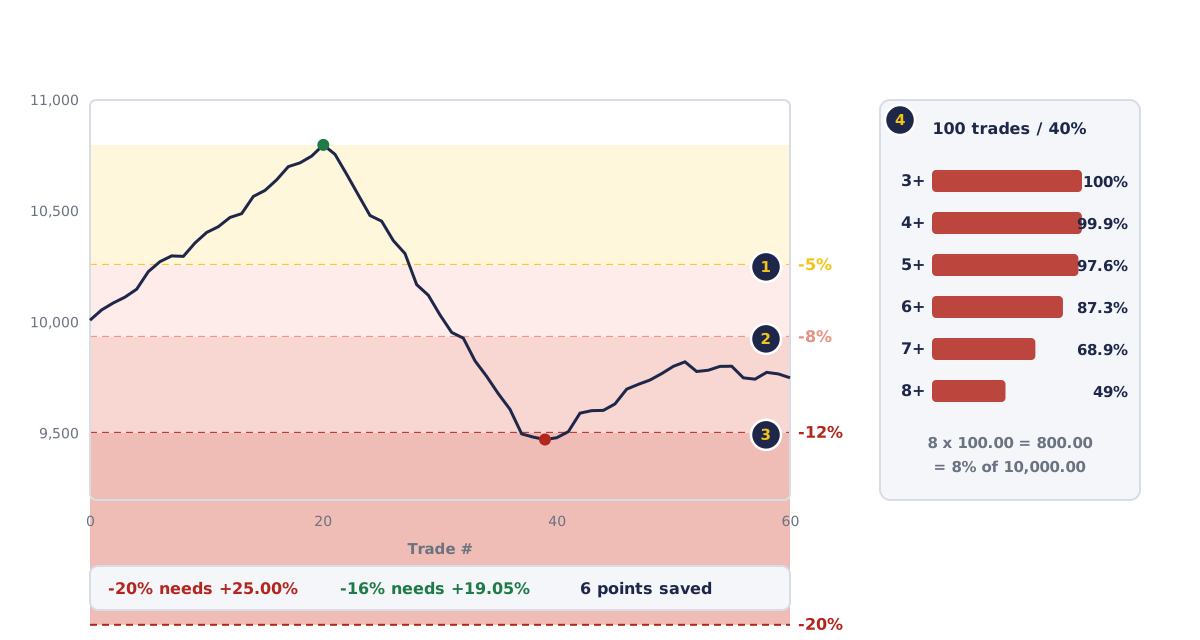
- The trigger levels at 5%, 8% and 12% below the equity peak, set in advance.
- Where full size stops and half size starts.
- The 12% trigger: five days off, then twenty trades at half size.
- The losing-run chances from the table above.
Worked example: what halving size does
Suppose the account is at $8,800, 12% below its $10,000 peak, and a further run of eight losses arrives.
- At full size ($100 a loss), eight losses take $800 off: $8,000, which is 20% below the peak.
- At half size ($50 a loss), eight losses take $400 off: $8,400, which is 16% below the peak.
- Getting back from $8,000 needs $2,000, a gain of 25%. From $8,400 it needs $1,600, a gain of 19.05%.
The protocol won no trades. It cut the required recovery by about six percentage points.
The trade-off is speed. Half size also halves what a winning trade earns on the way back. If the run had turned at the 12% level, full size would have climbed out faster. The protocol accepts that cost on purpose, because the run that does not turn is the one that threatens the account.
Why do bigger losses need bigger gains to recover?
A loss needs a larger percentage gain to undo, because the gain is earned on a smaller balance. The formula is gain needed = loss ÷ (1 − loss). A 20% loss, for example, needs 0.20 ÷ 0.80 = 25% to recover. The table uses a synthetic $10,000 account.
| Loss from peak | Balance left | Gain needed to get back |
|---|---|---|
| 10% | $9,000 | 11.1% ($1,000) |
| 20% | $8,000 | 25.0% ($2,000) |
| 30% | $7,000 | 42.9% ($3,000) |
| 50% | $5,000 | 100.0% ($5,000) |
The jump after 20% is why protocols act early and cut size sooner than feels necessary. A 50% loss means the balance has to double. The trading capital management lesson covers this asymmetry in the context of long-term capital.
How do you tell normal variance from a broken method?
You tell them apart with checks you wrote in advance: did you follow your rules, is the fall within what your own record allows, and have conditions changed? One losing run cannot answer this on its own, and a small sample cannot prove either answer.
| What you find | What it suggests | What the protocol says |
|---|---|---|
| Rule breaks in the journal | A process problem, not a method problem | Fix the process; see trading discipline |
| Rules followed, fall within your record's range | Ordinary variance | Follow the size cuts; change nothing else |
| Rules followed, fall far beyond your record | Possibly a changed market or a flawed method | Pause and review on demo; do not rewrite the plan mid-run |
Fix the second check's limit in advance, for example "a fall deeper than the worst in my record triggers a review". Your trading journal supplies both inputs, the rule-check column and the record of past drawdowns. The process over outcome lesson explains why a run of losses taken within the rules is still a correct run of decisions.
A short record will not always separate bad luck from a flaw in the method, and the protocol does not need it to. It limits the cost in both cases and sends you to a review when the numbers go beyond your own range.
Why do skilled traders keep deposits out of a drawdown?
Skilled traders keep deposits out of a drawdown: a top-up does not undo the loss; it puts more money at risk under the same method. A deposit changes the balance, not the result. Say the $8,000 account is topped up by $2,000 to look like $10,000. The $2,000 loss still happened, and now $10,000 is exposed instead of $8,000.
A top-up also hides the drawdown. Peak-to-trough figures become hard to read once deposits are mixed in, so your review tools stop telling you the truth. And it is the break-even urge from earlier, acted on with fresh funds.
If a drawdown makes you want to deposit, treat that urge as the signal to pause and use the review step in your protocol.
What makes a drawdown protocol work?
A drawdown protocol works when its levels come from your own record, its trade-offs are accepted in advance and it is followed at every trigger. It controls how much a bad stretch can take. Improving the method itself is the job of the review step, done on demo.
- Accept the speed cost. Smaller size means smaller gains on the way back, and that is the price of a smaller worst case.
- Update the levels. They come from your record, so revisit them at each review as the record grows.
- Plan for gaps. In a volatile market a stop loss can fill at a worse price, so a loss can be larger than planned. Leave room for that between your trigger levels.
- Follow it at the first trigger. A rule you override when it first applies is no longer a rule.
Try it on demo
On a MetaTrader 5 demo account, write three trigger levels into your trading plan, each with an action, a length and a restart condition. Then open your demo report: the Growth mode of the trading report shows the current drawdown, the drop in equity from the local maximum. Find your deepest demo drawdown and check which trigger it would have hit.
Quick check
- A drawdown protocol is best written
- An account falls 20% from its peak. The gain needed to get back to the peak is
- A trader following every written rule is down 6% after five losses in a row. This is most likely
- After a drawdown, depositing more money to get the balance back to its old figure
- An account is at $8,800, 12% below its $10,000 peak. Eight more losses at half size, $50 each, leave it at
Frequently asked questions
How do you handle a drawdown in trading?
You handle a drawdown by following a protocol written before it started: act on set loss levels measured from peak equity, such as half size at one level and a pause at a deeper one. Check your journal for rule breaks, avoid revenge trades, and do not deposit more money to repair the balance.
How do you recover from a drawdown?
You recover from a drawdown by trading your rules at a reduced size until your protocol says otherwise, because the gain needed grows with the loss. A 20% fall needs a 25% gain. The first aim is to stop the fall growing, then return to full size only when the protocol's restart condition is met.
How much drawdown is normal?
How much drawdown is normal depends on your win rate, your trade sizes and the number of trades, so your own record sets the figure. A synthetic method that wins 40% of trades has about a 49% chance of eight losses in a row over 100 trades. Use your own record to set limits.
Should you stop trading during a drawdown?
You should stop only when your written protocol says to, for a set period with a restart condition. A pause chosen on impulse can be fear, and a refusal to ever pause can be stubbornness. A rule fixed in advance removes the argument.
Sources
- Thaler, R. H. and Johnson, E. J., Gambling with the House Money and Trying to Break Even: The Effects of Prior Outcomes on Risky Choice, Management Science 36(6), June 1990, accessed 19 October 2026: real-money experiments support a house money effect and break-even effects, in which outcomes that offer a chance to break even are especially attractive after prior losses. https://doi.org/10.1287/mnsc.36.6.643
- MetaQuotes, MetaTrader 5 Help: Trading Report, accessed 19 October 2026: the report's Max. Drawdown is the largest drop in balance from the local maximum as a percentage, and the Growth graph mode shows the current drawdown as the drop in equity from the local maximum. https://www.metatrader5.com/en/terminal/help/trading/report
- MetaQuotes, MetaTrader 5 Help: Testing Report, accessed 19 October 2026: maximal drawdown is defined as the difference between the highest local value and the next lowest value of balance or equity. https://www.metatrader5.com/en/terminal/help/algotrading/testing_report
Practise what you learned
Open an account to use MetaTrader 5. Start on a demo account before risking real money.
Open Account