
Hedging Meaning in Trading: Types, Examples and Costs
Hedging means opening a position that moves opposite to one you already hold, to reduce the risk of a loss from an adverse price move, usually at a cost.
Hedging in trading means opening a second position that gains when your first position loses, so that a price move against you is partly or fully offset. A hedge trades some of your possible gain for a smaller possible loss, and both positions carry their own costs.
The CFTC glossary describes a hedger as someone who enters positions opposite to those already held, to minimise the risk of financial loss from an adverse price change.
What is hedging in trading?
Hedging is risk reduction: you hold one exposure and add an opposite one, so a move that hurts the first helps the second. In forex, the opposite exposure is usually a sell on the same pair, a position on a pair that tends to move the other way, or a trade that offsets a real currency bill.
A hedge works by pairing two exposures that tend to gain and lose in opposite directions. If you hold a buy on a currency pair and open a sell on the same pair, a fall in price loses money on the buy and makes money on the sell. The bigger the sell, the more of the move is offset. With a CFD broker each leg is a contract for difference (CFD), settled in cash with its own costs.
What types of hedging do traders use?
Forex traders mainly use three hedges: a direct hedge on the same pair, a correlated-pair hedge on a pair that tends to move the other way, and a currency-exposure hedge. A currency-exposure hedge offsets money you will pay or receive in another currency. Companies also use forwards and options through their bank.
| Type | What you open | What it offsets | Main limit |
|---|---|---|---|
| Direct hedge | A sell against a buy on the same pair, or the reverse | Price moves on that pair | Needs an MT5 hedging account; both legs pay costs |
| Correlated-pair hedge | A position on a pair that tends to move the other way | Part of a shared move, such as a stronger US dollar | Correlations change, so the offset can fail |
| Currency-exposure hedge | A position that gains if your bill in a foreign currency gets dearer | Exchange-rate risk on a payment or income | Size must match the amount you owe or expect |
| Forwards and options | A bank forward fixes a future rate; an option gives the right to one | Exchange-rate risk for businesses | Contract terms and premiums; usually through a bank |
How does a direct hedge work on an MT5 hedging account?
On a MetaTrader 5 hedging account you can hold a buy and a sell on the same symbol at once. A full direct hedge opens a sell of the same size as your buy, which freezes the running result: further moves change both legs equally and in opposite directions, until you close one side.
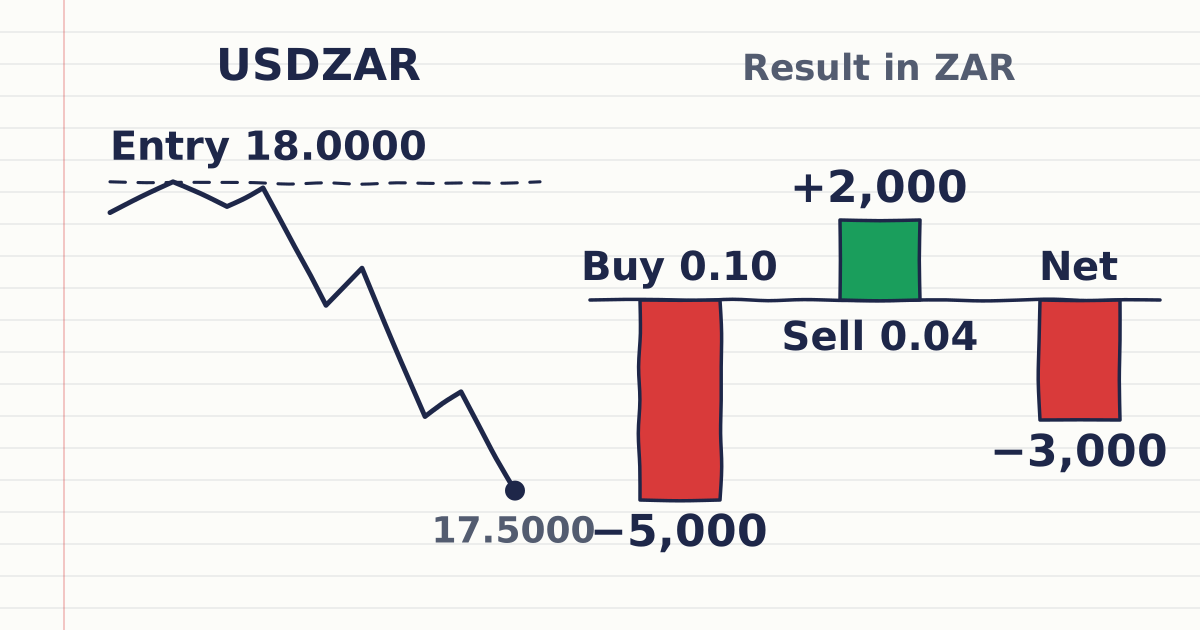
Partial hedge. You hold a 0.10 lot buy on USDZAR, which is 10,000 USD, opened at 18.0000. You open a 0.04 lot sell, which is 4,000 USD, as a partial hedge. Results on USDZAR are in its quote currency, shown here with an R.
- Price falls 0.5000 to 17.5000: the buy loses 10,000 × 0.5 = R5,000 and the sell gains 4,000 × 0.5 = R2,000. Net: −R3,000 instead of −R5,000.
- Price rises 0.5000 to 18.5000: the buy gains R5,000 and the sell loses R2,000. Net: +R3,000 instead of +R5,000.
The hedge cut the loss, and it cut the gain too. In fast, high-volatility markets the amounts on both sides grow.
Full hedge (costs left out). The same 0.10 lot buy from 18.0000 is at 17.8000, down R2,000. You open a 0.10 lot sell at 17.8000.
| USDZAR later | Buy from 18.0000 | Sell from 17.8000 | Net |
|---|---|---|---|
| 17.5000 | −R5,000 | +R3,000 | −R2,000 |
| 18.1000 | +R1,000 | −R3,000 | −R2,000 |
Wherever price goes, the net stays at −R2,000 before costs. The loss is not removed, only fixed, and it comes back into play the moment you close one leg. Close By then closes the two positions against each other and saves one spread.
What is a correlated-pair hedge?
A correlated-pair hedge uses a second pair that tends to move opposite to the first. EURUSD and USDCHF are a common example: the US dollar is the quote currency in one and the base in the other, so a stronger dollar pushes EURUSD down and USDCHF up. The offset is only as good as the correlation at that time.
Worked example. You hold a 0.10 lot buy on EURUSD at 1.0850 and a 0.10 lot buy on USDCHF at 0.8000.
- The dollar strengthens. EURUSD falls to 1.0800: 10,000 × −0.0050 = −$50.00. USDCHF rises to 0.8040: 10,000 × 0.0040 = 40 CHF, about $49.75 at 0.8040. Net: about −$0.25.
- The pairs drift apart. EURUSD falls to 1.0800 (−$50.00) but USDCHF only rises to 0.8010: 10 CHF, about $12.48. Net: about −$37.52.
The second case is why correlation is a tendency, not a rule. The correlation risk lesson shows how pairs move together and how to read a correlation coefficient.
How do you hedge a currency exposure?
You hedge a currency exposure by opening a position that gains when the foreign amount you owe gets dearer in your own currency. If you must pay US dollars later and earn euros, a sell on EURUSD gains when the euro weakens, which offsets the higher euro cost of the bill.
Worked example. A business that earns euros owes a supplier $11,000 in three months. At EURUSD 1.1000 the bill is €10,000. It sells 0.10 lot of EURUSD (10,000 euros) at 1.1000.
| EURUSD on payment day | Bill in euros | Sell position | Net euro cost |
|---|---|---|---|
| 1.0500 | €10,476.19 | +$500, or €476.19 | €10,000.00 |
| 1.1500 | €9,565.22 | −$500, or −€434.78 | €10,000.00 |
The cost stays at €10,000 either way, before spread and swap. The business gives up the saving if the euro strengthens in return for certainty if it weakens. Businesses often use a forward contract from their bank for the same purpose.
What does a hedge cost?
A hedge costs a spread on each leg, swap on each leg for every night both are open, and the gain the hedge gives up. Swap long applies to buys and swap short to sells, so a direct hedge can pay swap on both sides while the net position is flat.
- Spread on both legs. Each position pays its own spread. In the partial hedge, a 0.0300 spread on the sell costs about 4,000 × 0.0300 = R120.
- Swap on both legs. The MT5 symbol specification lists swap long for Buy positions and swap short for Sell positions. With swap of −2.00 a night on the buy and −1.00 on the sell, holding both for 5 nights costs 5 × (2.00 + 1.00) = 15.00 in account currency.
- The capped gain. Every pip the hedge offsets on the way down, it also gives up on the way up.
The spread, commission and swap lesson explains each cost and where MT5 shows it.
What are the pros and cons of hedging?
The main advantage of hedging is a smaller loss from a move against a position you want to keep. The main drawbacks are the gain it gives up, a second spread, swap on both legs every night, and the fact that a full hedge only fixes a loss rather than removing it.
| Pros | Cons |
|---|---|
| Limits the loss from a move against you while you keep the first position | Caps the gain by the same amount |
| Lets you keep a long-term position through a short event, such as a news release | Both legs pay spread, and swap every night |
| Fixes the cost of a future payment in another currency | A full hedge only freezes a loss; closing one leg reopens it |
| Close By on an MT5 hedging account saves one spread when you exit | Correlated-pair hedges can fail when correlations change |
What is the difference between hedging and diversification?
Hedging offsets a specific risk with an opposite position, for a known amount. Diversification spreads money across different instruments so that no single one decides the result. A hedge targets one exposure directly; diversification lowers the effect of any one exposure without offsetting it.
| Hedging | Diversification | |
|---|---|---|
| Aim | Offset a known risk on a position you hold | Avoid relying on one instrument |
| How | An opposite or negatively correlated position | Several different instruments or markets |
| Cost | Spread and swap on the extra leg, capped gains | Costs on each position held |
| Example | Sell 0.10 USDZAR against a 0.10 buy | Hold positions on EURUSD, gold and an index |
Holding several pairs that all share the US dollar is not diversification: they can all move together, which the correlation risk lesson covers.
What is a hedge account in forex?
A hedge account in forex is a MetaTrader 5 account set to the hedging system, which lets you hold several positions on one symbol, including a buy and a sell at once. On a netting account, a sell on the same symbol reduces or reverses your buy instead of opening beside it.
MetaQuotes says the hedging system allows multiple open positions of one symbol, including opposite positions, and that the broker sets which system an account uses. In MT5, a buy and a sell on one symbol appear as two lines on the Trade tab only on a hedging account. The netting vs hedging lesson shows both modes side by side. Open a free MT5 demo to try both legs before you hedge a live position.
Does a hedging account mean you are hedged?
No: a hedging account only lets you hold opposite positions, and the offset comes from the sell you open, not from the account mode. "Hedging account" is the name of MT5's position accounting mode. A stop-loss and a position size set before the trade still do most of the work of controlling risk.
Frequently asked questions
Does hedging remove all risk?
No. A full direct hedge fixes the result while both legs are open, but both legs keep paying spread and swap, and the full exposure returns when you close one side. Correlated-pair hedges can also fail when the two pairs stop moving opposite each other.
Can you hedge on MetaTrader 5?
Yes, on an account that uses the hedging system. There you can hold a buy and a sell on the same symbol at once and close them together with Close By. On a netting account, opening a sell reduces the buy instead.
Is hedging better than a stop-loss?
They do different jobs. A stop-loss closes the position at a level you set, so the loss is realised and the trade is over. A hedge keeps the position open and offsets moves while it lasts, at the cost of a second spread and swap.
Sources
- CFTC, CFTC Glossary (entry "Hedger"), accessed 19 October 2026: a hedger enters positions opposite to those held, to minimise the risk of loss from an adverse price change. https://www.cftc.gov/LearnAndProtect/EducationCenter/CFTCGlossary/index.htm
- MetaQuotes, MetaTrader 5 Help: Basic Principles (Trading Operations), accessed 19 October 2026: hedging accounting allows multiple positions of one symbol including opposite ones; the system is set by the broker. https://www.metatrader5.com/en/terminal/help/trading/general_concept
- MetaQuotes, MetaTrader 5 Help: Performing Trades, accessed 19 October 2026: Close By closes two opposite positions, saves one spread and is available only in the hedging system. https://www.metatrader5.com/en/terminal/help/trading/performing_deals
- MetaQuotes, MetaTrader 5 Help: Market Watch, accessed 19 October 2026: swap long applies to Buy positions and swap short to Sell positions. https://www.metatrader5.com/en/terminal/help/trading/market_watch
Practise what you learned
Open an account to use MetaTrader 5. Start on a demo account before risking real money.
Open Account