
Forex Trading in Thailand: How Beginners Learn and Trade
How people in Thailand learn forex and trade gold, forex and indices with KCM Trade, from practising on a free KCM demo to MT5 on a phone, costs in US dollars, the session hours in Thailand time (ICT) and how the Revenue Department taxes foreign income.
Most people in Thailand learn how a CFD, a pip and trading costs work, practise on a free KCM demo, then trade gold, forex and indices in US dollars on KCM Pro or MetaTrader 5. This guide follows that path, the same steps as how to trade forex online.
It covers opening a KCM account, setting up MT5 on a phone, what you can trade, what a trade costs in US dollars, when each session opens in Thailand time, and how the Revenue Department treats income from abroad.
How do you start learning forex in Thailand?
Learn the building blocks first, then practise every step on a demo account, which trades virtual money at live prices, before you open a live account. The six steps below run from the first lesson to a first live trade, in the order that avoids repeat work: concepts, platform, orders, costs, size, then going live.
- Learn what you would be trading. A CFD, leverage and margin, and what a pip is worth: what is a CFD, leverage and margin, lots, pips and pip value.
- Open a KCM demo in KCM Pro. Register at KCM Pro, open a demo account and practise on its charts. What a demo can and cannot show you is in forex demo account, and MT5 setup is in install MetaTrader 5.
- Practise each order type. A market order, a pending order, a stop loss and a take profit: forex order types and place your first trade in MT5.
- Work out the costs in dollars. Price the spread and any swap on your trade size before each trade, as in the cost example below.
- Size every position from your stop distance. Position sizing and the position size calculator show how.
- Go live at the size you practised. When sizing and costing a trade is routine, open a KCM Trade account and log every trade, deposit and withdrawal in a trading journal.
How do you start trading with KCM Trade in Thailand?
Register at KCM Pro, practise on a KCM demo, open an STP account, fund it, then trade live on KCM Pro's charts or in MetaTrader 5 at the sizes you practised. The STP account is held in US dollars, so gold, forex and indices are all priced, costed and settled in one currency.
- Register and verify at KCM Pro. Sign up at pro.kcm.trade, then verify your account in KCM Pro. Verification comes before your first trade.
- Practise on a KCM demo. Open a demo account in KCM Pro and practise on its charts. It trades virtual money under the same conditions as a real account, you can open as many as you like, and you set its balance in KCM Pro to what you plan to deposit.
- Open an STP account. Open it in KCM Pro: it starts from US$20 with no commission, and you choose leverage of up to 1:1000 on forex and gold, or 1:100 on indices, when you create the account.
- Fund it under Funds in KCM Pro. The payment methods for the country you registered from show there, with limits and processing times, and each deposit lands in your US-dollar account. KCM's methods include bank cards (Visa, Mastercard and JCB) and mobile banking apps in certain countries, electronic payment systems, USDT and bank cashier slips. In Thailand you can also pay by Thai QR through KCM's local payment gateway. KCM charges no deposit or withdrawal fee, and you withdraw by the method you deposited with.
- Trade on KCM Pro or MT5. Trade directly on the charts inside KCM Pro, or install KCM's MetaTrader 5 from the KCM MT5 download page (iPhone, Android, Windows, macOS and a browser WebTerminal) and log in with the login, password and server shown in KCM Pro.
How do you set up MetaTrader 5 on your phone?
Install MetaTrader 5 from KCM's download page, the App Store or Google Play, then log in with the login, password and server shown in KCM Pro. The MT5 mobile app runs on iPhone, iPad and Android, supports every order type and the built-in indicators, and costs nothing to download.
- Open the KCM MT5 download page on your phone and tap the App Store link on an iPhone or iPad, or Google Play or the APK on Android.
- Open the app, add an account and search for KCMTrade to find KCM's live server, KCMTrade-Live.
- Enter the login and password of your KCM account from KCM Pro.
- In Quotes, tap a symbol such as XAUUSD or EURUSD and choose New Order.
- Set the volume, a stop loss and a take profit, then tap Buy by Market or Sell by Market.
- The position appears on the Trade tab. On Android, press and hold it, choose Close Position, then confirm. Closed trades move to History.
Stop loss and take profit sit on KCM's server once placed, so they work even when your phone is offline.
What can you trade from Thailand with KCM?
From Thailand you trade what every KCM client trades: gold (XAUUSD), over 40 forex pairs such as EURUSD, and indices such as US30, in a US-dollar account on KCM Pro or MT5. Profits, losses and costs all come out in dollars, so one set of numbers covers every trade.
KCM's specification tables list these figures for some of the most traded symbols:
| Symbol | What it tracks | 1 lot is | 1 pip on 1 lot |
|---|---|---|---|
| XAUUSD | Spot gold in US dollars | 100 ounces | $10 |
| EURUSD | Euro against the US dollar | 100,000 euros | $10 |
| GBPUSD | British pound against the US dollar | 100,000 pounds | $10 |
| US30 | Dow Jones Industrial Average | 10 × the index | $10 |
| US100 | Nasdaq 100 | 20 × the index | $20 |
| US500 | S&P 500 | 50 × the index | $50 |
Each of these trades from 0.01 lot up to 20 lots per order. On gold, 0.01 lot is 1 ounce, so a $1 move in the gold price is worth $1 on 0.01 lot and $100 on 1 lot. KCM lists more than 200 instruments in all, with the full tables on its forex, precious metals and indices pages. Gold is covered step by step in how to trade gold, and index CFDs in what are indices.
What does a trade cost on KCM in US dollars?
A trade on KCM's STP account costs the spread, plus swap on nights it stays open where swap-free status does not apply; there is no commission, so the whole cost is one dollar figure. Spread cost is the spread in pips × pip value per lot × lots.
KCM's STP spreads start from 1.2 pips on EURUSD, and on XAUUSD from 1.6 pips. At those spreads, with no commission:
| Trade | Pip value | Spread cost | Commission |
|---|---|---|---|
| 0.10 lot EURUSD | $1 a pip | 1.2 × $1 = $1.20 | $0 |
| 0.01 lot XAUUSD | $0.10 a pip | 1.6 × $0.10 = $0.16 | $0 |
Costs apply in both directions. On the EURUSD trade, a 20-pip gain of $20 nets $18.80 and a 20-pip loss of $20 becomes $21.20. On the gold trade, a $5 rise in the gold price is +$5, or $4.84 after the spread, and a $5 fall costs $5.16.
KCM gives swap-free status by default on eligible instruments, except to accounts that frequently hold positions overnight. Where swap does apply, right-click the symbol in MT5's Market Watch on desktop and open Specification to see swap long, swap short and the weekday charged three times; a position closed before the daily rollover pays none. The trading cost calculator, pip value calculator and XAUUSD lot size calculator run the numbers for your own trade, and each cost is explained in spread, commission and swap.
What time is the forex market open in Thailand?
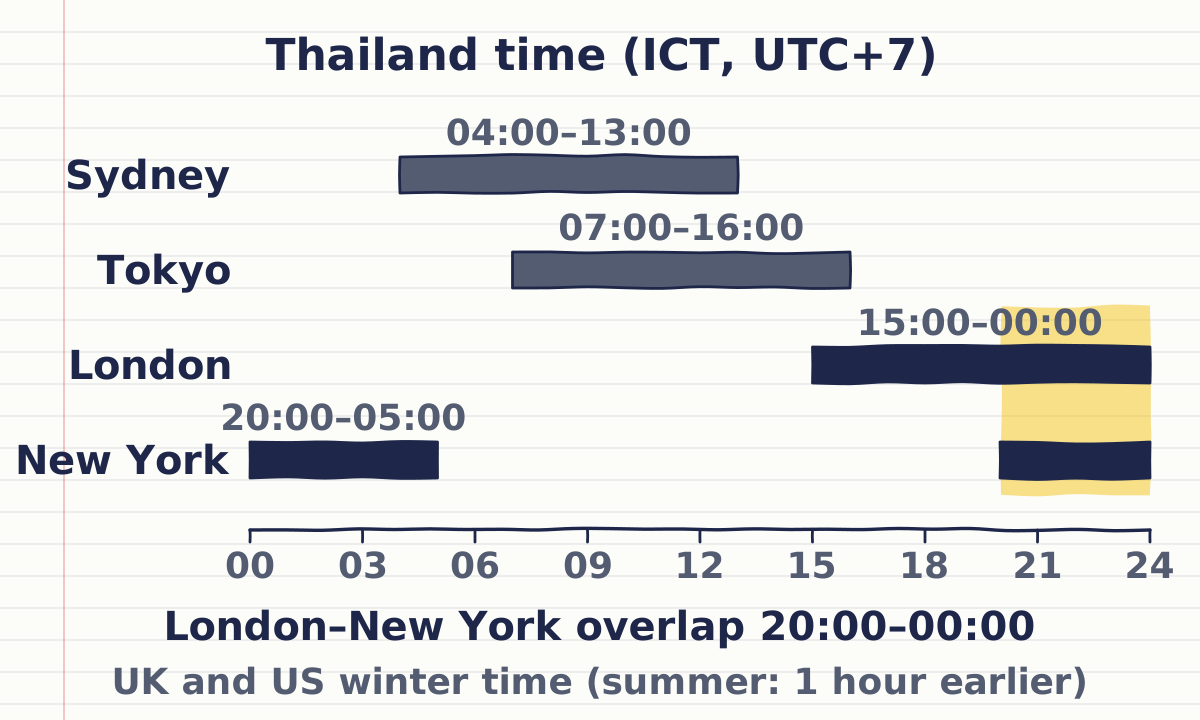
In Thailand time (ICT, UTC+7), the Asian sessions run through the Thai working day, London opens mid-afternoon, and the busiest window, the London and New York overlap, runs from about 8pm to midnight. Thailand stays on UTC+7 all year, so only the UK and US clock changes move these times.
Approximate session hours in ICT, for when the UK and US are on winter time:
| Session | UTC | Thailand (ICT, UTC+7) |
|---|---|---|
| Sydney | 21:00 to 06:00 | 04:00 to 13:00 |
| Tokyo | 00:00 to 09:00 | 07:00 to 16:00 |
| London | 08:00 to 17:00 | 15:00 to 00:00 |
| New York | 13:00 to 22:00 | 20:00 to 05:00 |
| London and New York overlap | 13:00 to 17:00 | 20:00 to 00:00 |
When the UK and US are on summer time, London and New York open about an hour earlier in ICT, so the overlap runs about 19:00 to 23:00. The UK and US switch on different weekends, so for a week or two each spring and autumn the overlap is shorter or longer. The forex market hours tool shows which sessions are open now in your own time zone.
MT5 shows quote times in its trading server's time zone, which can differ from ICT. Each symbol's Specification window lists its trading sessions for every day of the week.
What is the best time to trade forex in Thailand?
The most active hours in Thailand time are the London and New York overlap, about 8pm to midnight in UK and US winter time, when liquidity is usually highest and spreads on major pairs are often narrowest. Daytime in Thailand falls in the Tokyo session, when yen and Australian dollar pairs are usually the most active.
A currency pair tends to be busiest when the markets for both its currencies are open, and busy hours also bring the largest news-driven moves. Gold and US indices such as US30 and US100 come alive in the same evening window: the New York stock market opens at 9:30am New York time, which is 9:30pm ICT in US winter time and 8:30pm in summer time. Release times for scheduled data are in an economic calendar; convert them to ICT by adding seven hours to UTC. How spreads change through the day is covered in forex market sessions.
Do you pay tax on forex trading in Thailand?
Thailand taxes a resident, someone in the country 180 days or more in a calendar year, on income from foreign sources when that income is brought into Thailand, under the Revenue Department's rules in force since 2024. It goes on the PND.90 or PND.91 return with your other income, due by the end of March.
For the amount to declare, the Revenue Department uses a commercial bank's exchange rate on the day the money comes into Thailand, or the Bank of Thailand's reference rate for the business day before. Keep every closed trade from your trade history and every transfer slip, and ask the Revenue Department how your own trading results are classified.
Frequently asked questions
How do I start forex trading in Thailand?
Learn how lots, pips and costs work, then register at KCM Pro and practise on a free KCM demo with virtual money. When you can size and cost a trade in US dollars without help, open an STP account from US$20, fund it under Funds in KCM Pro and trade the same size you practised.
Can I practise forex for free?
Yes. Open a free demo account in KCM Pro at pro.kcm.trade and practise on its charts. It trades virtual money under the same conditions as a real KCM account, and you can open as many demo accounts as you like.
Can I trade gold from Thailand with KCM?
Yes. Gold trades as XAUUSD on KCM Pro and KCM's MT5, alongside more than 40 forex pairs and indices such as US30, all in a US-dollar account. One lot of XAUUSD is 100 ounces, so 0.01 lot moves $1 for each $1 change in the gold price.
What time does the forex market open in Thailand?
The week opens with the Sydney session at about 4am Monday in Thailand time (UTC+7), and trading runs around the clock until New York closes early Saturday morning. The busiest window, the London and New York overlap, is about 8pm to midnight in UK and US winter time and about 7pm to 11pm in summer time.
Sources
- The Revenue Department, Personal Income Tax (accessed 27 October 2026): a resident is a person in Thailand for 180 days or more in a tax year and pays tax on the portion of foreign-source income brought into Thailand; returns are due by the last day of March following the tax year. https://www.rd.go.th/english/6045.html
- The Revenue Department, Manual for Foreign Tax Credit Calculation Tool (Personal Income Tax), November 2025 (accessed 27 October 2026): a resident's foreign-sourced income is included in the tax year in which it is remitted into Thailand; income earned before 1 January 2024 and remitted later is not included; conversion at a commercial bank's rate on the remittance date or the Bank of Thailand reference rate at the end of the preceding business day; report on PND.90 or PND.91. https://www.rd.go.th/fileadmin/user_upload/porphor/GuideTaxFromAbroad_EN.pdf
- IANA, Time Zone Database, file asia (accessed 27 October 2026): Asia/Bangkok has been on UTC+7 since April 1920 with no daylight saving time. https://github.com/eggert/tz/blob/main/asia
- MetaQuotes, MetaTrader 5 mobile trading (accessed 27 October 2026): MT5 apps for iPhone, iPad and Android with all trade order types and built-in indicators. https://www.metatrader5.com/en/mobile-trading
- MetaQuotes, MetaTrader 5 Help: Open an Account (accessed 27 October 2026): a demo account trades virtual money at live prices. https://www.metatrader5.com/en/terminal/help/startworking/acc_open
- MetaQuotes, MetaTrader 5 Android Help: Opening and Closing Positions (accessed 27 October 2026): New Order from Quotes, Buy by Market and Sell by Market, positions on the Trade tab, Close Position. https://www.metatrader5.com/en/mobile-trading/android/help/trade/open_positions
- MetaQuotes, MetaTrader 5 Help: Market Watch (accessed 27 October 2026): the Specification window shows swap long, swap short, the weekday swap multiplier and trading sessions; quote times are shown in the trade server's time zone. https://www.metatrader5.com/en/terminal/help/trading/market_watch
- MetaQuotes, MetaTrader 5 Help: General Principles of Trading (accessed 27 October 2026): pending orders, stop loss and take profit are held on the trade server. https://www.metatrader5.com/en/terminal/help/trading/general_concept
- GOV.UK, When do the clocks change? (accessed 27 October 2026): UK clocks went back on 25 October 2026. https://www.gov.uk/when-do-the-clocks-change
- National Institute of Standards and Technology (NIST), Daylight Saving Time (accessed 27 October 2026): US daylight saving time ends on the first Sunday of November. https://www.nist.gov/pml/time-and-frequency-division/popular-links/daylight-saving-time-dst
- KCM Trade, Download KCM MT5 (accessed 29 October 2026): MetaTrader 5 for Windows, macOS, iPhone and Android (Google Play and APK) and the MT5 WebTerminal; download links for the KCMTrade-Live server. https://www.kcmtrade.com/trade/download-kcm-mt5
- KCM Trade Help Center, How do I start trading with KCM Trade? (accessed 29 October 2026): register and verify, deposit from the Deposit Fund tab in the CRM Area, which lists the methods for your region, then log in to the platform. https://www.kcmtrade.com/hc/content/how-do-i-start-trading-with-kcm-trade
- KCM Trade Help Center, How do I make a trading account? (accessed 29 October 2026): leverage is chosen when the account is created. https://www.kcmtrade.com/hc/content/how-do-i-make-a-trading-account
- KCM Trade, Forex (accessed 29 October 2026): over 40 currency pairs traded 24/5, leverage up to 1:1000 and 200+ instruments in all; its trading specifications table lists EURUSD and GBPUSD at 100,000 units of the base currency per lot with a pip worth $10 per lot, and 0.01 to 20 lots per trade. https://www.kcmtrade.com/trade/forex
- KCM Trade Help Center, What is a STP account? (accessed 29 October 2026): account currency USD, no commission. https://www.kcmtrade.com/hc/content/what-is-a-stp-account
- KCM Trade Help Center, What is the difference between a real and demo trading account? (accessed 29 October 2026): demo market conditions are the same as for real accounts. https://www.kcmtrade.com/hc/content/what-is-the-difference-between-a-real-and-demo-trading-account
- KCM Trade Help Center, Which account types is a demo account available in? (accessed 29 October 2026): no limit on the number of demo accounts. https://www.kcmtrade.com/hc/content/which-account-types-is-a-demo-account-available-in
- KCM Trade Help Center, How do I top up a demo trading account? (accessed 29 October 2026): set the demo balance with Add Demo Funds in the CRM Area. https://www.kcmtrade.com/hc/content/how-do-i-top-up-a-demo-trading-account
- KCM Trade Help Center, Which payment methods are available for KCM Trade? (accessed 29 October 2026): electronic payment systems, 3D Secure Visa, Mastercard and JCB cards and mobile banking apps in certain countries, USDT and bank cashier slips; availability depends on the country you register from. https://www.kcmtrade.com/hc/content/which-payment-methods-are-available-for-kcm-trade
- KCM Trade Help Center, Are any fees charged by KCM Trade for deposits or withdrawals? (accessed 29 October 2026): no fee on a deposit or withdrawal. https://www.kcmtrade.com/hc/content/are-any-fees-charged-by-kcm-trade-for-deposits-or-withdrawals
- KCM Trade Help Center, What is the fastest way to deposit or withdraw? (accessed 29 October 2026): withdraw by the method you deposited with. https://www.kcmtrade.com/hc/content/what-is-the-fastest-way-to-deposit-or-withdraw
- KCM Trade, Precious Metals (accessed 29 October 2026): trading specifications table: XAUUSD, spot gold to US dollar, 100 oz per lot, a pip worth $10 per lot, 0.01 to 20 lots per trade. https://www.kcmtrade.com/trade/precious-metals
- KCM Trade, Indices (accessed 29 October 2026): trading specifications table: US30 (Dow Jones Industrial Average) 10 × the index and $10 per pip per lot, US100 (Nasdaq 100) 20 × and $20, US500 (S&P 500) 50 × and $50; 0.01 to 20 lots per trade. https://www.kcmtrade.com/trade/indices
- KCM Trade Help Center, Do all clients receive Swap-Free status by default? (accessed 29 October 2026): yes, except accounts that frequently hold overnight positions. https://www.kcmtrade.com/hc/content/do-all-clients-receive-swap-free-status-by-default
- KCM Trade Help Center, Which accounts benefit from Swap-Free? (accessed 29 October 2026): swap-free status applies account-wide to all accounts and account types for eligible instruments. https://www.kcmtrade.com/hc/content/which-accounts-benefit-from-swap-free
- New York Stock Exchange, Holidays and Trading Hours (accessed 29 October 2026): core trading session 9:30 a.m. to 4:00 p.m. ET. https://www.nyse.com/markets/hours-calendars
Practise what you learned
Open an account to use MetaTrader 5. Start on a demo account before risking real money.
Open Account